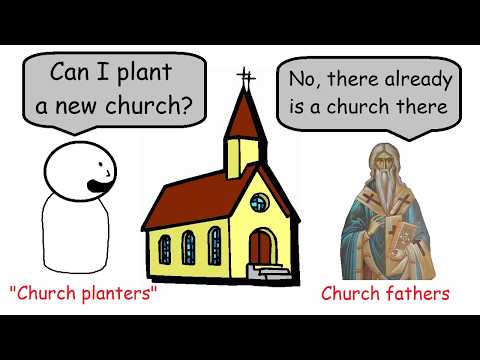
[0:00]Hey guys, I'm Arthemis Zoomer. So today we are talking about a rule that is in the Bible that the church fathers took really seriously, but almost no Christians know about it and the ones that do don't care about it. It is jurisdiction.
[0:15]What's that? We'll get into that. But this has been on my mind because my friend Young Anglican recently made this video.
[0:20]He's a really smart guy, he's been on this channel many times.
[0:23]He made a video about why he's leaving the ACNA, which is the conservative schismatic Anglican denomination in America, and joining the Episcopal Church, which is the historic mainline Anglican church in America.
[0:35]And the Episcopal Church has largely been hijacked by liberalism, but the point he makes in this video is despite that, they still have the valid jurisdiction, therefore ACNA had no right to split from it, no matter how corrupt it was getting, and therefore he needs to join the Episcopal Church.
[0:51]And this concept of jurisdiction is in the Bible, it's in the church fathers, it's in 90% of church history, but due to American individualism and modernity, we've forgotten about it.
[1:01]So, where do we get this from? The most explicit verse in the Bible about jurisdiction is Romans 15:20 where Paul says, It has always been my ambition to preach the gospel where Christ was not known, so that I would not be building on someone else's foundation.
[1:15]Now that can sound crazy to us modern Americans. It's like, obviously, the gospel's been preached in New York, but we're like, oh, well, I got to preach the gospel in New York because not everyone believes it.
[1:24]Well, it's not like you can't share Jesus with people in a place where people have already shared Jesus. It's not like the only place you can share Jesus is an island where nobody's heard of Jesus.
[1:32]What this means though, is you cannot plant parallel churches in places that already have churches, because if you do that, you're building on another person's foundation, you can't do that.
[1:43]Jesus also prayed for unity. It's important for believers to be united, especially if they live in the same area.
[1:49]For most of church history, all the Christians in a town would go to the same church.
[1:53]That was very important for building local Christian communities.
[1:57]Uh we're going to talk more about that later. In the New Testament, we get the sense that there is the church in Rome, the church in Corinth, the church in Ephesus, there's not like 40 different churches in Corinth where there's like the Bible church and the community church and the fellowship church and which church you go to depends on your personal needs.
[2:14]It's like, oh, I like the kids program here. I like the pastor here. Nope.
[2:18]There is the church in Corinth, so that everyone, every Christian in the city is under the same authority.
[2:24]Um and if you, if the church got too big and uh you needed to plant another church, you wouldn't just say, all right, form a new church, do whatever you want. No.
[2:32]Uh there would be an official process for doing that. You'd say, okay, if you live in this part of the city, you're going to go to this church.
[2:39]If you live in this part of the city, you're going to go to this church. Um now who decides that? It wasn't just anyone who can do what they want.
[2:45]At first there was a council made up of representatives from each church to decide, you know, who goes to what church.
[2:50]But by the time you get to the mid-second century, to make sure that there are no schisms, they appoint a bishop over all the churches in a certain city or region to prevent schisms.
[2:58]Uh Ignatius of Antioch talks a lot about this.
[3:01]And Ignatius, especially all the church fathers, but especially Ignatius, considered it a grave sin to schism from the bishop.
[3:09]And his definition of schism is trying to do Christianity, trying to do the Eucharist and preaching the word without the authority of the bishop, without the authority of the established church.
[3:19]Now, schism was not a trivial sin for the church fathers, especially not for Ignatius.
[3:24]John Chrysostom said schism is as bad as heresy. It's as bad as denying the gospel to schism from the established church.
[3:31]And uh Ignatius of Antioch said, whoever follows a maker of schism will not inherit the Kingdom of God.
[3:37]And he defines schismatics as people who will not submit to the rightly appointed church authorities in a particular place.
[3:44]What this means is anyone who just goes to a random non-denominational church that started for no reason in a place that already has churches, they are following a maker of schism.
[3:54]Now, is everyone who does that unsaved? I'm not going to say that because I don't think people are guilty of sins that they don't know are sins, but that's why I'm trying to tell people this was considered a grave sin in the early church.
[4:04]All right. This rule continued into the uh Post-Constantine era into the early church with the Council of Nicaea.
[4:11]Uh the rule is that you never plant parallel bishops in places that have bishops. Get this, even if those bishops become heretics.
[4:21]That is what almost no modern evangelicals understand.
[4:25]They think if a church starts teaching heresy, it immediately loses its authority, it immediately loses jurisdiction, and then he should immediately leave and start a new church.
[4:33]That was not the mindset of the early church.
[4:36]Uh there was the Aryan crisis shortly after the Council of Nicaea, where despite the fact the Council of Nicaea happened, many, many bishops became Arian heretics.
[4:44]That means they denied that Jesus was God, and that is heresy. That denies the gospel. That's a denial of the Christian faith.
[4:51]But despite that, the solution was never to plant parallel Trinitarian bishops in places that had Arian bishops.
[5:01]The solution was always either to convince the bishops to stop being Aryan or to appeal to the emperor to forcibly remove those Aryan bishops from their dioceses and replace them with Trinitarian bishops.
[5:08]If the early church was evangelical, they would have said like, oh, the Bishop of Spain is Arian. No problem. We'll just do a parallel Trinitarian church plant in his diocese.
[5:18]But they didn't do that because that would be the sin of schism.
[5:21]And it also shows the early church wasn't Roman Catholic either, because nowadays in the Roman Catholic Church, the Pope has, you know, unlimited universal authority over all the bishops.
[5:27]If the early church was Catholic, it would have been like, oh, there's Aryan bishops. Well, the Pope can just fire them and replace them.
[5:33]But the reason the Pope didn't do that back then is because the Pope didn't have the power to do that back then.
[5:40]Uh back then the Pope was seen as first among equals, but all bishops had jurisdiction over their regions.
[5:45]So you couldn't have the Bishop of Rome just unilaterally firing all the other bishops and replacing them.
[5:50]Uh if they wanted to replace a bishop, they would often have to appeal to the state, not the church, because even though uh the state was distinct from the church, it was the state's role to make sure that, you know, the church was following the rules sometimes.
[6:03]We're going to get more into that. Uh St. Ambrose, uh is very uh reconquistate you could say.
[6:09]Uh St. Ambrose was the Bishop of Milan, uh and he was preaching in Milan Cathedral. It's not the same Milan Cathedral that's, you know, the tourist attraction these days, but Ambrose was in Milan Cathedral and he was a Trinitarian.
[6:21]And the emperor replaced him with an Arian bishop, and he had to be forced out with armed guards because he didn't want Arian heretics to take over such a beautiful building.
[6:31]But when they did, he still acknowledged that Arian bishop as being the legitimate bishop over that jurisdiction.
[6:40]He didn't like it, but he didn't just go off and plant his own new church. No, he petitioned for the emperor to come to his senses and to not appoint heretical bishops over places.
[6:51]Okay, so what about during the Great Schism? The Great Schism is a time when the Eastern Orthodox Church retains the early church's view, and the Roman Catholic Church starts to depart from it.
[7:02]So at some point, uh throughout the first millennium, the Bishop of Rome began seeing himself less and less as the first among equals and more and more as the universal bishop with universal jurisdiction.
[7:13]So when the Great Schism happened, the East didn't plant like parallel Orthodox bishops in Roman Catholic lands, but the Roman Catholic Church did start planting Roman Catholic bishops in Eastern Orthodox lands because the Bishop of Rome claimed universal jurisdiction.
[7:28]Uh the Roman Catholic Church has always thought the church should be organized on a global basis, but the Eastern Orthodox Church has always believed the church should be organized on a national basis.
[7:36]That's why you have Russian Orthodoxy and Greek Orthodoxy, and Romanian Orthodoxy, and Bulgarian Orthodoxy, but you don't have like French Catholicism and Spanish Catholicism and Italian Catholicism.
[7:47]Now, the Orthodox Church eventually departed from this view too. It just took them a lot longer to depart from it.
[7:53]Nowadays, the Orthodox Church in the past 200 years or so has started planting Orthodox bishops in Catholic and Protestant countries.
[8:01]And in America, it's a complete mess with like 10 different overlapping Orthodox jurisdictions.
[8:07]Now in America you have like uh the Russian Orthodox bishops and the Bulgarian Orthodox bishops and the uh Greek Orthodox bishops, and they're all like overlapping dioceses.
[8:14]Uh and they're they're all in communion, but they have overlapping dioceses.
[8:18]So, in effect, Orthodoxy in America is uh no more united than mainline Protestantism, because the mainline Protestant denominations are all in communion, but they have overlapping jurisdictions or about to get to that.
[8:29]The point is that none of the major Christian traditions are following the early church's rule about jurisdictions, but they should.
[8:36]Okay, now here was the Protestant view. The Protestant view was in many ways a return to the earlier view, which Eastern Orthodoxy still holds to, of national churches.
[8:46]Uh a lot of people think, you know, if you have this view of jurisdiction, how do you justify the reformation?
[8:51]Well, there's two ways to justify the reformation. If the church is defined on a national basis, then there's nothing wrong with the Church of England, uh not obeying the Church of Rome because the Church of England is autonomous from the Church of Rome.
[9:05]And that was the argument of many of the Anglicans. Now, the only thing that's debatable is, okay, what if you are in a country where the established church is Roman Catholic, where the established church does submit to the Bishop of Rome?
[9:17]Uh now the majority view in Protestantism is it's not like you can never separate from the established church, but the only time you can separate from the established church is following the standard of the apostles.
[9:28]They didn't separate from the temple until they were forcibly kicked out when Stephen was stoned to death.
[9:33]Likewise, the Protestants thought, the only reason they could separate from the Roman Catholic Church was because not only had Luther been excommunicated, but Luther and anyone who agreed with him had been excommunicated.
[9:44]Anyone who agreed with Protestant heresies was excommunicated from Rome.
[9:50]So, it's not like they voluntarily left, they had no choice but to leave because they were literally excommunicated.
[9:54]But the rule was still if you're not excommunicated, then no matter how corrupt the church is, you have no right to leave and make a new church.
[10:00]Uh Samuel Rutherford was the chief Scottish Westminster Divine, and he distinguishes between negative separation and positive separation.
[10:09]Young Anglican talks about this in his video. A negative separation is where you separate yourself from false doctrine in the church. Positive separation is when you actually create a new visible church jurisdiction.
[10:20]He says positive separation is not warranted unless you literally cannot be in the established church without affirming something that is not true.
[10:30]And from the Protestant perspective, it became a requirement in Catholicism to affirm things that were not true.
[10:34]Uh and now you might disagree with that if you're Catholic, but you can't deny that from a Protestant perspective, that's still the case.
[10:40]So the only debate is whether it's okay to set up parallel churches in Catholic lands.
[10:44]There was no debate about whether it's okay to set up a, there was no debate about what you should be if you're in a Protestant country.
[10:51]Uh because all the Protestants agreed with national churches, it was very clear that when the Church of Sweden went from being in communion with Rome to not being in communion with Rome, then everyone in Sweden should just be Church of Sweden.
[11:03]So nowadays, we think of the Protestant view of the church as this denominational libertarianism, where you can go to whatever denomination you want.
[11:09]No, that was not the historic Protestant view.
[11:12]Historically, Protestants believed if you were in Sweden, you had to be Church of Sweden.
[11:16]If you live in Norway, you have to be Church of Norway.
[11:19]If you live in Scotland, you have to be Church of Scotland. If you live in England, you have to be Church of England.
[11:23]Now, we define things in terms of like the flavor of the tradition, like Lutheran, Anglican, and yep, uh the churches in Scandinavia tended to be more Lutheran, the churches in Scotland were more Calvinist.
[11:35]But you didn't have like the Church of England planting Anglican churches in Norway, and you didn't have the churches in Scandinavia planting Lutheran churches in England.
[11:45]They just respected each other's jurisdiction.
[11:49]All right, what's next? So, what's the point of having national churches? Why should the church be organized on a national basis instead of a local basis or a regional basis or a global basis?
[12:00]It seems kind of arbitrary to have national churches be like the highest possible court of the church, right?
[12:06]Well, basically, here's why. It has to do with uh the state's role in enforcing jurisdiction.
[12:14]Let's say you have uh let's say you have the Episcopal Church and the one of the bishops, the Bishop of Texas, let's just say, decides he's going to leave the Episcopal Church and he wants to take his entire diocese with him. Can he do that? No.
[12:25]Uh the denomination would simply fire him and replace him. But what if he says, no, I'm still the legit bishop. I'm still taking all the churches under my diocese with me.
[12:35]Then you have to appeal to Caesar. Then you have to appeal to Uncle Sam. Uh you have to appeal to neutral law to figure out who gets the property, who actually gets to take the church is legally speaking.
[12:46]And as long as the denomination has bylaws, it shouldn't be a problem.
[12:50]Uh so that's why I don't think even uh the ACNA diocese that left had the right to do that because denominations are organized on a national basis, not a diocesan basis.
[13:01]So that's how it works. The state is still necessary as a contract enforcer.
[13:06]This is not a theocracy by the way.
[13:09]Uh it's like if you're a pastor and some random dude uh comes up to you in your church and says, I'm the pastor of this church now and tries to take over the church from you.
[13:17]It's not theocracy to appeal to the state to get him out of the church because legally, the church belongs to uh you and your denomination and your session and all that.
[13:27]That's all we're talking about here. So it is impossible to enforce global church authority.
[13:35]So that's why the church is organized on a national basis. I mean, there's other reasons, it's so the church can be like a voice to the nations because uh the churches in different countries are going to have different customs, but the main reason is that that's the highest level on which you can actually enforce jurisdiction.
[14:09]Okay. So, if there should only be uh one church per place, why does America have seven main lines?
[14:17]Now, that's not the way it's supposed to be, but based on America's history and America's laws, that's the best it can be.
[14:26]Basically, America was settled at the same time, during the colonial age, by many different churches from overseas.
[14:33]Many different colonies had different churches that settled there. It was the congregationalists in New England, it was the Dutch reformed in New York, Presbyterians in the middle colonies, Lutherans also in the middle colonies, and uh Episcopalians and Methodists in the Southern colonies.
[14:46]Nobody was expecting all 13 colonies to unite. The 13 colonies were set up as a place where different religious groups could practice their religion freely because they were settling new land.
[14:56]They were creating new jurisdictions. So what happens when all the 13 colonies unite?
[15:01]Uh should all the churches unite? Absolutely, but that is easier said than done.
[15:07]Uh any as RC Sproul says, anytime you try to unite two denominations, you end up getting three denominations.
[15:12]You get the merger and the remnants of both that didn't want to join the merger. If the church is unite, who decides the terms of union?
[15:19]Um now, in an ideal world, the state would help mediate that union.
[15:23]In Europe, what would happen is if you had two kingdoms that had their own national churches and they united, the state would just force the churches to unite into one thing.
[15:32]That's what happened in Prussia, and many Lutherans were unsatisfied with that, so they came to America.
[15:37]So yeah, it's not good that you have overlapping jurisdictions in America, but because all seven mainline Protestant churches have legitimate claims to being established colonial churches, uh there's basically no way to force them all to unite because we have something called the First Amendment, which uh forbids the government from getting involved in these affairs.
[15:56]The government can make sure that they keep the property that they rightfully own, but the government can't force a bunch of denominations to unite into one denomination.
[16:05]So, the seven mainline churches that can trace their roots back to before the founding of the country are the United Church of Christ, uh the American Baptist Churches USA, the Reformed Church in America, the Presbyterian Church USA, the ELCA, the Episcopal Church, and the United Methodist Church.
[16:21]Um there are some other denominations that aren't exactly schismatic, but they're sort of like remnant churches has been more complicated.
[16:26]But generally speaking, these seven mainlines, which are all in communion with each other by the way, these seven mainlines are America's de facto established church because we don't have an official state church.
[16:37]That's why generally speaking, I think almost all American Protestants should be part of one of those seven denominations and not be part of groups that have split off and formed parallel jurisdictions since the foundation of this country.
[16:51]Because once the country has been founded, then it's very clear that anyone who splits off voluntarily and starts a new parallel jurisdiction is a schismatic.
[17:01]Yes, it's a complicated situation that is sort of unprecedented in the old world, but that's not a license to just start infinite parallel jurisdictions, the way evangelicals do.
[17:08]So, the parish system is also a way that this used to be enforced, and everyone, both Protestant and Catholic has moved away from the parish system, and it's bad.
[17:17]Like, even the low church Puritans in the Massachusetts colony enforced the parish system, where there was one church per town and the church you went to depended on what town you lived in.
[17:27]Nowadays, it's like, oh, what church you go to? I go to this church, I go to this church, I like the pastor, I like the kids program, I like the coffee here. No, it used to be that what church you go to? Well, that depends on where you live.
[17:37]That is called the parish system.
[17:40]Um and it's not just uh Puritans that did that, like the Church of England has a parish system, the Church of Scotland has a parish system, the Church of Sweden has a parish system.
[17:46]Going to your local parish church means the church that is assigned to your district.
[17:50]Uh the denominations would just draw districts and if you live in this district, you go to this church, if you live in this district, you go to this church.
[17:57]And in theory, Catholics still have this system, but so many modern Catholics violate this.
[18:02]So many modern Catholics like refuse to go to their local parish church because it's a yucky, modern, contemporary Novus Ordo service, and they'll drive like two hours either to a traditional Latin mass or a or a Byzantine mass.
[18:12]Guys, I'm not going Catholic, but if I go Catholic and q all the common, I'm not doing Catholic.
[18:17]If I go Catholic, which I'm not going to, if I were to go Catholic, hypothetically, I would just go to my local Novus Ordo parish, and if it was a little bit modern, I would deal with it.
[18:27]Same way I deal with things in my current denomination. This was a way of ensuring everyone in a certain town would be part of the same community, which was very important for building up Christian societies.
[18:38]I think we might have a lot more Christian cohesion if every Christian in a town had to fellowship with each other on Sunday.
[18:45]And now this is a bit of a sort of a rage bait headline, but many times church planting, especially the way church planting is done in America is actually sinful.
[18:56]So, basically, Paul says to not build on another man's foundation. I call that the anti-church planting verse.
[19:02]So many times a historic mainline church that's been here for like 200 years will die because all the Christians are being attracted to this new church plant that somebody felt called to plant.
[19:14]They take all the new members and then the historic mainline boomer churches die out.
[19:19]I sometimes I sound harsh against non-denominational churches, but the reason I'm so harsh is because for the past 50 years, non-denominational churches have been building up themselves by pooping on the mainline churches, by saying, oh, we're not your grandma's church.
[19:32]We do church differently. Yeah, that's called being schismatic.
[19:35]If there's already established churches in a given area and they're not like filled to the brim, which in America, they're not.
[19:43]In America, there's dying mainline churches everywhere. It is a sin to plant a new church.
[19:48]It is a sin to plant a new church in places that have historic, established churches with legitimate jurisdiction.
[19:54]If you're in a town and that town has uh uh like a mainline Presbyterian or Methodist or Lutheran church that is dying and needs more members, it is sinful to plant a new church in that place.
[20:07]I know that sounds harsh, but I can defend my case with scripture and with the church fathers.
[20:11]If you don't like it, take it up with St. Ignatius of Antioch who studied with studied with the uh the Apostle John himself.
[20:17]It's not just non-denominations that do this.
[20:20]Uh schismatic denominations like the ACNA, PCA, or non-denominational churches will just split off from denominations and then plant parallel churches in places that already have established mainline churches.
[20:28]Now people will say, okay, maybe there's churches in this place, but there's no good ones. Okay.
[20:34]Uh when Paul was writing to the Galatian Church, that was literally denying the gospel.
[20:39]Did he say, okay, if you're a still a faithful believer, you have to split off and plant a new church?
[20:43]Did Paul plant a new church when the Galatian Church was denying the gospel? No, he told them to get their act together.
[20:48]When the Corinthian church was filled with the worst immorality possible, did Paul plant a new church in Corinth because the old one went bad? No, he told them to get their act together.
[21:00]And it's not like they got their act together immediately, you know how we know? Because like 60 years later, when St. Clement was writing to the Corinthian Church, he was addressing the same problems.
[21:10]But St. Clement did not plant a new parallel church in Corinth. St. Clement said, guys, get your act together, stop being so weird.
[21:15]So, you might think that like the mainline churches near you are liberal or lukewarm, that might be true, but according to scripture and according to the church fathers, that does not justify planting new churches.
[21:26]The only way it would justify planting new churches is if um First Presbyterian Church forbids you from joining if you are a Christian, and that is basically unheard of.
[21:35]All right. So, how should we fix this? Obviously, this problem exists across the board.
[21:42]Um there's no modern denomination that doesn't have this problem.
[21:45]But there are ways that we can fix it. It's clear that Jesus, the apostles, and the church fathers wanted all believers in the same place to go to the same church.
[21:51]So the first rule is discourage church planting. I want to speak with these leaders of these church planting networks.
[22:01]They they have to realize that what they're doing is schismatic behavior.
[22:08]So if you know a leader of a church planting network, either contact them yourself or get them in contact with me because this has to stop. Honestly, I hate to be cynical, but I feel like a lot of these church planting networks just exist to give people jobs.
[22:15]Uh the second thing is if you are part of a corrupt denomination, do not make a voluntary schism.
[22:21]Uh now if you are excommunicated from that denomination, it's one thing, but almost all conservative schisms are just the conservatives getting fed up with the liberalism and walking out the door voluntarily.
[22:31]Uh yes, there might be parallel jurisdictions that's bad, but that doesn't justify creating even more jurisdictions because that makes the problem even harder to solve.
[22:39]And the third thing, and this is probably the most controversial, try not to be part of any denomination or any church that was formed by voluntarily setting up its own parallel jurisdiction in places that already have established churches.
[23:21]So, that's about it for this video, it might be kind of controversial, but you know, I think it needs to be said nonetheless.
[23:27]If I was just if I just cared about being liked and growing on YouTube, I would just keep making those Microsoft paint denomination explainer videos.
[23:34]I like doing that, I like denominations, but I also care about the bride of Christ, and what is going on right now is not good for the bride of Christ.
[23:41]Even if you don't agree with me, I would encourage you to at least consider what I am saying.
[23:45]Read Samuel Rutherford's treatise on separatism, read Ignatius of Antioch, and yeah.
[23:50]As always, I will see you all later. God bless.
[23:53]And by the way, uh only a small percentage of people who watch my videos are actually subscribed.
[23:58]So if you like what you see here, consider subscribing, it's free, you can always change your mind.
[24:03]If you like the video, make sure to like it, and if you don't didn't like it, make sure to hit the dislike button twice.


