[0:00]50% of thyroid patients who take levothyroxine still have low thyroid symptoms. If that's you, know that you aren't alone. The fact that so many people do poorly on levothyroxine isn't surprising. What is surprising is that most of these same people have no idea that alternatives exist, or that these alternatives are much better than levothyroxine. If you're someone who's sick of it not doing its job, try these instead. Alternative number one is Tirosint. Some people think the problem with levothyroxine is the fact that it contains only T4 thyroid hormone. And while that's a big part of it, there's another that most people miss, the inactive binders and fillers found inside. These inactive ingredients are there to stabilize the medication and help with the manufacturing process. But they also happen to negatively impact its absorption and utilization in your body when you take it. This is where Tirosint steps in. It contains the same T4 thyroid hormone found in levothyroxine, but without the added fillers or dyes. Fewer fillers and dyes for you as a thyroid patient means better absorption of the hormone that you care about, and better absorption means better symptom control. It's that simple. Want to give it a try? Here's how to use it: Swap out your dose of levothyroxine at a ratio of one to one for Tirosint. If you're taking 100 micrograms of levothyroxine, you would simply switch to Tirosint at 100 micrograms as well. And the great part is, because it's a T4-only thyroid medication, most doctors have no problems prescribing it. And because it's much cleaner, many thyroid patients who make the switch will notice an improvement within just a few weeks. The biggest downside is the cost, but there are now generics available, so try those if your insurance doesn't want to cover it. Alternative number two is Tirosint-sol. If you really want to take absorption to the next level, try this medication. It's made by the same people who make Tirosint, but instead of being a gel cap, this one is a liquid. In fact, it's the only liquid thyroid medication on the market, and just like Tirosint, this one is incredibly clean. In fact, it's a little bit cleaner with only three ingredients: T4 thyroid hormone, glycerol, and water. The biggest downside is the fact that it's so expensive. For this reason, I generally don't recommend that you go straight from levothyroxine to Tirosint-sol. Unless you've had a number of gut surgeries impacting absorption, or if you know you have serious allergies to certain dyes and fillers. If that isn't you, then start first with the generic Tirosint gel cap and then switch to Tirosint-sol if that doesn't work for you. Alternative number three is Synthroid. Most doctors and thyroid patients believe that Synthroid and levothyroxine are basically identical. They're not. Yes, Synthroid is the name brand, and yes, levothyroxine is the generic, which is why they're often used interchangeably. But they differ in their inactive ingredients, and that can make all the difference. This is why some research has shown that people who are taking levothyroxine and switch to Synthroid see an increase in their free thyroid hormone lab tests even without changing their dose. The only explanation for this is the inactive fillers and binders. It seems to be the case that some thyroid patients are just so sensitive to these compounds that it negatively impacts the absorption and therefore their free thyroid hormone levels. But there is a big downside to Synthroid, and that is the fact that it contains lactose. So, it is not a great option if you are somebody who is lactose intolerant. And unfortunately, that amounts to about 70% of thyroid patients, at least according to some research. But if you aren't lactose intolerant and levothyroxine isn't working for you, then Synthroid is a great option. Your doctor typically won't give you pushback for trying to make this switch, but your insurance might. Synthroid is more expensive than levothyroxine, so your pharmacy may try to swap out levothyroxine for Synthroid even though your prescription says that's what you need. If you are currently on Synthroid or trying to make the switch, make sure that you touch base with your pharmacist to ensure that's what you're actually getting. Alternative number four is Armour Thyroid or NDT. Many thyroid patients consider Armour Thyroid the "gold standard" of thyroid medication treatment. I don't necessarily agree with that, but I will say it is often a much better alternative than levothyroxine for most people. Unlike levothyroxine, Armour Thyroid contains the full spectrum of thyroid hormones. That means every time you take it, you're getting T4, T3, T2, T1, calcitonin, and trace minerals. This matters because your thyroid produces more than just T4. So when you take Armour Thyroid, you are getting more of what your body was already used to creating. And this is probably at least partly why people who take Armour Thyroid prefer it over levothyroxine. But it's not without its downsides. Among those is that it's just very hard to get because most doctors do not like to prescribe it. They would prefer to put you on synthetic alternatives like levothyroxine, Synthroid, or maybe even Tirosint. On top of that, even if you do get it prescribed by your doctor, they will almost always underdose it. This is because they don't really understand how to convert a T4-only thyroid medication to a medication that contains much more than T4, like T4, T3, T2, T1, and so on. In addition, at least right in this moment, Armour Thyroid is also under pressure by the FDA. So there is a non-zero chance that Armour Thyroid may no longer be on the market in the near future. But if you are able to get your hands on it, and your doctor gives you enough of it, you are probably going to love it. Alternative number five is liothyronine. If you are looking for the strongest levothyroxine alternative, this is it. Liothyronine contains pure T3 in an immediate release form. Because of its raw power, it's best used in addition to levothyroxine, not 100% in place of. Though, I will say there are some population of thyroid patients who gain tremendous benefit by taking T3 by itself. Dose for dose, liothyronine is about four times stronger than levothyroxine in its impact on the TSH. This means a 5 microgram dose of T3 is worth about 20 micrograms of levothyroxine. For this reason, most dosing of T3 is in the 5 to 25 micrograms per day range, and this dose is typically added on top of your levothyroxine dose. Research shows that swapping out T3 for T4 in equivalent doses leads to more energy, more weight loss, and a better quality of life. The biggest downside is that it's hard to get. Most doctors don't want to prescribe it, and when they do, they're probably going to underdose you, and because it's so strong, it's more likely to cause side effects. None of this means that you shouldn't use it, it just means you need to be careful when you do. For the record, liothyronine is probably one of my most favorite thyroid medications on the market. Alternative number six is the levothyroxine 50 microgram tablet. If you are someone who can't get your doctor to prescribe anything else other than levothyroxine, this is your answer. I call it the 50 microgram levothyroxine hack. Here's how it works: If you look at all of the various doses of levothyroxine, such as 25 micrograms, 75 micrograms, 100 micrograms, and so on, you will see that they are all different colors. What you may not realize is that this coloring is not natural. They have all been dyed to a different color with synthetic chemical dyes. This may be good for pharmacists, but it is not good for you because every single compound is a potential compound that you can react to when you take it, and thyroid patients definitely react to these compounds, as we've already discussed. There's one caveat here, though: The 50 microgram levothyroxine tablet has no extra added dyes. In other words, it is the cleanest dose of levothyroxine out there. This means that you can dose whatever you are taking in 50 microgram increments to eliminate those unneeded dyes. For instance, if you are someone who is taking 100 micrograms of levothyroxine right now, you would switch your dose to take two 50 microgram tablets to get the same equivalent dose, but in the process, eliminate the extra dyes. Believe it or not, this small change can have a profound impact on how you feel as a thyroid patient. The moral of the story here is that you should never settle for low thyroid symptoms on levothyroxine. There's always another alternative, another thyroid medication, or another combination that you can take to get your symptoms under control. If you've found that levothyroxine does not work for you, try these alternatives and let me know how it goes. And if you need help to optimize your thyroid medication more perfectly, make sure you check out this video next.
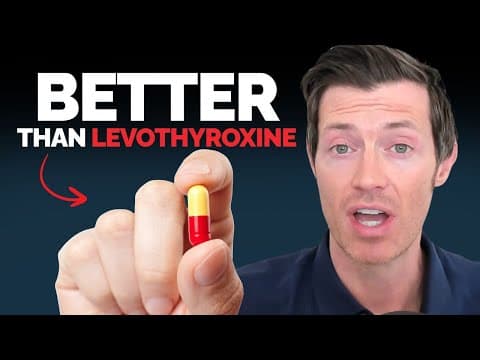
I Found A Better Thyroid Pill
Dr. Westin Childs
9m 3s1,535 words~8 min read
YouTube auto captions
Transcript source
YouTube auto captions
This transcript was extracted from YouTube's auto-generated caption track. The transcript below is server-rendered so it can be read, searched, cited, and shared without opening the original YouTube player.
Pull quotes
[0:00]What is surprising is that most of these same people have no idea that alternatives exist, or that these alternatives are much better than levothyroxine.
[0:00]Some people think the problem with levothyroxine is the fact that it contains only T4 thyroid hormone.
[0:00]And while that's a big part of it, there's another that most people miss, the inactive binders and fillers found inside.
[0:00]These inactive ingredients are there to stabilize the medication and help with the manufacturing process.
Use this transcript
Related transcript hubs
Watch on YouTube
Share
MORE TRANSCRIPTS


