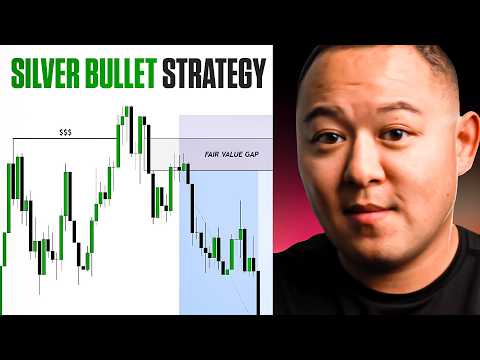
[0:00]Mastering one trading strategy is the biggest cheat code when you're aiming for consistent profits in the markets. The ICT Silver Bullet model is one that's easy to understand, doesn't have a whole lot of moving parts, and it's mechanical, so you can essentially set and forget it. In this video, I'm going to share with you a simple step-by-step process that anyone can understand so you could take your trading to the next level. But before I get into that, why should you listen to me? My name is Kyle, and I've been trading the markets since 2011. In the past few years, I made over a million dollars using prop firms with some of the best metrics in the industry. And here's some of the proof. But that's enough about me, let's get right into the video. Okay, so let's review the silver bullet model. Now, there's not a whole lot that goes into this trading strategy. And there is a level of context that will add to your performance, but that comes with experience. So I'm just going to quickly go over the couple moving parts that we have to look for when we're trying to trade this model. So, first of all, this is going to be used for indices or equities, uh, the futures markets. So, our pre-market prep is really going to come around 9:00 a.m. to 9:30. We don't really need to sit down the prior day and really just showing up at the charts every day is enough for you to be able to get enough prep in. Now, if you have a job, or you have uh, other responsibilities, you might have to uh, do some of the prep ahead of time. Um, but typically, you know, coming into the charts half an hour early is fine because we are going to focus on trading the 10:00 to 11:00 a.m. Eastern time window, or the 2:00 to 3:00 p.m. Eastern time window. So, we have uh, one or two windows, so essentially the AM session or the PM session. And when we're thinking about, you know, trading within that specific window, basically we're trying to find a fair value gap that appears uh, as soon as that 10:00 a.m. candle or that 2:00 p.m. candle opens. So, okay, so when we get a five-minute fair value gap that opens or is printed, you know, it's the first presented fair value gap after 10:00 a.m., we're essentially trying to trade that move. And possibly, you know, if possible, try and get out of that trade if the 10:00 a.m. candle expands to a target. So, what we're going to do when we get to our charts, we're going to mark out the Asian range, high and low. So, up here, we can see that our Asian range, this is all Eastern military time. So, I will usually use 8:00 p.m. up until midnight, so this is all Eastern Standard Time. And then the London range, I'll use 2:00 to 5:00 a.m. Now, everybody, what I've seen online, everybody uses different times. I've been using these times for many, many years now, and I haven't had any issue with them. Even if you extend them an hour or reduce an hour, you're not going to get that much of a difference, uh, as far as a range. What we're really looking for is the liquidity to be rated out. So, has the Asian range, or has the Asian, London, or 9:00 a.m. candle. Sorry, I mentioned uh, the 9:00 a.m. candle. So, the the 9:00 a.m. candle is really the prior candle uh, to the to the 10:00 a.m. open. So, what we're we're really looking for a raid on one of these ranges highs or lows, okay? So, has the Asian, London, or 9:00 a.m. candle higher low been swept since midnight? If no, we don't have a trade, so we need to see a run on liquidity. And if we don't have a trade, if we don't have a raid, we don't have a trade. So, the liquidity raid is basically when we have uh, a a fake out move where we have buyers or sellers being trapped in the markets, and then we're looking for uh, displacement going the opposite direction, okay? So, that's really what we're looking for. We're looking for some range to be swept, and then we're looking to position ourselves in the opposite in the opposing direction. Okay, so we need to have that liquidity being engaged when we're sitting down in front of the charts. Now, this can be anytime after midnight, so it doesn't really matter what time, uh, these ranges are swept. Uh, as long as one of them is swept going into 10:00 or 11:00 a.m., uh, 10:00 a.m. or 2:00 p.m. Eastern. So, we're going to wait for the first 5-minute fair value gap to form. If the fair value gap is bearish, one of these range highs need to be taken out. So, it's either the Asian range high, the London range high, or the 9:00 a.m. candle high. Okay, so, at 10:00 a.m., we can possibly even just see, let's just pretend this is the candle that appears prior to 10:00 a.m. When this 10:00 a.m. candle opens, all we're looking for is a run above that candle if we're trying to go short or below that candle if we're trying to go long, okay? So, any raid above or below that uh, 9:00 a.m. candle is going to be enough uh, for us to position ourselves into the market, or it could be any one of these other ranges. If the fair value gap is bullish, one of those range lows must be taken out, okay? So, we're looking for an opposing liquidity pull to be rated, that's really what we're looking for. Then we're looking for us, uh, so for as far as execution, this is going to be our execution over here. We're going to enter a limit order at the fair value gap, our stop loss is going to go behind candle one of the fair value gap. And we're just going to target 2R or close by end of day. Now, end of day could mean a bunch of different things for you. I would typically try and exit by 4:00 p.m. Eastern. All right, so let's get into some of the trade examples and I'll go over, you know, step by step what we're looking at. So here we have Asian range, right? You can see that this is from 8:00 up until midnight Eastern. This is our Asian range. We can see that the Asian range high has been taken out and then the London range high has been taken out. And also know that we're only trying to execute inside of this 10:00 a.m. time window. So, you can see here, this is 10:00 a.m. When we get to when we get to our charts, we're looking for a fair value gap. Now, this could be either a bullish one or a bearish one. If it was bullish, we would have seen the London range low be taken out, okay? And then we would be going the opposite way. But what we see here is a bearish fair value gap being printed here, and it's a three-candle pattern. So, we have candle one, candle two, and then candle three is the high of candle three. Okay, so, what we're going to do is step our limit order, a market, uh, sorry, a limit sell order here with our stop loss above candle one's high. Okay, so, as soon as we trade into that fair value gap, we will be triggered into the market. You can see here that we've almost gotten stopped out, but yes, this is a mechanical system. We don't want to uh, use any discretion when it comes to managing this trade. The only discretion we're going to have is when do we close if our trade hasn't hit the target by say 4:00 p.m. That's really the only discretion you should have when you're trying to trade this model. Um, and that's why it it makes it very simple and very easy to follow, and that way you don't have to you know, have a whole lot of uh, thought process behind it, and you don't have to worry so much about the trades. So, as soon as we enter the the short position here, we're just waiting. All right, either our stop loss is going to get hit or a take profit is going to get hit, or we have to make a decision on closing out if neither are hit by say 4:00 p.m. So, here we can see that this one has went straight to our target. All right, so this is an example where all these conditions are met. Right, we had Asian range or London range high being taken out. Uh, if neither of those had been taken out, let's say if the London printed inside here, just as an example. If the London session printed inside of the Asian range, then we would need to wait for one of these ranges to be taken out, okay? So, even if a fair value gap appeared at 10:00 a.m. inside of this range, but we haven't taken out any of these highs or lows, then we don't have a trade, okay? That's one thing that you need to pay attention to. We're not just trading fair value gaps for the sake of trading fair value gaps. We need to see a raid on one of those ranges. All right, example number two, this is actually a loss. But here we can see the Asian range high being taken out. So, again, when we come to the charts, and there are indicators out there that will automatically plot these ranges for you, but when you're trying to get used to trading the markets, I prefer if you hand draw these levels just so you get a a feel and an understanding of these different time ranges. All right, don't be lazy. I did this for many years. I was drawing out all my levels manually, and I still prefer to do so, even though at times, I'll just use some indicators. So, we have our Asian range high and low. We can see during London, that high has already been taken out. So, when we come to the charts at 10:00 a.m., I probably should have marked our vertical line in here. I believe the 10:00 a.m. candle is this one. So, we have our fair value gap, our bearish fair value gap being printed, I believe this was 10:05. So, we're going to do is enter short, uh, so we need to get a candle closure, right? Obviously for a fair value gap to be printed, so we have candle one up here, this is candle one, candle two, and then candle three is this one here. So, after candle three closes, right? Again, we're going to enter a limit order, a limit sell at this fair value gap, and then our stop goes above candle one high. And here is just an example where we are going to take a loss. Now, that's okay, um, this model does not work 100% of the time. And the reason for me showing you why, uh, you should follow your rules, is because just for the fact that we've taken a loss doesn't mean that we change up our process. All right, we're following the process outlined here, regardless of uh, what our previous trade was or what our future trades might look like. We have to follow the process. So, even though we've taken a 1-hour loss here, let's just assume that the prior trade here was a win. All right. Now here, we've taken a loss. We can see that the market did eventually go down to our target, and this is just an example that we might have the right bias, we might have the right direction of the market, but sometimes the market just doesn't agree with what we're trying to do. And this is the part of trading that is difficult that not a lot of people get a whole grasp of. They just can't, uh, wrap their head around that the markets are a probability mechanism, okay? You're not going to win every single trade, even if you have an amazing system that you think has 100% win rate. Here's just another example. So we have, again, Asian range and London range. I've plotted both of those out during here at the 9:30 open, we can see that the market went down, flushed all of them out, even took out the previous day's low, okay? And then we're just waiting for a fair value gap. So, the first fair value gap that appears after 10:00 a.m. is, so this is our 10:00 a.m. Eastern divider, appears right around 10:05. So, after 10:05, we're going to enter a market a a limit buy order here with our stop loss at candle one's low. Now, we can get aggressive with our stop loss placements if we really wanted to. Sometimes I'll use candle number two, it really depends on, uh, how you're feeling about a specific trade and and the level of displacement you're expecting from a specific market. Because if you're using candle number two as your stop loss, you can just imagine that half of this risk would be cut out. Okay, and you would get a much tighter stop loss and then possibly a better risk reward. But for the sake of this video, just stick to 1 to 2 and, uh, you know, really aim for the long hang new fruit with a reasonable logical stop loss at candle number one. So, this is an example where the market did not trade to our target. So, this was 2R up here. The market did not trade to our target, so we have to make a decision when it it starts approaching the latter part of the day. So, closing anywhere up here, you know, this is 2:30, 3:00, anywhere in here, uh, we're just going to end up closing our position, you know, ahead of say 4:00 p.m., which is right around here. So, ahead of 4:00 p.m., we have to make a decision because neither our stop loss or our take profit's been hit, okay? Here's another example of the silver bullet strategy. We have our Asian range here, and then our London range. So, coming into the session, we've seen both of these highs be taken out, and then not only that, we've traded much higher. So, based on this overnight price action, we can already anticipate that there's going to be a gap from where the market closed the prior day. So, often times we might have gaps that will want to get filled in after the market opened. So, this is really just a a run back towards to try and fill in some of this range that was created overnight, okay? So, this is our 10:00 a.m. candle. We've got a, oh sorry, this is 10:05. This divider should have been one candle over, my apologies. Um, but this fair value gap was printed at 10:05. So, this is our candle number one, candle number two, and then candle number three. Right? Again, we are going to place a sell limit order here with our stop loss above candle number one. Oh, sorry, my apologies again, this is candle number one, candle number two and then candle number three. So, this is where our stop loss is going, above candle number one. Right, this is our sell limit and we're just aiming for a two to one. Okay, you guys can see that when you are using limit orders after these first fair value gaps are presented, you are getting a very, very good fills. So, often times you are not going to see a whole lot of drawdown. Um, even if you do, we just have a we have to understand that we are using a logical stop loss and that, you know, when we're trading these these levels, all of the logic is there. We've met all of the criteria for us to trade these specific fair value gaps. Uh, you know, if we're bearish, we need to see previous range highs be taken out, and if we're bullish, right, we need to see previous range lows be taken out. Right, very, very simple, very mechanical. So, if you want to learn how you can possibly trade live with me, these are just some of the results. And I will I will mention that, you know, trading these strategies without context, uh, can often times be a little bit more confusing. And what I try to do with my students is provide more context behind why they're taking specific trades. So, even if you try and go back test this silver bullet strategy and you're lacking context, your performance and your win rate might not be as high as somebody that has as much experience as me that can really read the tape and determine live market conditions, help you avoid trading conditions where you shouldn't be trading, you know, ahead of news events, uh, trying to determine the market sentiment. All of those things that an experienced trader has gone through, right, this is exactly what I'm trying to help with my students. And here we can see just see some of the results from my students. One of one of my good friends Mike, uh, when he first started studying under me, he was having a hard time, he had already been trading, uh, at an actual institutional firm, and their methodology just didn't line up with him. But as you can see, uh, after he's been studying with me, we can really see a massive improvement in his equity curve. We can see his average loss is only about $200, and then his average win is about $2,100. His win rate 83%, and his risk reward 56R. All right, so I'm just posting this here so you guys can see that I'm trying to help my traders and my students understand that it's one thing to know a strategy, but it's also another applying it in the real life markets. All right, so having that experience and being able to ask me anything that you want week to week is extremely, extremely important. Here we can see Dom taking a short in NQ.
[18:54]And then fit had a massive $3,000 day on his top step account. Uh, Abdullah has mentioned that, you know, I've helped him tremendously since he's joined, uh, you know, providing context around specific market conditions. That way you're not just lost blindly trying to sit in front of the screens, you don't really trust the system that you're following. All right, so inside of the mentorship, right, you're going to be able to trade live with me each and every week. I provide commentary live all the time, even if I'm not on stream, I will follow up with all my students if I see something in the markets. You can ask me anything that you feel about the markets, you know, if you want me to cover a specific market, I will. I'll review your trades, help you pinpoint some of the mistakes that you're making, and I'll give you specific assignments so you can improve your edge. So, recently, we've just done a no trade challenge and a trade consistency challenge where I'm asking all of my students to take 10 consecutive trades in a row at the same position size, at the same risk level. And once you do, we will assign you a new role in the Discord, and eventually, hopefully, I can get actual certificates so you can actually flaunt off that you've completed these challenges and that you've actually made an improvement in your trading. So, if you're interested, make sure you book a call using the link in the description. I'm only looking for the most serious students, and if you want results like some of my students, you know, Mike had a $20,000 day on his funded account. Uh, Julie had a really amazing trade here on NQ. Fernando had a $3,500 payout the other day, and, you know, these are just some of the results. And I'm really trying to focus on how do I get my students to move from $3,000 days to $10,000 days, to $20,000 days, and then hitting massive payouts like this. Really, it's all about process. So, when I look at my payo certificates where I've made $2,000, the process was the exact same for the ones that I've made $60,000. And that's what people don't really understand. When you're trying to scale up, it has very little to do with the actual position size. If you're following the process, you can make as much money as you want in the markets. All right, so I hope you guys enjoyed this video. You know, if it doesn't interest you, just go ahead, leave a like, uh, drop a comment. Subscribe to the channel as I'm dropping free value each and every week, and I hope to see you guys in the next one. Take care.


