[0:13]Khaled ibn Walid, the Sword of Allah, destroyer of two empires, and undefeated general. A man who was dismissed from command for drawing too close to divinity himself. He was a leader who never lost a single expedition during his life, and who led Muslims in many battles to the farthest east and west. He fought against the biggest two empires of that period. The Byzantines, Romans and Persians of Iran feared his speed and technique, and cavalier swordsmanship, and his unique battle strategy, which sent shivers down the spine to all garrison of the non-Muslim army. Heraclius, one of the great leaders of the Byzantine Christian Romans, stood by the window with one hand on the wall gazing down at the city. He stared at the morning bustle in the streets of Constantinople, but he wasn't interested in the life below. He was lost in thought, disturbed by the reports he just received, a Roman legion defeated by desert nomads! The engagement at the oasis of Dasin, just outside of Gaza, was a minor skirmish, but the Muslim victory sent a shock wave all the way up to Constantinople. To Heraclius, the Arabs were a backward people, living in a desert wasteland. The Arabs he knew were an unsophisticated lot, in constant conflict with each other, just barely eking out an existence under the unforgiving desert sun. The Arabs were not a military threat, let alone a military power, they were just a thorn in his side, but united for the first time under the banner of Islam, the Arabs unleashed a gale force wind that would sweep across the Middle East, and blow as far east as China, and west across North Africa. Heraclius wrapped his arms behind his back, and staring down at the cobblestone floor, he pulled away from the window, and trudged his way back towards his chamber. He entered his dimly lit room, as his mind raced back four years earlier, the citizenry showered him with honor, as he rode through the streets of Constantinople in triumph, after defeating the Persians, and restoring the empire's splendor, it was a glorious time. He clenched his teeth, and grimaced, now was the time to enjoy the fruits of his labor, but he did not expect this from the Arabs. Four Muslim divisions marched through the Holy Lands, and swept across Jordan, Palestine, up the Mediterranean coast, and penetrated as far north as Emessa. When Emessa was still under siege, Heraclius, the Byzantine Emperor made another bid to muster strength, and drive away the Muslims from the land of Syria. This time he planned action on a massive scale, a Byzantine army of one hundred, fifty thousand men, had been put in arms and concentrated at Antioch. At this time, the Muslims were operating in four pockets. Amr ibn al-Aas was operating with his corps in Palestine, Shurahbil was in Jordan, Yazeed was in Caesara, while Abu Ubaida, and Khalid were at Emessa. The plan of the Byzantines was that one Byzantine force, was to march from Damascus from the west, and cut off the Muslim force at Emessa. Another force was to attack the Muslims at Emessa from the north, one force was to attack Emessa from the east, and still another from the west, the plan was to recapture Emessa and Damascus. When the Muslims came to know of the Byzantine plan, they held a council of war, the Muslims decided, that instead of being divided into four pockets, they should consolidate their forces at one point, and face the Byzantines as a united force. When the Byzantine force reached Emessa, they found that the Muslims had left. They found that Damascus had also been evacuated. The Byzantines marched to the south and reached the Yarmouk Valley, some time in the third week of July 636. Here they settled down in camps, and began their preparations for a confrontation with the Muslims. The Byzantine camp was 18 miles long, and between the Byzantine camp, and the Muslim camp, lay the central parts of the Plain of Yarmouk. The Byzantine forces comprised of two hundred thousand men fully equipped. The Muslim army consisted of forty thousand men. Against every five Byzantine soldiers, there was only one Muslim soldier. When the Byzantine generals surveyed their army, they felt sure of their victory. The Muslims were fired with their faith, and hoped that Allah would grant them victory in spite of the odds against them. Abu Ubaida felt that it was going to be a tough battle. He thought that at that critical stage, it was necessary to avail of the military skill of Khalid. Abu Ubaida accordingly decided to remain the nominal commander-in-chief. He delegated his powers of field operations to Khalid ibn al-Walid. For some time, there were negotiations between the two parties. The Byzantines offered to pay the Muslims some money, in case they left Syria, and returned to Arabia. The Muslims spurned the offer. In return, the Muslims offered the Byzantines the usual three alternatives, Islam, Jizya or the Sword. After the failure of negotiations, the arbitration was left to the sword. The battle began in the third week of August 636. Both the armies faced each other across the Plain of Yarmouk, about a mile apart. Before the two armies clashed, a Byzantine General George emerged from the Byzantine centre, and rode towards the Muslims, halting a short distance from the Muslim centre. He raised his voice and asked for Khalid ibn al-Walid. From the Muslim side, Khalid rode out, delighted at the thought, that the battle would begin with himself fighting a duel. As Khalid drew near, the Roman made no move to draw his sword, but continued to look intently at Khalid, until the necks of the horses crossed, and still George did not draw his sword. Then he spoke, in Arabic, "Oh Khalid, tell me the truth, and do not deceive me, for the free do not lie, and the noble do not deceive. Is it true that Allah sent a sword from heaven to your prophet, and that he gave it to you, and that never have you drawn it, but your enemies have been defeated?" No, replied Khalid. Then why are you known as the Sword of Allah? Here Khalid told George the story of how he received the title of Sword of Allah from the Prophet (S). George pondered this a while, then with a pensive look in his eyes, he asked, "Tell me, what do you call me to?" "To bear witness," Khalid replied, "that there is no God but Allah, and Muhammad is his slave and messenger, and to believe in what he has brought from Allah." "If I do not agree?" "Then pay the Jizya, and you shall be under our protection." "If I still do not agree?" "Then the Sword." George considered the words of Khalid just for a few moments, then asked, "What is the position of one who enters your faith today?" "In our faith, there is only one position, all are equal." "Then I accept your faith." To the astonishment of the two armies, which knew nothing of what had passed between the two generals. Khalid turned his horse and rode slowly with the Roman to the Muslim army. On arrival at the Muslim centre, George repeated after Khalid, "There is no God but Allah, Muhammad is the Messenger of Allah!" The commander-in-chief of the Byzantine force felt much annoyed, at the walk over of his general George to the Muslim camp. He vowed vengeance against the Muslims as well as George. In a fit of fury, he chose a few selected warriors from the Byzantine side, and they challenged the Muslims to duel. Scores of duels were fought on the Plain of Yarmouk, practically, all the Byzantine champions were slayed on the combat. On the Muslim side, honours went to Abdur Rahman, the son of Abu Bakr, who slew five Byzantine champions one after the other. After the duelling was over, Mahan the commander-in-chief of the Byzantine forces asked his forces to launch the assault. Khalid ibn al-Walid arranged his numerically inferior army, in a large number of small units, in order to make it look bigger, and thus fool the Byzantines. For the first four days of the battle, the Byzantines took the offensive, but the Muslims, though very hard-pressed at times, refused to break. At one point on day two, the Muslim left flank almost fell apart, but soldiers retreated toward their camp encountered their women, who were in the battle, to encourage the men to fight. They promptly returned to the battlefield, and managed to hold out long enough for Khalid to shift troops around to support them. On the fourth day, Khalid attacked the Byzantines from two sides. The Byzantines broke under the blows of the Muslim cavalry, and fell back to their original position, losing heavily in the process. The Byzantine archers now let loose a rain of arrows on the Muslim forces. Over seven hundred Muslims were hit in their eyes, because of these arrows came to be known as "The Day of Lost Eyes", that was the worst day of the battle for the Muslims. Seeing the consternation in the Muslim ranks, the Byzantines increased their pressure, even the corps of Abu Ubaida and Yazeed were pushed back. At this critical hour, Ikramah and his contingent refused to retreat. They took the oath of death, and fell upon the Byzantines with the fury and violence of desperate men. Under their blows, the Byzantines pulled back. Of the four hundred dedicated men who took the oath of death, almost all, including Ikramah died, but they saved the day for the Muslims. Seeing the plight of the Muslims, the Muslim women rushed forward with tent poles to fight against the Byzantines, that inspired the Muslims to heroic effort, and when the day's action was over, both the armies stood once again on their original lines. On the fifth day, an emissary came forward from the Byzantine side, proposing a truce for the next few days, so that fresh negotiations could be held. The Muslims did not accept the proposal, they said, that they were in a hurry to finish the business, that day, there was no battle. By the afternoon of the sixth day, only a third of the Byzantine army remained in the battlefield, the rest had fled away. In the meantime, a storm began to blow. It blew against the faces of the Byzantines, and provided a greater momentum to the Muslims to rush forward, in the confusion that followed, the Byzantines lost their bearings. Panic stricken, they fled, and the pursuing Muslims slew thousands of Byzantines left and right. Khalid amassed his entire cavalry for an offensive, this was the decisive stroke. First, they chased off the Byzantine cavalry. Then they got around the Byzantine left flank, and attacked the infantry from the rear, so it was here, where the Byzantine line of retreat was complicated by rivers and mountains, and it was a relatively simple matter for the Muslim cavalry to cut off the easiest paths of retreat to the north. It's estimated that about half the Byzantine army wound up dying, and there are reports of men falling off of cliffs, and drowning in rivers in panicked flight. It was a crushing victory! The Battle of Yarmouk was the greatest battle that the Muslims had fought so far, that spelled the end of the Byzantine rule in Syria, and ushered in the Muslim rule.
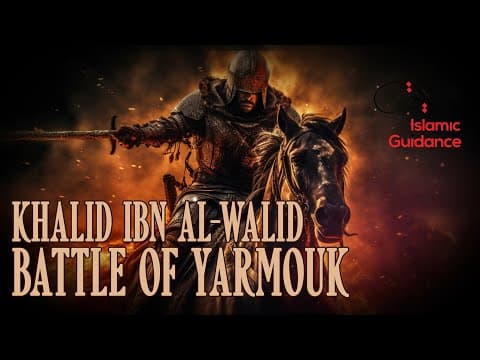
Khalid Ibn Al-Walid - Battle Of Yarmouk
Islamic Guidance
15m 11s1,935 words~10 min read
YouTube auto captions
Transcript source
YouTube auto captions
This transcript was extracted from YouTube's auto-generated caption track. The transcript below is server-rendered so it can be read, searched, cited, and shared without opening the original YouTube player.
Pull quotes
[0:13]Khaled ibn Walid, the Sword of Allah, destroyer of two empires, and undefeated general.
[0:13]He was a leader who never lost a single expedition during his life, and who led Muslims in many battles to the farthest east and west.
[0:13]The Byzantines, Romans and Persians of Iran feared his speed and technique, and cavalier swordsmanship, and his unique battle strategy, which sent shivers down the spine to all garrison of the non-Muslim army.
[0:13]Heraclius, one of the great leaders of the Byzantine Christian Romans, stood by the window with one hand on the wall gazing down at the city.
Use this transcript
Related transcript hubs
Watch on YouTube
Share
MORE TRANSCRIPTS


