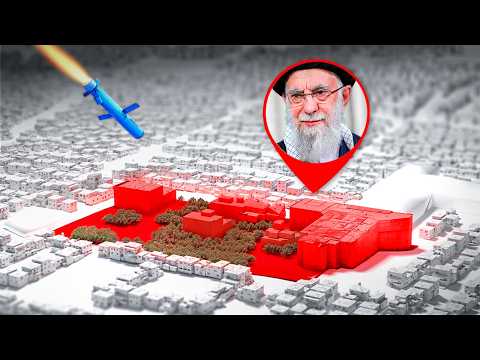
[0:01]It's roughly 6:00 a.m. in Israel. A series of fighter jets takes off, armed with long-range high-precision missiles. According to CIA and Israeli intelligence, a significant portion of Iran's leadership has gathered here in a compound in Tehran. Among them, Ayatollah Ali Khamenei, the country's supreme leader. 2 hours and 5 minutes after the jets took off, Israeli missile strikes the compound.
[0:34]This is how the Israeli and US attacks on Iran unfolded. How the country's leader was killed and what has happened since. Khamenei drank the sweet, pure drought of martyrdom.
[0:52]By the time this video is published, new details might have emerged. The US, Israel, and Iran have a long history of tensions. Until 1979, Iran was an authoritarian monarchy ruled by Shah Mohammad Reza Pahlavi. He was supported by the US. When his regime was overthrown in the Iranian Revolution, Ayatollah Ruhollah Khomeini took control of the country and founded the Islamic Republic. He was determined to transform Iran into a country ruled by Islamic law. Khomeini abandoned the former Shah's pro-Western stance. The US and its close ally Israel were declared sworn enemies. Especially the opposition of Israel became a strategic and ideological goal. Ruhollah Khomeini died in 1989 and was succeeded by Ali Khamenei, a cleric who quickly rose through the ranks and had become a key figure in the religious leadership of the country. Over time, Iran, Israel, and the US repeatedly engaged in conflicts, sanctions were imposed on to Iran. Iran became a key financier of anti-Israeli militias in the region. In 2002, it was uncovered that Iran was enriching uranium at two secret locations. The enriched uranium could be used for nuclear reactors or nuclear weapons. A fear the US and its allies had had for a while already. Iran has repeatedly denied its alleged pursuit of nukes. The US and Israel ran many attempts to stop the nuclear program. Through cyber attacks, the assassination of key scientists and especially in the US's case through diplomacy. In 2015, the Obama administration and the Iranian regime agreed to a nuclear deal. This is a good day. Because once again, we're seeing what's possible with strong American diplomacy. Under the nuclear deal that we, our allies and partners reached with Iran last year, Iran will not get its hands on a nuclear bomb. However, in 2018, President Trump pulled out of the deal. The fact is, this was a horrible one-sided deal that should have never ever been made. Ever since, relations have tensed up. In 2025, in the midst of new negotiations, Israel and the US launched a series of air strikes on Iran using bunker buster bombs. Three Iranian nuclear sites were heavily damaged. In the same year, Iran plummeted further into an economic crisis. The currency crashed, food prices soared, people grew frustrated. By the end of 2025, mass demonstrations erupted across the country. Peaceful protesters and rioters called for the end of the Islamic Republic. Trump called for an uprising of the Iranian people against their government, saying help is on its way. But the regime brutally cracked down on the protests. It shut down the internet across the country. For days, little to no news made it out. In the end, thousands of people were killed, 50,000 reportedly got arrested. The US began to build up troops in the region with Trump repeatedly threatening Iran. On Thursday, February 26, there was a last ditch diplomatic effort between the two countries in Geneva. To no avail. Saturday, February 28, around 9:40 a.m. in Tehran, Iran's capital. This government compound is not far from Whoa Square. It reportedly houses offices of the Iranian presidency, Iran's National Security Council, and the Supreme Leader. Since 2025, the US has apparently gained specific insights how Ayatollah Khamenei and the Islamic Revolutionary Guard Corps communicated and moved while under pressure. Reportedly, the CIA has tracked Khamenei for months. They've mapped his whereabouts and studied his patterns. They're confident he's here today. And they learned of a meeting of top Iranian officials on site. The US and Israel originally intended to strike at night under the cover of darkness. But they reportedly moved the time of attack. This opportunity was too good to miss. Suddenly, Israeli missiles hit the buildings. During impact, several national security officials are in one of them. Supreme leader Khamenei reportedly in another. Afterwards, satellite imagery shows heavy damage to the buildings. Black smoke is rising. Geoconfirmed footage recorded here also shows massive amounts of smoke in the area of the compound. A picture taken here too. Ali Hosseini Khamenei died in the attack. Also killed, Sayyid Abdolrahim Mousavi, chief of staff of Iran's armed forces. Ali Shamkhani, head of the National Defense Council. Mohammad Pakpour, commander in chief of the IRGC. Aziz Nasirzadeh, Defense minister. According to Israeli news, a total of 30 senior Iranian officials were killed in just half a minute in the opening strike. The operation was dubbed Roaring Lion in Israel and Epic Fury in the US. It has been planned for months. Masoud Pezeshkian, President of Iran, however, survived. Ali Larijani, Secretary of the Supreme National Security Council, vowed Iran would fight back and assured continuity of governance. The strike on the government compound was just one part of the operation. Afterwards, Israel reportedly take out Iran's air defenses, especially around Tehran. In a third wave, Israel deploys roughly 200 fighter jets, bringing much of its air force into Iran. The goal is reportedly to destroy as many Iranian missiles as possible, as fast as possible. The US reportedly joins in about 30 minutes after the attack on Iran's leadership. According to The New York Times, their attacks focused primarily on targets in Eastern Iran, far away from Israel. They also attacked the Iranian fleet. Reportedly, US warships fired Tomahawk cruise missiles at Iranian targets. American ground forces use artillery rocket systems. Several military and command centers in Tehran are hit by Israeli air strikes. Further explosions are reported in Iranian cities across the country. Trump releases a video officially announcing the military operation and urges the Iranian people to take over their government. When we are finished, take over your government, it will be yours to take. Netanyahu later said the same.
[7:13]Shortly after their announcement, an air strike hits the Sarah Tayebi Elementary Girls School in Minab, Hormozgan Province. Iranian state media and officials claim that at least 175 people got killed, most of them likely children. These numbers have not yet been confirmed independently. According to The New York Times, the school is adjacent to an Iranian naval base. US Central Command announced an investigation into the strike. Iran launches Operation True Promise 4 and the retaliatory strikes begin.
[7:50]Countless missiles are fired at dozens of sites across the Middle East. More than 200 missiles are launched at Israel alone. In solidarity with Iran, the Houthis in Yemen announced that they will resume attacking shipping lanes in the Red Sea. This effectively ends a three and a half month pause following the 2025 Gaza ceasefire. The US-led coalition reportedly intercept several drones and missiles heading towards Erbil in the Kurdistan region of Iraq with no casualties. Multiple news outlets later report explosions near Erbil International Airport where US soldiers are stationed. That afternoon, Dubai International Airport is hit with an Iranian drone, striking Terminal 3 and effectively closing UAE air space. Several luxury hotels like the Burj Al Arab and Fairmont the Palm are set on fire. It's unclear whether this was the result of a direct attack or if the fires were caused by debris from intercepted missiles. But the UAE isn't the only country targeted by Iran. In Bahrain, missile and drone attacks hit the US Navy 5th Fleet headquarters. Footage shows what appears to be an Iranian Shahed drone striking a tower block roughly 20 minutes from the facility. In Qatar, the Ministry of Interior reports 66 ballistic missiles were fired at the country. The debris reportedly injured at least eight people. In Saudi Arabia, the Prince Sultan Air Base is targeted by ballistic missiles, which are reportedly successfully intercepted. In Jordan, the military reports that it has intercepted and downed 49 drones and ballistic missiles, likely headed for the major US military bases across the country. In Kuwait, Iranian drone strike two passenger terminals of the Kuwait International Airport. In Syria, debris from an Iranian missile kills at least four civilians while injuring several others. Both Qatar and Saudi Arabia announced that they reserved the right to respond. The Arab League condemns Iran's attacks.
[9:48]Following the blanket strikes by Iran, NATO senior commands had its missile defense systems in Europe and its early warning radar in Turkey on alert. Some experts warn that Iran may activate sleeper cells in Europe and North America. There are many more events and details we can't cover in this video, as attacks continue back and forth. So, let's zoom out a bit. The US's involvement in the attacks is controversial. On Truth Social, Trump said this.
[10:18]Our objective is to defend the American people by eliminating eminent threats from the Iranian regime. Its menacing activities directly endanger the United States, our troops, our bases overseas, and our allies throughout the world. It's an argument for a war of necessity. An attack was looming across the sea, so the US had to strike preemptively. But it's unclear how Iran's activities directly endangered the United States. Iran was apparently years away from obtaining a nuclear weapon, according to the US's own intelligence. The country's ballistic missile arsenal is estimated to reach no more than 3,000 km. A threat to neighboring countries, but not to the US. Iran might have been attacked because it was in a uniquely weak position, as a type of preventive measure. This might make this a war of choice, not one of necessity. These preventive wars are often condemned internationally, not only because they're optional, because if every nation went out to strike adversaries who they thought were temporarily weak, we would live in a world of constant war. According to international law, a war of choice would be illegal. There are also discussions whether the attack was in violation of the US Constitution. Trump started the war without congressional approval. Across the US and parts of the world, protests erupted. Partly against the Iranian regime, partly against American involvement in the war. Oil prices have risen sharply. Experts warn of an impending global energy crisis because of the closure of the Strait of Hormuz. The Iran people celebrate the death of Ayatollah Khamenei. Others are grieving. At this point, it remains unclear who will succeed him. For now, the regime formed a provisional government. It seems set on revenge and continues to strike Israeli and US bases. The exact number of deaths is hard to determine at this point. According to the US military, so far, three American soldiers have been killed with five seriously injured. According to Al Jazeera, 10 people have been killed in Israel, three in the UAE, one in Bahrain, one in Kuwait, 13 in Lebanon, and two in Iraq. The Iranian Red Crescent has reported that since the attacks, at least 555 people have been killed with hundreds injured. According to The Times of Israel, these numbers do not differentiate between military and civilians. The situation is likely to escalate further in the upcoming days. Timely reporting like this is incredibly resource intense. It's only possible thanks to today's sponsor, Henson Shaving. We're grateful they're supporting our work. Many men experience razor burn, ingrown hairs, or skin irritation when shaving. Henson approached the problem from an engineering perspective, researching what actually makes a shave more precise and skin friendly. The result is a sleek, long-lasting aluminum razor designed for accuracy. The blade sits at a 30-degree angle and extends just 0.0013 inches past the shave plane, less than the thickness of a human hair. That precise blade support reduces flex, which can mean less irritation and a smoother, more controlled shave. We're genuinely big fans. To support the channel and get started, visit hensonshaving.com/ferntv and use code ferntv at checkout to get a free pack of 100 blades with the purchase of a razor.