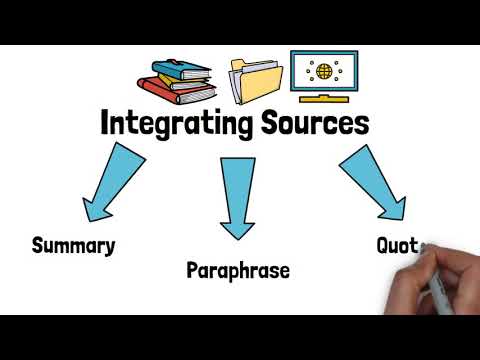
[0:00]Today, we're going to talk about integrating sources. If you've ever been asked to do a research project or a research paper, you may have had to read a number of outside sources like books, articles, or even web sources, and then use the information in those sources in your own argument. This is a form of integrating source material into your own writing. Many students struggle with integrating source material because it can be difficult to adequately, accurately, and ethically represent other people's ideas in your own writing without plagiarizing. Today, we're going to talk about three tactics for integrating sources in your own work that both adhere to academic honesty requirements and are effective at supporting your own argument. Those three tactics are summary, paraphrase, and quotation. So let's start with summary. Summary writing is when you take a large piece of text and condense it down into a short, one page or even one paragraph version. Summary writing is useful if you want to give an overview of the main ideas in a text without having your readers focus on the details. If you've ever read scholarly texts, you've probably encountered summaries before. For example, most scholarly articles include something called an abstract. An abstract is a form of professional summary writing, where the author of the article summarizes the main points of the article and the main takeaways, so that readers can decide in advance whether or not they want to read the entire article. In academic writing for students, summary writing is often used if you're dealing with a lot of text and are about to get into the details. Summary writing allows you to give your audience an overview of the entire argument briefly so that your audience doesn't have to go back and read the text themselves in order to understand your argument. For example, in a compare and contrast essay, where you want to focus on the details compared between two articles, you might first start with a summary of each article, so your readers have a sense of what you're talking about overall. Summary writing should be in your own words, because the whole point is to make sure that your readers don't have to go back and read the source itself. This means you should not borrow phrases from the core text that you're working with, and should attempt to represent it on your own. However, it is important that you let your readers know that you are summarizing a source, and you can do this by using things called signal phrases, such as Smith states or according to the article. These kind of phrases let your audience know where the information is coming from so that if they want more information or they want to read the entire source, they can find it. Next, let's talk about paraphrase. Paraphrase has a lot of similarities to summary. Both of them are in the writer's own words and are attempting to represent parts of a source. However, while a summary is trying to represent the main ideas of a source without getting into the details, paraphrase is focusing on the details. Typically, paraphrase will focus on a specific idea or example from a text, and writers will reframe it in their own words and in their own sentence structure to help support their argument. So, you might use paraphrase for passages that you don't want to quote, but that you use details that are important for your point. Paraphrase is often particularly tricky for students because it's very, very easy to slip into plagiarism, because paraphrase is often the exact same length as the source text. So, you might take two sentences from the source text and write a two sentence paraphrase. When it comes to avoiding plagiarism with paraphrasing, the one thing or the few things that you should remember is that plagiarism can happen both by stealing exact words and by stealing sentence structure. So, when we say stealing exact words, it means that you really do need to represent paraphrase material in your own words, using your own ideas. Even though you're representing someone else's argument or someone else's point, think about it as describing it to a friend who didn't understand it when they read it themselves. This can sometimes help you to rethink the idea in your own way.
[4:37]Additionally, when it comes to sentence structure, some students often try to paraphrase by simply changing some words around or changing some words for synonyms in the original text. This, unfortunately, does not count as paraphrase and is actually a form of plagiarism and can get you in a lot of trouble in your academic classes. In order to be an effective paraphrase, you need to use your own sentence structure and not just use the exact same structures from the source text. The final tactic I want to discuss today is quotation. Quotation is probably the most popular way to integrate sources, but it's also the most overused. Quotation is when you are using the exact phrasing from a source itself. Quotations have to be set off with quotation marks, and especially in academic writing, they have to be cited, depending on the style guidelines of your course. Additionally, depending on what style guide your professor is using, you may have to deal with specific types of quotations a little bit differently. For example, for MLA, the modern language association, long quotations, or quotations more than four lines long, have to be set off in the text by half an inch. A common issue for students when integrating sources is overquoting from sources, meaning including too many quotations in a single paragraph so that the student's own ideas and own arguments aren't clear. In general, you should avoid quoting unless the author's exact words help you make your point particularly clearly, or if they're from a respected authority. You may also choose to quote if the words of a quotation are particularly powerful or memorable, or if it's an opinion or an example you want to emphasize. But don't let quotations dominate your entire paper. Remember, it's your argument that your teachers want to hear, so you want to make sure that you use your own words as much as possible. When you use quotation, it's very important that you quote accurately and that you cite effectively. This means you can't change words or put quotations out of context, and you should definitely make sure that you introduce them for your readers so that they know where they're coming from. Many students do what I call a quote and run, where they drop a quote in the middle of a paragraph and then move on very quickly without explaining to their readers why that quote matters. Instead of quoting and running away, I recommend you use a tactic called the quote sandwich, where the quote is the meat middle, and you bookend that quote with an introduction and an explanation. So, for example, you might introduce a quotation by saying, according to Smith, or in the article entitled, and then have the title. Then you'll quote the text accurately and have a citation, and you'll follow it up with a sentence explaining why that quotation is relevant for your particular argument, and why it fits into your overall paper. This gives your readers a sense of how the quotation works with your overall ideas and it makes sure that you are still in control of your argument. Together, these three tactics of summary, paraphrase, and quotation can help you integrate sources effectively into your own work. However, if you have any further questions about integrating source material or about academic integrity or plagiarism, please feel free to reach out to your professor or see your campus writing center for more information.


