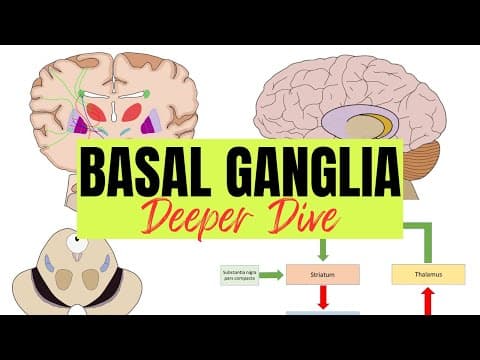
[0:01]Basal Ganglia, deeper dive. The basal ganglia are a group of structures that include the caudate, putamen, globus pallidus, substantia nigra, and subthalamic nucleus. The caudate and putamen are often referred to collectively as the striatum. The substantia nigra consists of two regions, the substantia nigra pars compacta, and the substantia nigra pars reticulata. And the globus pallidus is divided into the internal and external globus pallidus. The traditional view of the basal ganglia emphasizes their role in movement, and suggests they are important to facilitating desired movements and suppressing unwanted ones. We now know, however, that the movement-related operations of the basal ganglia are more complex and also involved tasks such as selecting which action to take to achieve a goal. Additionally, it is thought that the basal ganglia contribute extensively to non-motor functions, playing an important part, for example, in learning that depends on feedback and reinforcement, the development of habits and a variety of other cognitive, motivational and emotional functions. The basal ganglia are thought to shape behavior through circuits organized in loops, which carry information from other brain regions into the basal ganglia, and then send processed signals back out to influence activity elsewhere in the brain. Much of the information the basal ganglia receive comes from the cerebral cortex and travels first to the striatum, which is a main input area of the basal ganglia. The main output nuclei of the basal ganglia are the internal globus pallidus and the substantia nigra pars reticulata, which send projections out of the basal ganglia to the thalamus, as well as to nuclei in the brainstem. Through its connections in the thalamus, the basal ganglia can communicate with the cerebral cortex and various other structures. Importantly, activity in the basal ganglia does not cause movement directly. Instead, the basal ganglia affect movement by modulating activity in other brain regions, such as the motor cortex. One influential model proposes that the basal ganglia contain a circuit called the direct pathway, which facilitates desired movements, and a circuit called the indirect pathway, which suppresses undesired movements. It's important to note, however, that research indicates the basal ganglia are more complex than the traditional direct and indirect pathway model suggests. In addition to these circuits, a hyperdirect pathway has been identified, and much of the intrinsic circuitry of the basal ganglia is still being investigated. Nevertheless, we will now turn to an explanation of the traditional model involving the direct and indirect pathways, speaking mostly in the context of movement, before discussing how the basal ganglia might be involved in non-motor functions.
[2:57]The direct pathway ultimately influences glutamate neurons that project from the thalamus to motor regions of the cerebral cortex. These excitatory projections are thought to be involved with stimulating movement. Neurons from the globus pallidus internal and substantia nigra pars reticulata, however, project to the thalamus and maintain a steady release of the neurotransmitter GABA, which acts to inhibit the thalamic neurons and suppress movement. This mechanism is thought to be important in keeping unwanted movements from occurring. When we want to make a movement, however, information about the movement is sent from the cortex to the striatum via the cortical striatal pathway. Glutamate neurons in this pathway excite neurons in the striatum, and the activated striatal neurons release GABA in the globus pallidus internal and substantia nigra pars reticulata, inhibiting the activity of these regions and stopping the inhibition of neurons in the thalamus that are involved with movement. This effectively opens a gate for movement to occur. Activity along this pathway tends to occur just prior to a movement, and thus has been linked to the facilitation of movement. The substantia nigra pars compacta is thought to modulate the activity of the direct pathway. Neurons from the substantia nigra pars compacta travel to the striatum via the nigrostriatal pathway and release dopamine in the striatum. One effect of this seems to be the facilitation of activity in the direct pathway, which leads to the facilitation of movement. The indirect pathway model involves GABA neurons that project from the external segment of the globus pallidus to a region called the subthalamic nucleus. These globus pallidus neurons typically exert an inhibitory effect on glutamate neurons in the subthalamic nucleus. But when the indirect pathway is activated by signals from the cerebral cortex, this causes the activation of GABA neurons in the striatum, which project to the globus pallidus external and inhibit the activity of neurons there. This keeps the globus pallidus external neurons from being able to inhibit neurons in the subthalamic nucleus, freeing up the subthalamic nucleus neurons to stimulate GABA neurons in the globus pallidus internal segment and the substantia nigra pars reticulata. These GABA neurons in turn project to the thalamus, inhibiting thalamic neurons that travel to motor regions of the cerebral cortex to stimulate movement. The inhibition of these thalamic neurons thus inhibits movement. This activity in the indirect pathway is thought to antagonize the activity of the direct pathway and act to keep unwanted movements from occurring. Neurons from the substantia nigra pars compacta travel to the striatum via the nigrostriatal pathway, and they can modulate the activity of the indirect pathway through dopamine release in the striatum. One effect of this seems to be the inhibition of activity in the indirect pathway, which leads to the facilitation of movement. This is thought to be one reason why dopamine depletion in disorders like Parkinson's disease may lead to difficulties initiating movement.
[5:56]Just as the basal ganglia may help select and refine movements, they have also been hypothesized to help select and regulate a wide range of non-motor functions, including cognitive, emotional, and motivational processes. In this sense, the basal ganglia can be viewed as a general purpose system for shaping certain aspects of both movement-related and non-movement-related behavior. This perspective has also led to hypothesized roles for the basal ganglia in a number of non-motor disorders, such as addiction and obsessive-compulsive disorder. Much like motor circuits, non-motor basal ganglia circuitry typically runs in loops from the cortex to the basal ganglia, then to the thalamus and back to the cortex. One prominent non-motor loop, for example, involves the prefrontal cortex and is thought to potentially be important for higher order cognitive functions such as attention, decision-making and working memory. Another loop involves limbic regions like the amygdala, and is thought to be involved with emotion and motivation. Basal ganglia are believed to play an important role in learning, particularly forms of learning that depend on feedback and reinforcement. Dopamine signaling in the basal ganglia about expected rewards and actual results is thought to be able to influence basal ganglia-mediated learning, causing behaviors, thoughts or strategies that led to favorable outcomes to be reinforced. Similar mechanisms are thought to be important for habit formation, where actions or cognitive routines become more automatic with repetition, another process that the basal ganglia are considered important in.
[7:40]Parkinson's disease is considered a neurodegenerative disease because it involves the degeneration and death of neurons. It is most frequently seen in adults over the age of 50. The most recognizable symptoms of Parkinson's initially are movement-related and generally involve a tremor that is worse when a person is at rest, bradykinesia, which is slowness of movement, rigidity and postural impairment. Parkinson's patients also often experience non-motor symptoms like cognitive impairment or psychiatric symptoms. The causes of Parkinson's are not fully understood, but a combination of genetic and environmental factors is likely involved. Parkinson's patients have low levels of the neurotransmitter dopamine in the basal ganglia, a group of structures involved with movement among other functions. These low dopamine levels in the basal ganglia are caused by the death of dopamine neurons in a region of the basal ganglia called the substantia nigra. The substantia nigra has high numbers of dopamine neurons, but by the end stages of Parkinson's, patients have often lost more than half of the dopamine neurons in this region. The most common treatment for Parkinson's involves an attempt to restore depleted dopamine levels in the basal ganglia. Because dopamine does not cross the blood-brain barrier, dopamine cannot simply be administered to a patient. Instead, however, patients can be given a precursor to dopamine called L-DOPA. L-DOPA can cross the blood-brain barrier and is used by the brain to synthesize more dopamine. This can lead to improvement in the motor symptoms of Parkinson's, but L-DOPA does not halt the neurodegeneration that occurs in Parkinson's disease. And long-term use of L-DOPA can cause a number of side effects, including movement-related problems. So it's not a cure for the disease and other treatments are still being explored. The symptoms of Huntington's disease typically emerge during middle age, and at first often involves subtle changes in personality, cognition, and movement. Eventually, the symptoms progress into substantial movement problems like chorea, which involves uncontrolled spasmodic movements, impaired coordination and balance, muscle rigidity, and difficulty speaking and/or swallowing. Cognitive and psychiatric symptoms like dementia and depression occur as well. The disease is incurable and fatal. These symptoms are associated with neurodegeneration, or the deterioration and death of neurons. A group of structures called the basal ganglia are strongly affected, but other regions of the brain experience neurodegeneration as well. The pathology of Huntington's disease can be traced back to a mutation in a single gene called Huntington. The mutation that causes Huntington's disease is a dominant mutation, thus if one parent has the disease, their child has a 50% chance of developing it, too. The Huntington gene contains a DNA sequence that consists of three nucleotides: cytosine, adenine, and guanine, in repetition, a pattern known as a trinucleotide repeat. When the gene is mutated, an excess number of repeats can occur, and a mutated form of Huntington protein is created. The higher the number of repeats, the greater the risk of disease, and all people with 40 or more repeats in the Huntington gene will develop Huntington's disease. Mutated Huntington proteins have a tendency to group together, forming clusters within neurons that are not easily removed by brain enzymes. It has been hypothesized these clusters may play a role in the neurodegeneration seen in Huntington's disease for their accumulation in the brain is associated with increased neurodegeneration. Obsessive-compulsive disorder, or OCD, is a condition characterized by obsessions and/or compulsions. Obsessions are recurrent unwanted thoughts, while compulsions are repetitive behaviors or mental acts, often performed in response to obsessions, typically with the goal of reducing anxiety and discomfort. It's important to note that OCD is often very distressing and is not just a preference for orderliness, as the term is sometimes used to imply. The neuroscience of OCD is not completely understood, and it's likely that different neural circuits may be involved based on a person's age and symptom profile, among other factors. One supported perspective on the neuroscience of OCD, however, points to a prominent role for circuits that connect the orbitofrontal cortex with a group of structures called the basal ganglia. According to this perspective, increased activity in the orbitofrontal cortex is associated with a heightened focus on concerns that spawn obsessive thoughts. When the orbitofrontal cortex is activated in response to something the brain perceives as a danger or concern, it communicates with the basal ganglia. A simplified version of basal ganglia circuitry suggests it consists of two opposing pathways, an excitatory pathway called the direct pathway, and an inhibitory pathway called the indirect pathway. When the orbitofrontal cortex sends a signal to the basal ganglia, it often leads to an action designed to alleviate the discomfort caused by the perceived danger. That action is mediated by the direct pathway. In a healthy person, the indirect pathway then inhibits further action. In someone with OCD, however, the direct pathway is over-excitable, drowning out the activity of the indirect pathway, and causing a difficult time switching to a different behavior or turning focus away from the concern causing the discomfort. Thus, according to this model, overactivity in the orbitofrontal cortex and the direct pathway of the basal ganglia increases the likelihood of both obsessions and compulsions.
[13:12]Tourette Syndrome is characterized by recurrent involuntary movements or sounds called tics. Tics can be classified as simple or complex. Simple tics usually involve only one group of muscles and might consist of actions like eye blinking or throat clearing. Complex tics are more elaborate and might involve actions like reaching out to touch something or the involuntary use of obscene language, which is known as coprolalia. It's worth noting that coprolalia, while often associated with Tourette Syndrome, is actually thought to occur in less than 20% of cases. The neuroscience of Tourette Syndrome is still poorly understood, but a number of studies suggest an important role for a group of structures known as the basal ganglia, which includes the caudate, putamen, globus pallidus, substantia nigra, and subthalamic nucleus. The basal ganglia are involved in diverse brain functions, but they are especially relevant to Tourette Syndrome for their hypothesized role in suppressing unwanted actions. According to this perspective, one function of basal ganglia circuitry is to inhibit neurons in the thalamus and prevent them from sending undesired movement-related signals to the motor cortex. In Tourette Syndrome, it's thought that faulty inhibitory mechanisms in the basal ganglia may fail to stop unwanted signals from reaching the cortex. This causes the execution of an action that the patient might prefer to suppress, forming the basis for tics. The failed inhibition in the basal ganglia is thought to be coupled with increased activity in motor pathways that generate movements. Thus, patients with Tourette's might experience a problematic combination of high motor activity that generates habitual patterns of behavior, along with abnormally low inhibitory activity that would normally keep those behaviors from being acted out.