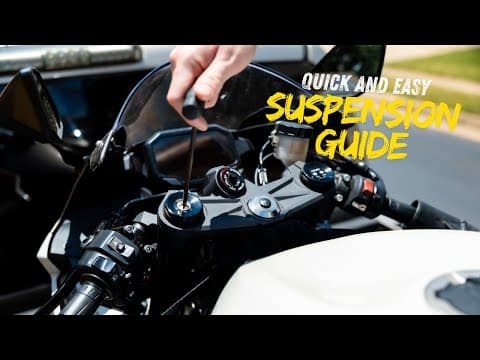
[0:03]Hey yo, what do you think of the suspension? What's up guys? Having your suspension dialed in is one of the most slept on things in the motorcycle community. So, if you have a 2013+ ZX6R, I've got a quick hack to get you most of the way there. So there is like a proper way to do this, that involves numbers and measurements and math, but Superbike.co.uk was testing the ZX6R and they had a factory rider do some laps to try to beat the MV Agusta F3. And they published the settings that they put on the bike on their article, and I'm about 170 lb and it's just a touch stiff for me. So if you're over 170, it'll be perfect. If you're under 170, maybe just kick the preload down just a touch. The other thing in the article is that they did add a shim to the rear shock, and I didn't have a shim and didn't really feel like messing with it, because I don't want a super twitchy bike because I'm not at the track. So on my bike, I applied the settings just like they were in the article, except for I did minus one turn on the rear preload just because it was just way too stiff. We're going to start out with the front preload, which we adjust with this adjuster right here on the left fork leg. So their setting was 11 turns in from fully clockwise. So we're going to back this all the way out, and it does stop, so you don't want to be forceful with it. Once it just gets hard to turn, you're done. So, now we're going to count our turns as we go back in. So if possible, I like to try to get this T-handle completely at the top or bottom. But, can't quite do that. So, I'm just going to know this is my position. So, One, two, three, four, five, six, seven, eight, nine, ten, eleven. Now we're moving on to the rebound and compression. So for this, it'll be on the right fork leg and you're going to need a flathead screwdriver. Now, these are the opposite, so these settings are from fully clockwise. So we're going to turn these things all the way in and then to get the measurement, we're going to come back out. I always try to be real careful to not scratch up the top of the top of the shock cap too, cuz they're nice pretty anodized metal from Kawasaki. So for the rebound, which is listed as tension here, it's going to be four and a half turns from fully clockwise. So we've just turned this all the way in, and we're going to come four and a half turns back out. So, half, one, half, two, half, three, half, four, and a half. And now same for the compression. First, we're going to bottom this thing out, again, being gentle with it. This one is going to be five and a half turns. So we're going to do the same thing. So it'll be half, one, two, three, four, one more half, five, and a half. Cool. So there you go, you're good to go on the front and now we're going to move on over to the rear. So on the rear, it's not quite as straightforward, but they're all going to be right around the rear shock unit. So to start, we have this collar above the spring, and that's how we're going to adjust the preload. And then right above that, we have the compression. It's this little flathead screw. It's a little tough to see cuz the light won't hit it. And then down below, they've put this convenient little window and back in there is going to be the tension. is going to be the tension or the rebound control. To adjust the preload, we're going to need an additional tool, which is a spanner wrench. I've got this one, which I got from, I've got this one just super cheap from Cycle Gear. This one actually goes onto a ratchet, which is kind of convenient rather than just having its own handle. And then I'm also going to be using a cheater bar because this thing is hard as heck to spin. We're also going to need a metric five T-handle because in order to adjust that rear preload, we've got to take this kick plate here off. One thing to consider with this is, it is kind of part of the cosmetics of the bike. So, I like to put it on a table with this side facing up, so that way it doesn't get stuffed. All right, so we're just going to eat the frog as they say and go right into this preload adjustment. It's going to be six turns in from the factory position. Like I said, I'm 170 lb and six was too stiff for me. So I did five, but my buddy who rides this bike is a little heavier than I, so I'll actually do the full six. I'm going to mark this tooth on that collar and that's how I'm going to count the turns. There is another one that's already marked, but it's way in the back and I just want it to be right in front of me. So I'll go six turns from right there. Plus it goes with the color scheme of this bike anyways. And get the ratchet on there. And then slide our cheater bar on. We're just going to let this thing rip.
[5:08]Like I said, I use the cheater bar because without it, this is pretty difficult.
[5:38]All right, now we're going to hit that rear compression. So this is going to be two and a quarter turns from fully clockwise. So just like before, we're going to slide in here with this flathead and bottom this thing out. And again, just be gentle. When it stops, that's it. So we're going to go half, one, half, two, and then a quarter. Now for the rebound, so this is going to be at the bottom of the shock. We have this little window here, so we can reach in with our screwdriver. And this is going to be one turn from fully clockwise. So again, we're going to bottom it out, and then we're literally just going to go half, one. Boom. So after about 20, 30 minutes, depending on how good at turning wrenches you are, your bike is set up most of the way. Again, there is a precise way to do this with numbers, math and measurement, but I didn't have a buddy to help me do that, and I really don't know how to do that. So, for the So, in the meantime, this does improve the bike quite a bit over the factory suspension setup. So now, instead of taking this thing for a rip, we actually have to take it to the dealer to get the crank bearing inspected because of the recall. So as you can see, it's quite a bit stiffer than it was, and that'll be great for the truck ride to the dealership.


