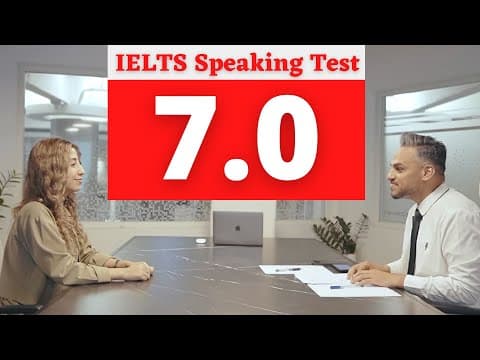
[0:00]Are you ready? Yeah. All right, from here starts the speaking test. This is the speaking mock test of the International English language testing system, taking place in Ross IELTS Academy. The candidate is Vita, the candidate number is 01413278. The examiner is Joseph, examiner number 44321. Good afternoon. My name is Joseph. Would you please tell me your full name? Thank you, nice to meet you. Uh, I'm beta Kovi. Can I see your identification, please? Yeah, here you are. All right, thank you. You're welcome. So, uh, let's begin by part one, and the first part of the exam, I will ask you some personal questions. Let's talk about friends. Who is your best friend? Uh, my best friend uh, is Azada. Actually, she was my classmate, and right now we are actually, we have a good connection by now. Are you still friends with people from your childhood? Uh, yes, I can say that, uh, you know, I, as far as I think, uh, the best friendships actually can't, uh, uh, can be made actually, uh, when actually you're a child, or uh, actually, if I want to say that, from your childhood. Do you prefer spending time with family or friends? Uh, honestly with my family, because I think we actually, we are a close-knit family, and I prefer to actually to spend my time with my family. Perfect. Let's talk about television programs now. Where do you usually watch TV programs or shows? Uh, I am really keen on, uh, sport TV shows and I really, you know, want to spend my time about that on that, of course. And what's your favorite TV program or show? Um, and it is actually called, uh, Nabad, and I really love that because, uh, because of actually it's, uh, host that, uh, his name is Oded, and I really liked this man. And do you think you will watch more TV or fewer TV programs or shows in the future? In the future, I think I will watch it more, you know, because right now I really trying for my life, and I really spend my time on studying and a lot of things. So I think, uh, in the future, maybe I am not busy as I am right now. I wouldn't actually. All right. Now, let's move on to talk about age. Are you happy to be the age you are now? Um, I think yes, I am happy, but you know, uh, I'm stressed because I'm getting older, and I think it is so scary for me, and you know, I think, uh, maybe I will lost, uh, my opportunities. And when you were a child, did you think a lot about your future? Uh, yes, I did, you know, I used to think a lot about my future because all the time I was so worried about my future, and I had a lot of goals and plans, and I wanted to achieve them. And do you think you have changed as you have got older? I'm sorry, can you repeat your question? Sure. Do you think you have changed as you have got older? Uh, I think yes. Uh, I actually, I changed a lot, uh, especially I was a kind of introverted person, and right now I am so extroverted, and I think it could be a big change for me. Thank you. That's the end for part one. Now, let's move on to part two. In part two, I will give you a card with a topic, and you will have to talk about the topic for up to two minutes. You have one minute to think about what you're going to say. You can make some notes to help if you wish. Do you understand? Yeah. Okay. Well, the topic would be, describe a time when you started using a new technological advice, e.g. a new computer or phone. That's your cue card. Thank you so much. That's a piece of paper for taking notes and a pen. Your one minute time for taking notes and thinking starts right now.
[5:47]All right, your one minute time is over, and now you can speak for up to two minutes. Okay. Uh, so if I want to start my speech, uh, I can say that one of the actually devices that, uh, I was really keen on, was my actually phone, my smartphones, because, uh, as I can remember, when I was a student at high school, uh, actually, I, you know, uh, I was familiar with these devices, and they were actually kind of, you know, uh, new devices, and I really wanted to have one, and, you know, because I, actually, I really wanted to improve my, uh, actually life quality, and I actually, you know, uh, of, uh, do a lot of things with that.
[6:45]And, so, uh, I can remember that when I really wanted these devices, the all the time, I was saying that I wish I would actually, uh, in a place that my friends, for example, uh, are in that, and, uh, you know, uh, it was so, uh, it was so dreamy for me. I really wanted to do that, to have them, of course.
[7:45]Perfect. Thank you so much. Now, let's move on to the third part, and would you please hand me back the piece of paper, the cue card, and the pen? Here you are.
[8:03]In part two, you talked about the time when you started using a new technological device. Now, in this part, I want to ask you some questions related to this topic. First, let's consider technology and education. What is the best age for children to start computer lessons? Uh, can you, sorry, can you explain it, can you, uh, check it again? Of course. What is the best age for children to start computer lessons? Um, I think, um, you know, when the children can understand what they can do for their life actually, and, uh, what is wrong, and what is, you know, uh, the best decision, they can actually, uh, keep learning, and, you know, start to starting, and just this. And do you think that schools should use more technology to help children learn? Definitely yes, uh, because, you know, as far as I think, uh, technology can be so effective in the actually learning process, and, uh, I think it could be so, you know, it could boost actually the process of learning. And do you agree or disagree that computers will replace teachers one day? Uh, I agree actually, because, you know, uh, nowadays, we can see, for example, some, uh, bots like AI that they can do a lot of things that, you know, it is, uh, more than a kind of, you know, it is more than individual, uh, powers, of course, and I think it could be, uh, so challenging, but I think yeah. Now, let's talk about technology and society. How much has technology improved the way we communicate with each other? Uh, a lot, of course, you know, it is different, uh, as my point of, actually, as, uh, I think, uh, it, uh, made people to have more connection with actually other people and make new friendships, and of course, uh, do a lot of things that we can't do it without them, but I think the, you know, some close, uh, actually close knit, uh, families, for example, destroyed by this, uh, technology, and, you know, for example, like, uh, some applications that you can have video calls or something like that. I think it could be, it couldn't be actually. Do you agree that there are still many major technological innovations to be made? Uh, yes, definitely, uh, because, uh, actually, you know, day by day, we can see the world actually, uh, getting better, and, you know, so I think because of that, we can see a lot of, uh, you know, new technologies and new approaches in the future, and yeah. And could you suggest some reasons why some people are deciding to reduce their use of technology? Um, sorry, can you repeat that again? Yes, could you suggest some reasons why some people are deciding to reduce their use of technology?
[11:32]Um, you know, it depends on, uh, each individual perspective, point of, actually, point of view, I wanted to say that. Uh, I think the people that, uh, decide to actually wanted to decide to, uh, reduce using technology, you know, maybe, uh, they thought is about we don't have any, uh, close relationship nowadays, and, you know, it make, people, it will make people so lazy, and so because of that, maybe they don't want to do that. Thank you so much. This is the end of the speaking test. Do you want to know what band score you'll get in the IELTS speaking test? Perhaps you want to improve your performance and prepare yourself for the real test, then why not book an online mock test with us that will last for 25 minutes, 12 minutes of the test itself and 13 minutes of comprehensive feedback plus, will give you useful tips on how to make your performance better. So, we know how to help you. Join us. Okay, that was a lot of talking. Do you have any questions? No, thank you very much. I really appreciate that you gave me this feedback, because I know this will help me. This is exactly what I need. Although my job is hard, I enjoy doing it. Okay, this is the last time I'm going to talk about now we are you were talking about the past. And for our generation, I kind of moved and talked about what's the new or I'm
[13:22]All right. So, time for the feedback. Well, as you know, there are four criteria for evaluating your performance, fluency, lexical resource, or vocabulary, grammar, and pronunciation. I want to comes to fluency, you were easy to follow, that's what matters. You were easily easily understandable, and then, um, you didn't repeat yourself. You had a couple of self-repetition and self-correction, but that's okay. It looks like you were repeating yourself naturally like everybody, even people with their even if they're native language is English, they do repeat themselves. So, that was the good part of it with with regards to the fluency and coherence, but you were coherent, easily understandable. Uh, but you need to slow down a little bit. You have to give yourself that time to find the ideas and find the words. You don't need to rush because rushing makes you nervous, and getting nervous is a killer in IELTS exams, speaking exams. So, you need to slow down, keep pace when you speak, try to think wisely before choosing any word. And in order to do that, you need to diversify your connectives. The fillers and boosters and connectives you need to pay close attention to what connectives to use. You know, we have fillers, which are the phrases used by the speaker to try to find the right word, okay, like you say, like or, you know, or I mean, you're buying yourself time to find the better word, right? So, you have to pay attention to the fillers and the boosters to find the next ideas, like you need to use some boosters, like, for example, you say a sentence, and you're not sure what the next sentence would be you said, you would say, with that being said, then blah, blah, blah, you you find yourself another ideas to move on and keep the the flow of speech, maintain the flow of speech. So, you need to also use a wide range of boosters to try to, uh, figure out what to speak about and maintain the flow of speech. But let me tell you something, you need to use those fillers and boosters judiciously, carefully. An overdose of fillers and boosters is not okay, because that would also show that, uh, you're not able to be coherent or be to the point. So, overdose or, uh, excessive use of fillers and boosters is dangerous, but try to use them carefully. So, that is for fluency and coherence. Let's move on to lexical resource, which is vocabulary. You did a great job finding some very good words like, uh, I'm keen on, that's perfect, that's professional. Uh, you also said, uh, use some idiomatic language, which is very okay. Very, you you were really great in finding some colloquial words and an idiomatic language, like you said, piece of cake, you used day by day, that is really important to try to diversify and expand the vocabulary use naturally used idioms by native speakers. That is okay. But, uh, pay attention to the over use of some words. Like, you overused the word actually. Yeah. And that is not okay. So, try to avoid overusing some specific words, and you also one good point is that you said, definitely yes, when you were really sure what the answer would be, definitely yes, absolutely yes. All those phrases are really amazing, and they really caught my attention. With regards to, uh, grammar, you had some little issues. You have to avoid them. Let me begin by your bright side. You used, uh, this phrase as far as, which is okay, that shows that you are able to use some complex structures, but your, uh, usage of complex structures were not, uh, fully okay because sometimes you make some mistakes when you want to expand, uh, the answer, or expound on the answer, elaborate on the answer, you would face some problems. You want to use that complex structure, but then you face some shortcomings. But as far as you were speaking and using some simple structures, you were okay. But the issues would be, uh, you used will, but instead of mentioning the simple form of the verb, you used the past form of the verb. So, that is an issue. And then you also said, a lot of thing instead of a lot of things. You said, I know that, how can I, which the correct form would be, I know how I can. You said, I wish I would, then, you didn't say, I wish I would be, I wish I would do something. You used, uh, you you didn't you were not accurate in this part. And you said, the world getting better without using the is. So, you you have to say, the world is getting better, instead of the world getting better. So, try to also use some complex structures and pay attention to how they're used. Try to practice them in order to increase your bad score. Uh, when it comes to pronunciation, you were easy to understand, that's what matters. You really, you you did a very great job. Uh, instead of a couple of mistakes, like, as stressed instead of stressed, you have to avoid that E, or shwa because, uh, in in Iran, because of the form of their language, Persian language, we cannot say stressed, or sport. People here in Iran usually say, sport, or stressed, or s-cool. You have to pay attention and remove that shwa, um, at the beginning of and each word. So, you also said, dreaming instead of dreaming. And then close family instead of close family. So, paying attention to those subtle mistakes will definitely increase your band score.