[0:00]It's not your fault you're not as assertive as you want to be yet. No, not at all. It's just no one has ever taught you when you were young or recently, how to stand up for your wants and needs and communicate that to the people who are important in your life in a way that isn't aggressive or doesn't diminish the other person. No, no one's ever taught me that. And most likely, I could be wrong, but someone from your past, either a parental figure or someone who was important in your life that you depended on, probably walked all over you and instilled the unconscious belief within you that if you speak up and admit what you actually think and feel, then you're going to be punished and something bad is going to happen. But although it's true that it's not your fault, in order to grow into your new assertiveness, we can't just stop at that line of thinking, we have to just take the next step of growth, which is responsibility. It's not your fault, but it is your responsibility for becoming more assertive. So here's what we're going to cover with in this short video. We're going to, I'm just going to share with you six simple mindset shifts that will help you step into your new found assertiveness and then one low stakes tool that will help you practice it straight away. With the whole intention of simply if you become 5% more assertive after this video, boom, job done. Okay, here's the first mindset shift. And please forgive me for the temporary whiteboard setup. Bear with me. Here's the first one. The first mindset shift is something I discovered for the first time when researching for this video and it's the etymology of the word assertive. And I looked into it and what I found is that the, and by the way, I love the etymology of words because it helps us understand their roots and what they actually mean at a deeper psychological level. The word assertive comes from two Latin words which the first one is Ad, which in English means to, and then Serere, which means to join. Mix them both together and it became the Latin word Assarore, which in English means to claim or affirm, which then in early 17th, in the early 17th century became the English word Assert. And I found this fascinating because the idea that the Latin root of this word is translated into English as claim or affirm, proposes the question of, well, what is assertiveness claiming as your own? What is it joining? What is it claiming? What is it, what is it affirming? As I knock the whiteboard. Well, it's claiming and affirming one thing. Self-respect. I saw this as a mindset shift for assertiveness because once you understand the root of the word is to claim, you start to see assertiveness as an opportunity to restore your relationship with yourself. And it just so happens that it restores your relationship with the other person, which we'll get into in a mindset or two time. I found that fascinating and I wanted to share it. Assarore, to claim your self-respect. My shift number, mindset, mindset shift number two. You can't stop people making demands on your time and energy, but you can develop the skills to protect yourself. I like this mindset shift because it is realistic. It's not saying that there's going to come a time in your life when when other people are going to get easier to deal with. No, it's it's always going to be how it is in terms of other people having expectations of you or requesting things of you, which you then have to decide whether to accept or deny. That's not going to change. In the same way as you're not going to stop requesting things of other people, you know, whether they're the people who are really close to you or just people in your general day-to-day life. People making demands on our time and energy is the tax we pay, the price we pay for being social human beings. We can't as soon as long as we step into the social arena, this is the tax we're going to pay, so we have to pay it gladly. Just in the same way as every single time you leave the house, the tax you pay is being around other people who could treat you in ways that don't align with your values. Just in the same way as if you start a business, then the tax you pay on that is some financial new territory you have to step into or financial struggles. There's taxes we pay in life and when it comes to being assertive, the main tax we pay is other people making requests on our time and energy. But you can develop the skills to protect yourself. I like that because it rounds it off and it helps us understand another reframe of assertiveness, which means, which is assertiveness is all about safety. In every single moment, you want to step into, communicating how you think and feel. I think and feel, to someone. Doing so is a way of protecting yourself. Again, reclaiming back your self-respect, which maybe up until this point you have lost or you're rediscovering. Assertiveness is safety. Was there anything else I wanted to say there? Yes. Safety. It's not aggression.
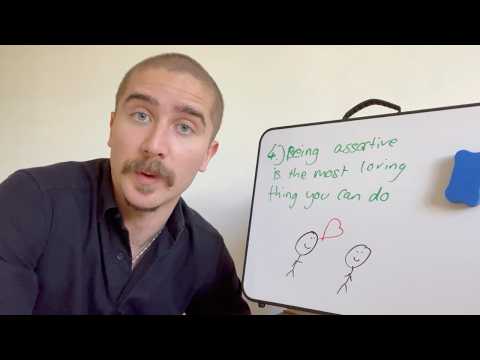
[5:43]Third one. Right, we're squatting. This is my favorite one. Being assertive is the most loving thing you can do for your relationships. Why? Well, it's because assertiveness communicates this. Look, I love us so much and I want to protect this connection so much that I'm actually willing to express the vulnerability to tell you what I think, feel, I think and feel because the opposite is deception, which I know will ruin our relationship in the long run. I'm not going to self-edit because I know that if I self-edit, then this is going to tarnish the connection we have. By me being assertive and stepping into myself, I invite you to be more yourself as well. That is the greatest act of self-love you can have and love for the relationship. No matter what shape or form that relationship takes, friendship, family, relationship, or just even with a stranger. And the more I research assertiveness, because it's been something I've struggled with most in my life, and I've felt that I had the unconscious belief of whenever I spoke up, and sometimes I still have it, whenever I speak up, something bad is going to happen from, you know, things that have happened to me. The more I research it, the more I've realized that beyond all of the tips and tricks and the body language hacks you can do and the specific things you can say to increase your assertiveness, although those things are helpful, none of it will work unless it's based on the foundation of your understanding that assertiveness is a virtue. And you have to believe in the virtue of assertiveness, not just for the reclaiming of your self-respect that it gives you the opportunity to step into, but also for the flourishing of it. It has the flourishing potential it gives you of any relationship you're in, the virtue of assertiveness is something that we don't speak about enough. And in order to be assertive, this is the most important mindset shift because you have to believe in the virtue of it. Just like you would believe in the virtue of honesty, truth, trust, integrity, loyalty, open and honest communication, no matter what rings is important in your soul and your heart, assertiveness needs to be one of them if you want to step into it. You need to believe in the virtue and the value of it. And just think about, think about this the next time you want to be assertive, but you're cringing in fear because you are afraid of stepping into it for fear of what the other person would say or the effect it would have on the relationship. Just think about this. You don't have to like conflict. I don't think any human being, well, some human beings do, don't get me wrong, but you don't have to like conflict. You just have to dislike delayed conflict more. And what that means is, okay, let's say you're in a relationship and someone says something to you, which you find disrespectful. You've got an opportunity in that moment, even though you feel hesitant to step into the conflict because you don't like it, you have an opportunity to step into it and check that person on what they said now and just question them on it and assert yourself and say, I didn't like the way you spoke to me. And that's it. You leave it there and then the conversation follows from there. You step into the conflict. Think about the delayed conflict if you're worried about actually stepping into it. What's what's the extreme of it? Well, you don't check this person on the thing that they say to you. They say more things to you like that. The relationship slowly tarnishes over time and your self-respect slowly road, erodes away with each time that you self-edit and that you don't speak up for yourself. Another quick example is just imagine that I don't know, okay, let's say you're in a friendship and then you and you keep organizing things to do and you really value this friendship, but with each invitation you give this person, they keep declining without giving a reason. Okay, you don't want to call them out on it because you feel fearful of the potential of conflict and them getting upset. Just imagine the extreme and what could happen if you delayed the conflict. Well, they keep declining your invitations, you feel like you're bothering them and then slowly the friendship fizzles out over time. Okay, that is more of a scary image to me than actually stepping into this short-term conflict. So I'm going to step into it because the opposite is worse and it scares me more than the immediate discomfort. When the of saying, hey, it seems like you've got a lot of, it seems like you're not free in your schedule right now and I don't want to keep being declined with invitations. So you just let me know when you want to meet up. Or, hey, seems like you don't actually want to meet up right now. You step into the conflict and you resolve it. When the fear of the long-term consequences outweigh the short-term discomfort you're facing. It will always be a no-brainer as to which path you should choose. Step into the short-term discomfort because the opposite of not doing that, or the consequence of not doing that, is choosing the long-term, bigger, delayed discomfort. Always. Always. Got a bit carried away there. This was meant to be a short video. The second to last one is a bit more direct. You're going to die. So stop choking. On your deathbed, you have a choice. You can either get the refreshing reflection of all the times you stepped into the short-term discomfort and grew from it, even though you felt paralyzed to do so, but you did it scared anyway. Or you're going to get the destabilizing, lump-in-throat, sudden, gasp-full regret of all those all those moments you let slide and actually didn't voice your opinion and communicate your emotions and thoughts. And instead, you just chose that long-term delayed discomfort. Look, as understandable as it is to not step into assertiveness, you have so much to benefit from doing it, from stepping into it. So let's end this on a practical note with the last mindset shift and the final tool. The last mindset shift is assertiveness is like a new language. It takes years of practice. So you have to be compassionate with yourself throughout this process of turning this volume button of your assertiveness up. And just like Alan Watts said, he put it brilliantly. You are under no obligation to be who you were five minutes ago. So you can change and step into assertiveness as soon as you decide to. So what's something you can do now, or this week, to practice that? Say no. Say no to one person, decline one invitation. Or just disagree with someone this week. Just one person. And see what happens. And you'll notice that as soon as you go to say no, disagree or decline that invitation, your mind will fire, your brain will fire with a belief along the lines of, if I say no, then, now I can't complete this sentence for you because I don't know. But it'll sound something like, if I say no, then X will happen, or this will mean this about me. Complete that sentence and you'll find the rule that's been programmed from your past experiences that is guiding all of your behavior. And that rule is called a belief. And that will fire when you go to say no, disagree or decline. But do it anyway. Because when you give your brain new evidence, which shatters its current story of hesitation and submissiveness, then it gets the evidence it needs to realize, oh, saying no is actually safe. Hopefully, these have been helpful. Just as they were helpful for me to consolidate. Please bear with me while I'm in my bear and trying to find the place to live in the world and then trying to stabilize and whiteboard and record videos throughout this whole process. It might be a bit rocky over the next few videos, but hopefully you guys will appreciate it and stay with me or stay with me. I mean, don't leave me. I mean, be patient with me. Here's a list of books which I would recommend to read on assertive. Some of them I haven't read, but they're in my upcoming book thing or books that I want to read. So, yeah. Stay disciplined, playful and dangerous. Go and claim your self-respect back. Adios, muchacho, see you muchachas.


