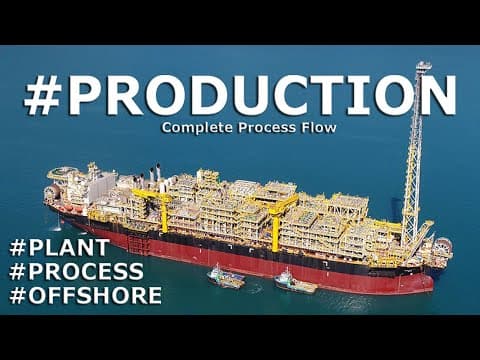
[0:10]Platform P63 petroleum processing plant. Petrobras's P63 platform is FPSO facility. FPSO stands for Floating, Production, Storage and Offloading. It will be placed in the Papa Terra field in Compos basin and will operate in waters 1,200 m deep. It will have the capacity to process 22,258 cubic meters of oil and 55,644 cubic meters of water per day. It will also have a storage system of 1,400,000 barrels of crude oil. We will describe the process according to the type of fluid being processed. Oil processing. 66 per cent of the processed oil will come from TLWP P61, from which it will be transferred through three flow transfer lines, which are also called FTLs. The remaining 34 per cent will come from eight satellite production Wells, six of which are operating and two of which are reserves. The oil from these Wells is received in the riser balcony area, from which it is sent to the production or testing manifolds. Next, the received oil at the P63 is sent to plate type pre heaters, which increase temperature to facilitate flow in separation.
[1:51]Afterward, the oil continues to a high pressure de gaser, where the gaseous portion is separated from the liquid.
[2:08]The liquid is sent to the high pressure separator, which separates the water and the oil. The oil is reheated through two types of heat exchangers. First the oil passes through a plate type heat exchanger, where it is heated through a thermal exchange with the produced water in the separation process. Next it goes through a shell and plate heat exchanger, where it is heated with saturated steam until it reaches 140 degrees Celsius, which is the ideal temperature for the final separation process. From there it goes to the low pressure gas de gasser, where the remaining gas is separated from the liquid. The liquid then continues to the low pressure separator, which works the same way as the high pressure separator, separating the oil from the water. From there, the gas free oil continues to the electrostatic treaters, where the remaining water is removed from the oil with the help of an electric current. The treated oil is then cooled before being stored in the storage tanks. Before storage, the treated oil passes through a metering system to verify that it is in accordance with its specifications and then sent to the storage tanks, where it will remain until the offloading ship arrives. the oil out of specifications will be sent to the off spec tank, where, by settling, the oil will be removed from the top and reprocessed. Gas processing. Gas separated during the separation process is sent to the P63 platform compression system. This system has the capacity to compress one million normal cubic meters per day. The process to gas on the platform is used for energy generation and to feed the boilers, lift gas to facilitate flow from the Wells. Gas re-injection.
[4:39]Gas extracted from the high pressure system goes directly to the main compression system, which has centrifugal compressors at the first and second stages and an alternative compressor at the third stage. Only gas used for re injection is sent to the third compression stage.
[5:00]Gas taken from the low pressure system is processed using a booster system, which is composed of a screw type compressor that operates with using the lubricating oil for machine refrigeration. The purpose of this stage is to adapt the low pressure compression system conditions to the main compression system. All the gas that has been separated enters the main compression process, where it goes through a cooler to reduce its temperature before being sent to the first and second compression stages. During these stages, the gas goes through scrubbers to remove any condensates resulting from the cooling process and then continued to the compressors.
[5:48]The compressed gas is cooled again in coolers. The compressed gas then goes to a dehydration system that is composed of absorption towers and filters that remove the humidity from the gas. The gas initially passes through coalescing filters to remove suspended particulate material. It then goes to the absorption towers, which contain xeolite, a particulate material that retains humidity from the air. The dry gas is sent to another filter to remove any xolite it may have picked up.
[6:33]At this point, part of the dry gas will be sent to the third main compression stage, and the rest will be sent to the fuel gas treatment system. In the third compression stage, the gas first goes to a scrubber to remove any droplets of liquid that might remain, before entering the main compressor, where its pressure will increase from eighty barg to 300 barg. The pressurized gas is cooled in a cooler and then sent either to a gas reinjection well or a gas lift system. The portion of the gas sent to the fuel gas treatment system is cooled in a multisteamer heat exchanger, with its fluid being used to cool the products obtained in the low temperature separation vessel.
[7:29]Before entering the vessel, the fuel gas goes through jewel Thompson valves, which considerably reduces the fuel gas pressure. This causes gas cooling, resulting in the condensation of the heavy hydrocarbons. Within the vessel, the hydrocarbons are condensed, and the light gas, which is mainly methane, goes to the top. After going through the multi steamer heat exchanger, this light gas is sent to the power generation motors, while the condensed gas from the vessel is re heated and afterward sent to another separation vessel, where it goes to another condensate removal process. It is then reheated before being sent to feed the boilers.
[8:26]Water processing. Now that we've seen how oil and gas are processed on P63, let's take a look at how water is processed on the platform. This includes both the produced water and the sea water that is used. All the produced water during oil processing on the platform is sent to the treatment system in module 51. The water taken from the high pressure separator is sent to the high pressure hydrocyclones, while the water taken from the low pressure separator is sent to the low pressure hydrocyclones.
[9:18]The water separated in the two hydrocyclone systems is cooled in coolers until it reaches 80 degree Celsius. When it is sent to the dissolved gas flotation vessels. The remaining oil is removed in these vessels. The treated water is analyzed before being discarded. The water must contain less than 29 parts per million of oil by volume. If it meets this specification, the water is dumped into the ocean. If it does not, it will be sent to the produced water tank, where, through settling, the water will be dumped into the ocean.
[10:10]The sea water used for utility purposes on FPSO P63 is pumped Into the platform's sulphate reduction unit. SRU, through pumps in the whole, the sulphate reduction unit reduces the sulphate level in the water. Initially, the water goes through three filtering stages, first to remove large particles that are more than 80 microns, and then to remove finer particles of five absolute microns. After filtering, the water is pumped to be processed twice in nanofiltration membranes, through which the water is forced to reduce its sulphate content.
[11:03]The low sulphate water is sent to the deaeration tower, which reduces the amount of oxygen in the water.
[11:22]The treated water is sent for processing through booster pumps, which elevate the pressure to nine barg.
[11:32]After processing, the treated water goes to the injection pumps. The purpose of the injection is to pressurize the reservoir, attenuating the loss of energy caused by petroleum production.
[11:49]Polymer pilot plant.
[11:55]The first polymer pilot plant used in Brazil will be installed on P63. Plant is located in module 83 on the upper level. And its purpose is to produce a polymer solution that will be injected into the water injection Wells to increase the viscosity of the injection water and the consequent well conversion. The polymer powder is stored in an inerted Silo from which it is transported pneumatically to the polymer process in unit PSU, where it is mixed with treated water from the SRU. After mixing, the polymeric solution is sent to four maturation tanks, where it remains for from 30 to 40 minutes to finish maturation. After maturation, the polymeric solution, with a concentration of 10,000 ppm is pumped by a set of two pumps in series, a metering pump and a high pressure pump. Finally, this 10,000 ppm solution is pumped and mixed into the injection water through a static mixer, which homogenizes the final solution, which is to have a final concentration of 1,500 ppm. The static mixer is installed in module 21 a little before the water injection risers.
[13:30]Power generation system. The P63 power generation system was designed to attend the electricity consumption requirements of platforms P63 and P61. It is composed of three modules with a total capacity of 103 MW, driven by six motor generators. P63 will be the first platform with technology that allows for use of three types of fuel. Fuel gas, processed crude oil and diesel oil, according to availability over the production platform's years, of operation.
[14:33]P63 is 334 m lomng and 57 m wide. Operating in the Papa teha field in the Campos Basin in Rio de Janeiro, it will produce 140,000 barrels of oil and one million cubic meters of gas per day.


