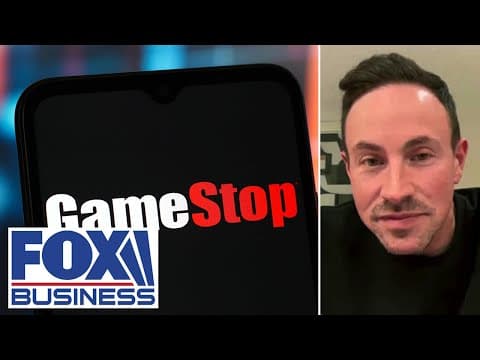
[0:00]last month, and I'm sure most of you heard this, right, during the frenzy of the Mint Light Midnight release of the much anticipated Nintendo Switch two. employees over at the Staten Island Game GameStop punctured holes in both the cardboard uh the packaging and the screens of the game stop, right? as they were stapling on the receipts. this instantly became sort of a hot topic on social media. And then of course, the CEO of GameStop came up with a brilliant idea, how about we turn this into a positive development. So on July 9th, the company began auctioning off what it's calling authentic relics of Staple gate, right? And this is crazy. We're up almost to three hundred bids on this thing and the stapler, that's the infamous stapler. It's at two hundred and fifty thousand dollars. And here's the good news. All the proceeds will be donated to the Children's Miracle Hospital Network or Network Hospital. All right, let me bring it out the brain the brains behind this and so many other things. GameStop Chairman and CEO Ryan Cohen. Ryan, I got to just ask you, so someone calls you up and says, Ryan, someone at the at the Staten Island store is stapling holes in the screen. What were you your first thoughts when you heard about this whole thing? We got limited inventory and they're uh they're damaging our limited inventory. You thought about it like a shopkeeper, you didn't think about the public relations part of it, huh? I thought about it as we got to get rid of them. I got you. Well, I'm sure they're probably watching the show from a sofa somewhere. But I love how you turned this into something positive, right? Something uplifting. And let's be honest, your emergence as the CEO of GameStop has been an uplifting. It's created a rock solid ground swell of believers. And so what I did is so many of them reached out to me on X, I told them they could help me ask you the questions today. So, this is what we're going to do. I'm going to get the first question to you. It's from a guest, he's one of my favorite guests. He's loaded up on your stock Kip Harris. His question is share your views on financial engineering in the GameStop way and give us a snapshot of what GameStop will look like in 5-10 years. That's what everybody wants to know. I don't have a crystal ball. Um, but if you look at where the company was from when I joined the board in January of 2021 and uh a few hundred million of debt losing hundreds of millions of dollars to where the company is today. Uh, you know, nine billion of cash on the balance sheet and the retail business is running profitably then uh, you know, if you may be able to extrapolate and see where we will be in the future, but time will tell. It depends on uh macro conditions, uh, but we'll see what happens. But we've come a long way in a really short period of time. You have come a very long way in a short period of time, but I think now everyone's kind of thinking the catalyst, right? Uh, a month ago, I took my granddaughter to the American Dream Mall in New Jersey and it was pretty much empty except we came up on this one store, it's called Pop Mart. And it mean it was just brimming with business. These kids were everywhere and they're doing the collectibles and they're doing all of this stuff and I'm thinking, I thought about you. I thought about GameStop immediately. Now, how do you tap it to something like that? I mean, we've uh we've moved the business from a big reliance on hardware and software to collectibles. And so, we're selling a ton of trading cards, um both sports and and TCG. And uh, you know, it's a much more durable business. It's not as cyclical as um hardware, which as you know, you know, it's it's hit driven the software business, hardware is every six to seven years, and it's TBD in terms of the future of hardware. So, we've got a much larger collectibles business today, uh, and generally the business is much more efficient. You know, it's it's going to be a smaller uh less stores, but more profitable company. And and most importantly, we're generating profits every single quarter now. So, uh, typically in the past, GameStop's only made money in Q3 and Q4. And actually, when I joined the board and before I joined the board, GameStop was losing money every single year. I mean, it's hard to uh it's hard to appreciate what a piece of crap the business was when uh when I joined the board and what was going on in the in the boardroom and management, but we're making progress. Yeah, I actually use this as a cautionary tell on a company buying back stock and rewarding CEOs of big bonuses uh while the company was itself failing. So you're absolutely right about the crappy part of it. Let me ask you about these earnings the last earnings release. It's really uh, to me, it was it was pretty evident when the number came out, it was all everyone was focused on Bitcoin. Right? And and everyone thought you would because you have so had so much money, have so much money that you would have bought more Bitcoin. What's the Bitcoin part of the strategy here?
[5:25]The I mean, uh, I look at it as a hedge against inflation, uh, a hedge against global money printing. We've already made an investment and we'll see, it depends on it depends on the price. So, I don't want to lose money. That that's the most important thing. And uh, you know, something could be a really intelligent investment at one price and it could be totally idiotic at another price. So, um, you know, we've I also uh I haven't called our shots, but we may buy more more Bitcoin or we may not buy more Bitcoin. We'll we'll see what happens. But so it's it's it's part of the strategy then it's it's it's an anti-inflation, it's a a hedge against inflation, but if it's the right place price, you also see it as an opportunity. Yeah. So, then not okay, so you're sitting on nine billion. I want to share one of the posts we got on X because people are saying, okay, it's a lot of cash. And someone to see you put it to work. One question is, would you consider a dividend or even a special one-time dividend? The thing with the dividend is you got to pay tax and so, um, you know, I look at it as in I own, you know, just over 8% of the company and uh, yeah, granted, we better not do something foolish, uh, but if we don't do something foolish, uh, then better off keeping the money in the company and uh, and looking for the right opportunity than going and paying a dividend uh, and paying taxes. You're speaking of looking for these opportunities, are you uh, because it feels I look, you took you did the you did the hardest part. You cleaned up a business that was awful. But this next leg up, are you being too cautious? Folks want to know where are you looking? Where where is the magic coming from the Ryan Cohen magic? Where exactly can will is that going to come from uh, you know, because it's not going to fall you in lap.
[8:09]It has to be the right time. Um, so, you know, we are in a position today where the retail business is profitable. Uh, maybe the future value when you think about GameStop has more to do. Uh, yeah, again, this is a guess, but it may have more to do with how we deploy our balance sheet than the cash that the retail operations will will generate. But it needs to be the right time and, you know, the the capital markets are funny.
[8:49]They can go, you know, and this happens every five or ten years, they they can go from green to red and they don't flash yellow. And so, you know, and there may be an opportunity tomorrow, you never know. I mean, uh, you know, we could wake up tomorrow and the markets can be down 20%, and GameStop will be in a position to take advantage of those opportunities, uh, when they happen. But, you know, We'll look everywhere. Okay. Oh yeah, listen, that's how we all do I own individual portfolios as well. I want to ask you about shareholder value and someone said, hey, what about these convertible notes and the delution that comes with them? Uh, why does GameStop keep doing them? And why is and how does this add to shareholders value? Well, they only converted a premium, um, and so, you know, we've done these convertible notes at a 30% plus premium. And essentially, we're borrowing money at zero percent. We're you know, we're giving a a conversion rate at 30% plus. So, uh, if someone's willing to lend you money at at zero percent then it it'd be pretty foolish not to take that money. as long as we don't do something stupid with it. Sure. So, obviously, we got to talk about short selling. Short selling GameStop has been legendary. At one point, you know, it probably was valid considering again past management, uh, just about everyone's and asking about three things when it comes to this. First of all, why GameStop and are are do you see any form of illegal synthetic shares or whatever it might be, illegal shorting? And what are you doing to fight back against this? Even from when I made my original investment, I was fascinated at how much how much uh hatred there was towards an investment in GameStop. It was one of those things where, you know, you would tell someone invested in GameStop and they'd be like, what? What are you invested in GameStop for? And so, there's always been a lot of people on the other side of the trade and uh, I have my own personal views on it. I think that it's un-American to uh to bet against uh to bet against business, but it's a free market and if you want to be on the other side, no problem and if things work out, uh then those shorts ultimately need to cover and, you know, that could ultimately be be a good thing. So, I don't think it's all bad. Uh, you know, I don't I don't really have much respect for for shared short sellers and someone who's ultimately not smart enough to find someone successful, they have to bet on someone's failure. But uh, if things work out then they got to cover. So. Yeah, and uh, to your point, I point this out at least once a week, more probably more often, uh, since 2009, how everything has changed the financialization of our nation, where money just creates money, and it's all about gimmicks and product and instead of real true innovation and hard work. And that brings me to something I just wanted to just get you to share a little bit, Ryan, just your own personal background, your own personal success story because I think it's I think it's really something that can motivate a lot of people. Where where do you want to start? Uh, well, we've got about a five minute window, so you decide.
[13:00]I built this pet food company. Someone had uh and I did to sell 30 pound bags of dog food in the mail. And uh, we ended up going head to head against Amazon. Built a bunch of big uh warehouses and ultimately ended up delivering a really high touch, better better experience focused on the pet category. And I've always been an entrepreneur. Uh, I learned from the best, my father. Never went to college. And um, thank God, by the way, if you look at what's going on now in the colleges today. So that's a competitive advantage too, as far as I'm concerned. But, uh, I've always been an entrepreneur and uh, and I invested in GameStop originally as a passive investment, actually. And um, as I engaged with the board, they had originally reached out to me to join and they offered me a single board seats. And I was, you know, ultimately just be a Paty, one of whatever ten or a dozen people on the board. And as I really got an understanding for what goes on in these corporate boardrooms where, you know, you've got these board members that are collecting, I think on average like $350,000 a year, the average board director makes uh in the S&P 500 just to serve on a board and to do absolutely no work. And so, as I saw what was going on and everything was in the name of corporate governance. There was nothing about the business or shareholders or anything like that. I felt like I needed to file a 13D and really just clean out the the boardroom. And so today we've got a much smaller board and we've got a significant portion of our board that's invested in the company with their own money. And there's no compensation. And, you know, we'll see what happens with GameStop. Uh, you know, hopefully things work out well. Well, I can tell you, hopefully is uh everyone's hopeful, but I tell you, just listening to you and knowing your background and just knowing who you are, uh, we feel pretty good and pretty, pretty, pretty confident that things will work out. Just have to have the right patience. Ryan, I really appreciate you coming on. Thank you very much and much success to you. Charles, I want to say that, you know, I don't do much with the mainstream media, but, you know, I know we've spoken in the past and, uh, I like you, you're a good guy. So, we need more people like you in the mainstream media. Thank you very much. I appreciate that. Thanks, Ryan. All right. It's good to see you. See you soon.