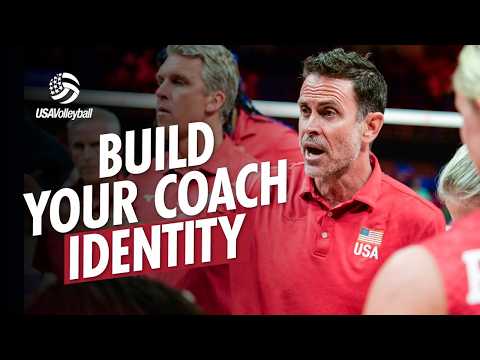
[0:00]Hi everyone. I'm Lauren Walker, the manager of athlete development here at USA Volleyball. And today I'm privileged to be joined by new head coach of the Women's National team, Eric Sullivan. And he's going to explain a little bit about his coaching journey, his coaching philosophy, and some reflective practices that he's incorporated to grow within his position.
[0:19]Thanks for joining us, Eric. Thanks for having me. So, first question, um, tell us a little bit about how you've ended up moving through your coaching career.
[0:29]You had a pretty illustrious playing career, so what led you into coaching? Yeah, um, actually while I was playing with the national team, I had the opportunity to be involved with some junior programming, so kind of my first four into coaching.
[0:43]Um, I found I really enjoyed that, and then the progression of that, getting into the NCAA space just kind of made sense.
[0:50]Um, I think it, one of the challenges of being a high-level athlete at some point in your life, you end up stop playing, you know, whether that's your decision or someone else's. And then trying to figure out what to do with the rest of your life, because there's still a lot of it left.
[1:04]Um, for me, the the coaching piece just made sense. So, I was pretty fortunate. Um, I actually was hired to be a coach at the University of Colorado before I was done playing.
[1:12]Um, they decided to wait for me, so I finished my career playing through Athens. Um, and actually coached my first college match the day after I got back.
[1:21]Um, and then it's I've been really fortunate and been able to work with great programs for the last gosh, 20 years now, so. Absolutely. As you've moved through your coaching career, what helped you establish your coaching philosophy and maybe how did it change over time?
[1:36]Yeah, it's for sure changed. Um, again, I I think I've been really lucky or fortunate to have the coaches that I have. I think a I would if I ever look back or reflect on my style, I would say it's kind of a a product of all the coaches I've had, the pieces that resonated with me.
[1:50]Um, it's probably just a little bit of all of that. Um, I've been lucky to play for Doug Beal, Al Gates, Mark Dunfey, Carl McGown.
[2:02]Um, the list is is pretty lengthy on the on the guys' side and I I feel like the way I think about the game, the way that I relate to our players is a product of all of their influences.
[2:14]Absolutely. So, as you think about how your philosophy has changed over time, as you moved into your coaching role at Texas, as you now move into your coaching role with the Women's National team,
[2:26]what is a really important part of your coaching philosophy that you want to come out with the women? Yeah, I think a big part of it is uh the relationship for our group.
[2:35]Um, how our coaches interact not only with each other, but with our athletes, how our athletes interact with themselves, kind of the culture of that piece.
[2:42]Um, I see us not as this hierarchy coaching structure with our athletes below us. I I think that about us is like, we're all part of this big group trying to do something that's pretty extraordinary and extremely hard.
[2:56]And so, um, I know journey gets used as this term, it's kind of cliché, um, but I really see it as that is like we're on this four-year journey where we get to experience and do all these things that are not only really challenging and hard, but also super unique and cool. So,
[3:10]um, that part of it is really important to me, developing those relationships, making sure that everyone in the group has some say and some some buy-in to what we're doing. It's not just, hey, I'm the head coach and you need to get behind me and in my decisions. I want feedback from everyone.
[3:25]Um, within our program. So, that part of it is really important to me. You know, I I think when you have that that buy-in and that feedback loop, then the group becomes one and you can go do some some pretty extraordinary things.
[3:39]Absolutely, I really love that idea of making sure everyone feels like they're part of that decision-making process. You're part of a group and that Now, that's an easy idea to voice.
[3:52]Tell me some practical ways that a coach could actually do that. Yeah, it is challenging because I know as a coach, and as a head coach, a lot of the decision making falls on your shoulders.
[4:02]Um, it's impossible to make everyone happy in the program. Um, I think one of the best ways to talk about it is the decisions that get made are what's best for the group.
[4:11]Doesn't always mean it's best for the individual. Doesn't always mean it's best for the head coach. But the the having the group's goals in mind and and thinking in that way is really important.
[4:22]I think voicing that to the group is really important, so that they're aware of of those situations as well, like, so when something does happen that maybe you don't feel great is for your individual best interest,
[4:30]you understand that that decision's being made in the interest of the group. Um, and then the the relationship piece, I think, has to extend beyond the gym.
[4:40]It can't just be, hey, I care about you because you can side out on the left for us. Um, you know, we're all people on this, we're all human beings. It's the part that I've come to enjoy more and more as I've been in coaching longer.
[4:52]Um, creating those relationships, having, making sure that there is some connectivity outside the gym. Um, it goes both ways. I know coaches that talk about it a lot and pull a lot of effort into it, but I think it it's really important that it gets conveyed to the athletes too.
[5:08]That that relationship needs to come back, that they need to put that effort into. Um, again, when you can have those foundations, I think, you know, those decisions get easier to make, the the hard conversations get easier to have.
[5:19]Um, and again, I I just think for the health of the group, um, it it's awesome. But it does take a lot of work.
[5:27]Uh, you know, it can't be something that there needs to be some organic feel to it, but you need to put some effort into it. So, this is a little bit of a a curveball question in there, but where have you failed with that in the past and how have you then gotten to the point where you are?
[5:43]Because that is a really powerful statement that you just said about the relationship, about the trust with athletes. But I think sometimes as young coaches, we think about, well, what are the missteps here and how do we recover from them to get to that point?
[5:56]Yeah, um, look, it's taken time to get to that for me. Um, you know, I think when I got into coaching, it was much more of that hierarchy of, hey, I'm the coach, you do what I tell you.
[6:06]You know, I'm going to try to instill what I want from you. Um, and then we'll move from there.
[6:14]Uh, I it the failures are plentiful. You know, learning that process, what it takes, um, getting comfortable with the hard conversations.
[6:23]I think that, you know, looking at myself, um, as well as the other coaches and seeing coaches maybe shy away from those conversations when they need to be had.
[6:36]Um, I always feel like those conversations they create some anxiety going into them. But coming out of them, there's a relief of that, right?
[6:44]Because, um, you know, for me, perception's reality, if I'm thinking one thing and trying to portray that message, it doesn't always get to receive the same way that I feel like I'm sending it.
[6:53]So, making sure that that connection's occurring, I think is really important. Um, and that only comes with having some some conflict resolution.
[7:00]You know, when things aren't maybe lining up the way we want, someone's not behaving the way that we want, are you willing to sit down and and really have a a real in-depth conversation of why maybe that behavior needs to change or what, you know, here's what I'm thinking,
[7:14]this is why we're doing what we're doing, making sure that those athletes and coaches are kind of on the same page. Absolutely. So, that lends really nicely into the next question that we wanted to ask you about, which is as a coach, as you've gone through your career,
[7:27]what have been some really key items to make you reflective, whether it's about coach athlete relationships, whether it's about what you're doing on the court?
[7:37]What are the key things that you've done to make you reflective to get better? Yeah, um, you know, I think just the periodization of of being a team sport.
[7:46]You know, obviously you get into a season. You go through that season. Season ends, whether it ends in a way that you wanted it to end or it ends in a way that it doesn't end the way you wanted it to, which is more often than than that, that is more often the case.
[8:05]Um, you know, only one team gets to walk away holding the holding the title and and typically all other 99% are somewhat upset about how the season ended.
[8:14]Um, having those moments where things kind of quiet down a little bit and looking back and trying to understand of maybe when you didn't achieve what you wanted to achieve,
[8:26]you know, where did you miss on some of that stuff? Um, I think identifying, you know, where the the lack of connectivity was with some of your players.
[8:35]Um, again, if there was some behavior that that you didn't feel was in the best interest of the group, how did you get to that? Where could you have maybe cut that off a little bit earlier?
[8:44]Um, and having, you know, a hard conversation with somebody. Um, I I think just taking, um, note of kind of how the season progresses and having that moment.
[8:52]The other thing that you need to be careful of is not just burning the whole house down. It's really easy to to lose, and I've lost plenty in my coaching career, and to get back in the office the next day and think like, all right, we have to change everything.
[9:03]Um, trusting the the process, like we talked to our players all the time about that of, there's a process in this and the day-to-day processes probably more important than the overall goal.
[9:14]Um, understanding that as a coach as well, like, hey, I'm doing a lot of things right, understanding where you might be a little bit better is important, but not thinking like, I just need to scrap everything I'm doing because we didn't win it.
[9:26]What's been key to stop that tendency in you? Is that assistant coaches? Is that your athlete? Is that something you put in your office just to remember, hey, Eric, slow down? Yeah, I think it's a great question.
[9:35]Uh, some of it's just self-reflection. I've I've had those moments of like, man, we need to change everything and then like, okay, I know the world's not broken here. Here's what we really need to look at.
[9:47]And then some of it's the group. I think you need to surround your people yourself with people that are willing to challenge the way that you're thinking, the way they're willing to look at the overall picture and be willing to challenge, you know, everything that you're doing, and being very open to that feedback.
[10:02]Again, I know there's a lot of people that that have a hard time hearing that, and that as a human being can be hard to hear sometimes, but I think it's a super important piece for the growth of the group, for everyone.
[10:13]Um, again, kind of having those hard conversations. Maybe not how you want things to be portrayed to you, but it's important that you receive that stuff and take note of it.
[10:21]Absolutely. I think it requires a lot of humility to be able to sit there, to think about it, um, to take what you need to take, to leave what you need to leave.
[10:30]Um, as you've progressed through your career, how have you gotten to a place where you feel really comfortable with that? Yeah, to be honest with you, I don't know that I would say I feel really comfortable with it.
[10:41]Um, I for sure feel more comfortable with it. I think the the bigger thing to understand too, and I tell our players this all the time, I'm a human being just like they are. They're going to make mistakes.
[10:49]right? As a coach, you know that your players are going to make mistakes, both on and off the court. As a coach, I'm no different than that.
[10:56]And I think being comfortable with that, letting your athletes know that, I think goes a long way. Um, I always kind of like it to this, as you grow up, you kind of start to realize that your parents are people too, right?
[11:08]And they have their issues just like everyone else. I feel like it's the same way as you progress through your career as a player, understanding that your coach also has their issues every day too.
[11:19]Like we're not all perfect. Yeah. Kind of another question on this idea of reflective practice, you cited earlier the number of amazing coaches that you played for.
[11:29]So, as you think about back when you're playing experience, what did you see those coaches do to build in reflectivity that you either took with you or just were notable for you as an athlete?
[11:39]Yeah, it's a that's an interesting question. I again, I don't think I'm a a product of one or two coaches. I feel like I'm a product of the 30 coaches I've had.
[11:48]Um, I see sometimes in some junior programs where you'll have one coach that just kind of follows an athlete through their career.
[11:55]I'm not a big fan of that. I think it's important to again to get perspectives. Sometimes some coaches get to say something and another coach may say the exact same thing but in a different way, and it just resonates with you a little bit better.
[12:05]Um, I think that part of it is pretty important. Um, so I feel like I've I'm a product of all of that.
[12:13]And so, um, you know, it's hard to maybe pinpoint one thing or another. But I feel like I've as I've kind of grown as a coach, kind of look back and said, hey, I really enjoyed the way that this coach approached that thing.
[12:26]Um, I know the coaches that I had were very reflective and kind of that post-season, hey, why were we successful in this? What are we good at?
[12:34]What were we not so good at? Where do we need to kind of shift? Um, the way that we're training, what systems do we need to implement or tighten up?
[12:41]Um, how do we stop, you know, how do we, you know, getting into bigger picture things.
[12:46]We know these teams are doing these things. How do we implement that into how we play and the style of the game that we're playing and, I don't know, create some advantages for us.
[12:57]Um, so I I just think finding those opportunities, you know, whether it's coming and being involved in our program, coming to the open program and seeing how we're training in the gym and what we're talking about.
[13:07]Maybe going out and watching the men play, um, either collegiately or internationally, even though you're a women's coach, going watching other countries play.
[13:17]Most most countries have a different style of play and maybe even more specifically, the continents, right? The Asian teams tend to play a certain way versus the South American and the European teams.
[13:26]Um, watching professional teams play. I there's so much opportunity, a little different than when I played. Um, wasn't so easy to watch.
[13:35]You know, you had to get a a VHS tape of someone from somewhere. Um, so I I just think being as engaged as you can be in those those things, I think's really important.
[13:44]Awesome. Any other thoughts about your coaching journey or recommendations for self-reflection you'd leave our coaches with? I again, the the term journey, I I don't want to get super cliché and all that, but just be where your feet are and enjoy it.
[13:55]Um, again, there you get into these moments where you're looking ahead or I want to I get a lot of coaches that ask me like, hey, how did you, how did you kind of shape your journey?
[14:06]And to be honest with you, I kind of just went with where it took me. Um, again, I've been really fortunate in my career and that I had some unbelievable opportunities, but I didn't shy away from those things.
[14:19]Um, it wasn't by design by any means. There were some things that I thought about, um, you know, a lot of people asked me why I was at Texas so long and part of that was I wanted to give my family a place to grow up.
[14:29]Right? My kids would tell you they're from Texas and that was important to me. Um, I for sure had some opportunities to maybe go take another job somewhere and and do some of that.
[14:38]But that was a big piece for me. So, when I say I didn't shape my journey, I shaped it in that way a little bit, but the other part was as things came up and it was the right thing at the right time, I jump in with both feet. So,
[14:50]um, be where your feet are, be excited about it. You know, don't let the anxiety or the the fear of of failure kind of take over.
[15:00]Just own what you're doing and and go after it. I love it. Well, thank you so much for joining us today, Eric. Yeah. Welcome. Thanks for having me.


