[0:20]Good morning, ladies and gentlemen. This course has been designed for the students of post-graduation and also for those students who come to the final year of their F Y U P program. Either B.A. Honours or either graduation honours, B.A., B.S.C. Honours or B.Com. Honours or the B.A. research, graduation research, the B.S.C. research or B.Com. research. So those all who are in the final year of F Y U P, they have also to learn the course of research and methodology and also in the post-graduate courses. So for them this course has been designed. You have to attend the 60 lectures and today we begin with the first lecture of the series. The first lecture is meaning of research, characteristics of scientific research, etc., which will be the topic of the week, but the today's lecture, lecture one is science and common sense. Casually speak what we want to speak. We casually give our give statements what we want to state, casually we deliver the statements which we want to deliver. Which are based on normally the common sense, observations, experiences, and maxims in the social life. Observations, experiences and maxims in social life, may be sometimes based on the wisdom also. But it may not be based on the wisdom, because we have been listening, we have been sharing these statements, these observations for a long time. And this is why we take it granted to transfer it to to to the other person, to the audiences without any check, without any without any check or without any audit.
[3:09]So, but maybe these are based on wisdom sometime. But mostly, these are based on ignorance, prejudices, and wrong interpretations. These are these have come out of ignorance historically. These have come out of prejudices for many many years.
[3:44]These wrong interpretations has been has come for very long time back.
[3:57]So many times, what we find that these common knowledge are contradictory. They contradict each other. They are inconsistent also. They are not consistent. So, we have to, we have to check it, we have to audit it. On the other hand, the scientific observations, they are made on verifiable evidence. It requires systematic body of proof which can be cited, which can be produced anytime.
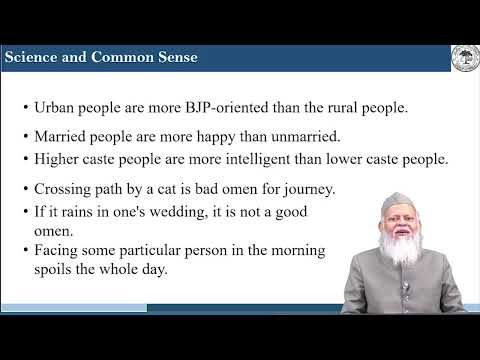
[4:50]So if we have a statement which we claim to be scientific, then other than the common sense in common sense, we don't require the verifiable evidence. In common sense, we don't require any proof, we do not require any empirical data to support, we quote it, we consider it, we produce it for others, we transfer it just because we have been, it has come to us the same way. But a scientific knowledge, a scientific knowledge is based on verifiable evidence, a systematic body of proof which has to be produced whenever it is demanded. So, when we, for example, you will find that people claiming that man is more intelligent than women. Many times, you will say that. Or people say that people from rural area are more hardworking than people from the urban area. We frequently listen than people from the rural areas, they are very laborious, they are very hardworking, because day and night they they do not see day or night when they have to go for work in the field.
[6:56]Whereas the perception is that those in urban areas, they are very comfortable, they are very comfort seeking persons.
[7:14]And that they are not very laborious as compared to the to the to the rural people. We have to check that. Again, there is claim that rural people are more Congress oriented than the urban people, implying that those who inhabit in the rural areas, they are more oriented towards Congress, than their urban counterparts.
[7:55]These are some of the some of the claims. Or the B J urban people are more B J P oriented than the rural people. So we that is something which goes in the society. Another example, married people are more happy than unmarried people. Many times, we will find that the claim is made that many people, married people are more more happier than the unmarried people. We have to see to it, is it a reality? Also, many times it is claimed that higher caste people are more intelligent than lower caste people. That is also to be checked, that is also to be audited, that is also to be verified. Many times we will find that people go out of the house and if there is a cat crossing their path, they will return back to the home taking it as bad ominous and bad sign for their travel, they will go back, sit in the house and then they will again proceed to the to the to the their journey.
[9:53]So, that is the things which is happening and which is taken in society.
[10:03]If somebody is has his wedding or her wedding and the rain comes, then in our society, people will people will say that it is not a good omen, it is not a good sign.
[10:33]Or some particular person if he has he is seen in the morning, it will spoil your all the day, the whole day, that is also something which is claimed in the society.
[10:59]We have to check it.
[11:04]So, what would scientific inquiry or scientific research conclude or it would observe?
[11:32]The scientific knowledge, unlike the common knowledge, woman is as intelligent as man.
[11:45]Both have same kind of aptitude, their intelligence. It is not the man or woman which is more intelligent. It is the opportunities, it is the training, it is the kind of conditions that make man or woman more intelligent, that is the scientific knowledge.
[12:31]There may be no relation between hard work and the rural area or the rural background. It has to be checked, it has to be studied, it has to be empirically verified whether it is reality or not.
[13:00]Maybe people from the urban background, they are more intelligent, sorry, they are more laborious. So, it has to be empirically, scientifically checked, verified through scientific methods, whether it is it is reality or not, it is verified through scientific method.
[14:21]Then, rural people can also be more BJP oriented, and urban people can also be more Congress oriented. There has to be data, what is data? Data is the fact on the ground. It has to be collected and then only through scientific methods, it has to be verified. Then only we can seal this statement as scientific knowledge, otherwise it remains a common common sense knowledge for just passing from one to another as we do. But it would never be considered as a scientific knowledge. We take the example of the Bengal famine which took place in the late 40s.
[15:32]Millions of the Indians in Bengal, they perished.
[15:41]And the common knowledge and the common statement was that they perished because food commodities were not available for the people. And it was taken granted that lack of the food availability, lack of availability of food commodities, that resulted in the in the in the this large famine which occurred in the in the Bengal those days, which is very famous that Bengal famine. However, the Bengal famine when research was done, the commodities were available.
[16:53]It was not that food committee commodities were not available, they were available, but they were available at very high prices, which cannot be which was not to be afforded by the common masses. Meaning that the purchasing power of the people had collapsed, simply collapsed. Why? Because there was no employment, there was famine. Who gives employments to whom, and it happened that people did not have even a penny to purchase salt or something. So, it was found that though prices were very high, but commodities, food commodities were available. And those who afforded it, they used to purchase it, consume it and survive. But it were those who did not have purchasing power.
[18:31]Unavailability of the purchasing power with the general public with the general people that collapsed, their purchasing power, and that turned into the punishment of human life, millions of human life, which happened in the Bengal famine.
[19:30]We have to differentiate between the two, the common sense knowledge and the scientific knowledge.
[19:44]Common sense knowledge tackles only superficially, whereas scientific knowledge goes into depth of the phenomenon, deep into the phenomenon to find the realities of a phenomenon which happens. We are going to discuss the how do we distinguish between the two kind of knowledges is the conceptual schemes.
[20:41]What are the concept, what is conceptual schemes? These conceptual schemes are rigorously used in scientific inquiry, in scientific in in in the journey to scientific knowledge.
[21:07]The scientists systematically builds his conceptual, theoretical structures and tests it, he checks checks it for the consistency.
[21:31]So in science, the conceptual framework, the theoretical framework, and its consistency are of utmost important. Whereas these are not of so importance to the common sense knowledge.
[21:57]They can use it in some loose way, but not the way as rigorously used by the scientists.
[22:14]So, for example, there is a person who is very corrupt.
[22:24]His son dies, everybody would blame his corruption, his father's corruption rather, to the death of the son. That is common sense.
[22:56]That father has done corruption and his son has died.
[23:03]So, do we think scientist would accept this? No, they will never. They would never, they would go for a postmortem and then certainly find the real causes of his death. Maybe it is heart attack, maybe some other thing which he was some other diseases which he was suffering from long, and he did not know and the family did not know. It is only a postmortem which will reveal which was the cause of death of the son of a corrupt person.
[24:29]That is the difference between the between the that is the difference between the scientific and the and the common sense knowledge. A somebody is ill, we will simply attribute it to his luck.
[24:54]We have to check it scientifically, what is happening. We should not leave it to the luck. We have to go to the doctor, who would who would be sending the patient to various kind of tests and after studying all the kind of those tests, the the doctor would decide what is the real cause of the disease suffered by the person. The science would explain explain in medical terms.
[25:38]Many times we blame ghosts for many psychological and medical problems in common sense knowledge in our society. Science would never accept this, they would go for a medical checkup, because there are many diseases in which these symptoms come that the patient behaves behaves abnormally. That has to be that has to be checked medically, that is the scientific knowledge. So, the science would search all this in medical facts, not in the here say, not in what the common people are saying.
[26:42]Not that, so, for any disease or for anything, there are many there are in in our society, they blame many factors, but do we accept them? The scientists accept them? No. We have to go for a medical checkup, that is what is scientific knowledge.
[27:06]Then comes the second criteria or second distinguishing factor between the science and common sense, that is the empirical tests.
[27:24]The scientist sets up tests, sets up hypothesis, test the hypothesis, and with the help of the theories, they arrive at a conclusion.
[28:29]It takes lot of time and effort and and money and human power, human resource to to to study any phenomenon scientifically. Whereas a common person, a general person in the street, he would within a second give his judgment of the phenomenon. Why this phenomenon happening? Scientific does not science does not science test or those with the scientific knowledge, they cannot do this. They have to first gather the empirical data, then they have to set up the hypothesis, they have to test it, and with the help of various theories, they they make the conclusion. It takes lot of time and effort and money and human power, human resource to to to study any phenomenon scientifically. Whereas a common person, a general person in the street, he would immediately within a second would deliver his judgment on the phenomenon, that is not the scientific way.
[39:34]So, we are going to discuss the other examples.
[44:25]Thank you very much.


