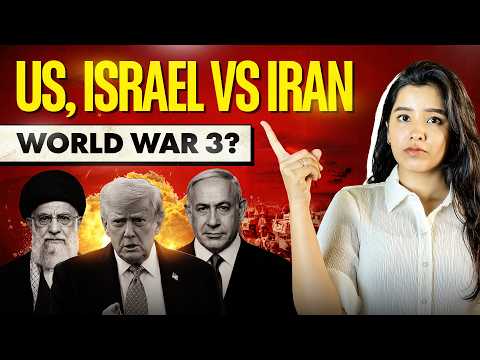
[0:00]Iran, Israel or USA war, and the whole world is watching. We are going to destroy their missiles. It seems to have fallen on their ears. At today's time, we have the most powerful organizations in history. But none of them are able to stop this war. So if these organizations can't stop a war, then why do they even exist? Or when powerful countries like the US and Israel get involved in a war, then rules and sanctions might be optional. Hey everybody, I am Priya. And in today's video, we are going to discuss some important questions. First of all, why is there a war between Iran and Israel? Was the situation between them always like this? How did the US get involved in this war? How did a war between two countries become a global crisis for the whole world? And what should you know about the Strait of Hormuz? We are going to discuss all these things in today's video. Let's start it. Now, the first question that arises is, were the relations between Iran and Israel always like this? And how did this situation reach war? So, until 1979, the relations between Iran and Israel were relatively normal. How? Because from 1941 to 1979, for almost 38 years, Iran was under the rule of Mohammad Reza Pahlavi. His regime was famous for Iran's White Revolution, in which he did many good things for Iran. Just like after India got independence, we abolished the zamindari system and brought land reforms to redistribute land. Similarly, they also brought land reforms in Iran, many good social reforms, such as women's right to vote, hold office, increasing the minimum marriageable age, reducing illiteracy, expanding healthcare, modernizing the economy, developing infrastructure, increasing oil wealth. Iran was becoming a fast-growing economy and a strong ally of the US. But many people also had problems, mainly three problems. First, there was a lot of corruption. Second, the gap between rich and poor was increasing, there was inequality, and third, political freedom was absolutely zero. So people were saying that development is definitely happening, but identity and political freedom are being lost, due to which mass protests started around 1978-79. Students, workers, religious leaders all gathered, and they all had one demand: remove the Shah. These mass protests turned into a revolution, which was named the Iranian Revolution, and its face was Khomeini. In January 1979, the Shah fled Iran, and Khomeini became the first Supreme Leader of Iran. This Iranian Revolution completely reset Iran's system. At this time, Iran changed from a monarchy to an Islamic Republic. So, after the Iranian Revolution, Iran's open rivalry with the US and Israel began. Listen to some stories, for example, Iran calls the US the Great Satan and says things like "Death to America." Iran even refuses to recognize Israel as an independent nation; an ideological rivalry begins. At this point, the leaders of Iran openly oppose Israel. At the same time, Israel also calls Iran the biggest security threat in the Middle East. Now, if we talk about the present day, how did this situation turn into a full-scale war? So, there are two very important reasons for this. First, if we talk about the Iran-Israel angle, Iran has always been supporting anti-Israeli groups, which we call proxy groups. Like Hamas in Gaza, Hezbollah in Lebanon, and Houthis in Yemen. These groups have been attacking Israel for the past 40 years. So, Israel considers Iran as the main supporter and backer of these militant groups and says that until Iran is weakened, Iran will continue to support these militant groups. And therefore, Israel is attacking Iran. Now, we come to a very important question: how did the US become a part of this war between Iran and Israel?
[4:08]For this whole war, there is one important international treaty, we will understand it, and then we will come back and discuss how the US became a part of this war. So, for this whole war, the important international treaty is the Non-Proliferation Treaty. Now, it may sound technical, but with one simple question, you can easily understand it. The question is, who decides who gets nuclear weapons? And who decides who doesn't get nuclear weapons? Because if we talk about 1974 or 1998, and if the US had its way, India would not have become a nuclear state till today. This is decided by the Non-Proliferation Treaty, which is an international treaty, made after the Cold War, whose simple objective is to stop the spread of nuclear weapons. There are three parts to its objective: first is Non-Proliferation, meaning whatever new countries there will be, what does this new country mean? We will understand it in a while. Whatever new countries there will be, they will not make nuclear weapons. Disarmament, meaning at the time of signing this treaty, whatever states had nuclear weapons, they will gradually reduce their usage. And peaceful use, meaning nuclear power can be used for better purposes, for energy, for electricity, for medical use, for these things. So these are the three main objectives, the main purpose is to stop the spread of nuclear weapons. 191 countries have signed this treaty, but please note that India, Pakistan, Israel, and South Sudan have never signed this treaty. North Korea initially signed this treaty, but in 2003, North Korea also withdrew. Now, the major criticism of this treaty comes from its exception clause. This treaty decides the cut-off date of 1967 and says that countries that had tested nuclear weapons before 1967, this treaty will accept and recognize them as nuclear states. For example, this treaty recognizes only these five countries as nuclear weapon states. Whereas after this, India, Pakistan, all of them have recognized that we have nuclear weapons, but this treaty does not officially recognize them. Now, Iran has also signed the NPT. This means Iran cannot develop nuclear weapons. But it can use nuclear energy for civilian purposes. Now, many people were speculating that Iran is storing uranium much more than the permissible limit, which indicates nuclear weapon development.
[6:28]Now, let's understand further. Now you are clear about what NPT is. So, let's come back to our discussion, how did the US get involved in this war between Iran and Israel? So, the US, which cares about the whole world, its foreign policy is very clear. The US's stance is very clear that it does not want anyone in the world, especially in the Middle East, to develop nuclear weapons. Why? Oh, world peace, baba. So, in 2025, when all negotiations between the US and Iran fail that Iran should not develop nuclear weapons, at the same time, Israel also gets convinced that Iran is very close to developing its nuclear weapons. And at the same time, Israel, with the support of the US, attacks Iran's nuclear facilities and military sites. And thus, the US becomes a part of the Iran-Israel war. Look, for the US, becoming a part of any war is very easy. Because, according to me, your diplomacy should be governed by how intelligent your heads are, how important they are, not by how you solve problems that have already arisen, or how you eliminate enemies. It should be governed by how you prevented problems from arising in the first place, according to me. So, thus the US became a part of this war. Two more things you should know. Look, the US wanted to weaken Iran's leadership so that it could not threaten Israel or the Gulf region. Second, analysts believe that just before the attack, Iran was already facing an economic crisis and massive protests, such as currency crash, inflation, and political instability. Analysts believe that the US and Israel saw this situation as a strategic opportunity. The major escalation happened when Israeli missiles and US bombers struck a secret meeting in Tehran, where several senior Iranian leaders and Ayatollah Ali Khamenei were killed. Now, here's a confusion that I had, and you might also have, so I want to clear it. Look, in all the religions in the world, their religious leaders are given some title. Similarly, the religious leaders of Shia Muslims are given the title of Ayatollah. So, Ayatollah is not a name, it's a religious title. Now, in the US, Iran, Israel war, we are going to talk about two Ayatollahs. First is Ayatollah Ruhollah Khomeini, who was the face of the Iranian Revolution, who was the first Supreme Leader of Iran, who established Iran as an Islamic Republic. He was succeeded by Ayatollah Ali Khamenei, who became the second Supreme Leader of Iran. From 1989 to 2026, all things of Iran, like foreign policy, nuclear programs, domestic affairs, all of these had him as the ultimate, absolute decision-maker. Ayatollah Ali Khamenei strictly supported anti-Israel policy and anti-Western foreign policy. He died in Operation Epic Fury. Now, the next question is, how did this war between three countries become a global crisis? And the answer to this is the Strait of Hormuz, which plays a very important role. Let's understand. So, this 50-kilometer wide sea route is one of the most important shipping routes in the world, which connects the Persian Gulf to the Gulf of Oman. Every day, 20 million barrels of oil are supplied to the whole world through this route. And specifically for India, this trade route is very critical, because almost 40% of India's crude oil import comes through this Strait of Hormuz. If Iran blocks it, there will be many problems, but Iran has not blocked everyone. All those countries that are still friends with Iran are all allowed, such as India is allowed, China is allowed. Whereas the US, Israel, and Europe are blocked. See, in this war, Iran is on the losing side. But still, as of now, through these two strategic moves, Iran is deciding who will get power in the world and who will not. So, let's discuss these two powerful moves. The first is blocking the Strait of Hormuz. So, we have already discussed that if the Strait of Hormuz is blocked, which countries in the world will face problems. The second strategic move is to make three such ceasefire demands that have no chance of being fulfilled, almost impossible. Now you must be thinking, why make such demands that cannot be fulfilled and will be rejected? We will understand this in a while. First, let's understand these three demands and what their problems are. The first demand is recognizing Iran's legitimate rights. Meaning, Iran's form of government, its nuclear program, the idea of uranium enrichment, all these things should be accepted. What will be the problem in this? The US will not agree at all. The US's stance is completely opposite and very clear that all things that already exist should also be dismantled. The second demand is payment of reparations. Meaning, whatever damage Iran has suffered in the war, loss of life, damage to the city's infrastructure, for all these things, pay reparations, pay money, pay damages. What will be the problem in this? Generally, in war, the country that loses pays damages, so the US and Israel will not agree to this. The third demand is a firm international guarantee against future aggressions. Meaning, give a guarantee that there will be no attack in the future, and this has also been signed before. In 2015, a nuclear deal called the Joint Comprehensive Plan of Action was signed between Iran and the US, UK, France, Germany, Russia, and the EU. In this, it was decided that Iran would control its nuclear program, and in return, all these countries would not attack Iran. What was the problem in this? In 2018, the US withdrew from this program, and the US will not sign this program again. Now, let's discuss the question of why Iran is making such demands that cannot be fulfilled and will be rejected. The answer to this is very simple: rejection is the strategy. When someone's demands are rejected, a narrative is built that, "Look, we wanted peace... they refused." In such a situation, you get domestic support and global sympathy. Diplomacy is business. So, friends, this was today's video, in which we covered all these important things. I hope that in today's video, you have definitely learned something new in a very easy way. Our International Law has a full-fledged course, all the details of which you will find in the description box below. Be sure to check out this course, you will like it very much. If you have any doubts related to this video or any suggestions for me, do let us know in the comment section and we will write back to you. That's it for now. See you in the next class. Bye bye.


