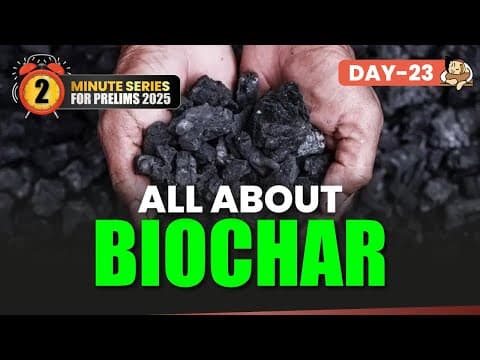
[0:00]Prelims ko bache hain sirf 88 days. And environment is an important subject. 1/4 to 1/5 paper environment mein se aata hai. Toh agar aapko lagta hai aap is subject mein lagging hai ya aapne isko itna importance nahi diya hai jitna required hai. So don't waste any more time, either prepare it on your own or join this environment only crash course. Now coming to biochar. Ab jab hum biochar ki baat karte hain na, it is bio plus charcoal. Ab jaise charcoal banta hai wood se, wood ko agar hum high temperature par heat karte hain incomplete combustion ki wajah se it chars and it forms charcoal. Biochar mein bhi hum heat wood ko ya biomass ya high carbon organic matter ko karte hain. Lekin it is heated in a controlled environment in the absence of oxygen and then we get biochar. It is purely carbon, lightweight hota hai. Aur banta kaise hai agar process ki baat kare to pyrolysis se. Ab dekhiye pyro matlab heat, lysis matlab tootna. Jab aap organic matter ya biomass ko high temperature par heat karte hain toh uska lysis ho jata hai in the absence of oxygen. In the presence of oxygen agar hum use heat kar rahe hain toh combustion hoga. In the absence of oxygen agar hum biomass ko heat kar rahe hain toh pyrolysis hoga. Pyrolysis mein hamare paas solid form mein biochar banta hai, liquid form mein bio oil banta hai aur gaseous form mein syngas. Syngas jisko synthesis gas bhi kaha jata hai. Syngas is CO + H2. Ab aap bologe ki oxygen ki to absence thi. Lekin organic material is also made up of CHO, toh uska oxygen se ye syngas ban jata hai. Right, so that is important. Toh pyrolysis is resulting in the formation of besides other products, biochar. Ab biochar na bahut uses hain biochar ke. And it is because iski properties unique hai. For instance, it is a very stable product, ye decompose nahi hota hai. Ab properties jo hai more or less same same rehti hai lekin konsa aapne feedstock use kiya, matlab konsa biomass use kiya, for instance wood use kiya ya corn use kiya ya kisi aur form mein humne biomass use kiya aur kis technology se isko banaya, kitne temperature par heat kiya, uske upar dependent hota hai specific properties. Lekin broader properties same rehti hai jaise ki ye stable hai and it can persist in soil for years or decades. Also honeycomb structure hota hai. Ab ye jo honeycomb structure hai na, isme beneficial bacteria grow karte hain aur iske uses ko enhance karte hain. Jaise ki iska jo sabse important use hai na, woh hai soil ki properties ko improve karna. Right, jaise na iske honeycomb jo structure hai usme rehte hain beneficial bacteria jo plants ko photosynthesis behtar karne mein photosynthesis enhance karne mein help karte hain. So plants are able to do more photosynthesis and capture more carbon dioxide from the atmosphere. Then, it also improves the biological nitrogen fixation by helping nitrogen-fixing bacteria survive and grow. Toh nitrogen fixation ko bhi enhance karta hai agar hum soil mein biochar dal dete hain. Fir biochar ka na porous nature hai, toh uski wajah se kya hota hai water retention bad jati hai toh aapki jo irrigation requirements hai soil ki woh kam ho jati hain. Fir ye soil acidity ko bhi reduce karta hai.
[3:59]Toh jo plants hain, right, agar woh acidic soil mein nahi grow kar sakte aap biochar dal do acidity kam ho jayegi, they'll grow. Then aisa bhi study mein pata chala ki agar hum DDT infested soil mein biochar dal dete hain toh jise infertile declare kar diya gaya tha uski fertility badhni shuru ho jati hai. Toh soil amendment ek important use hai, dusra important use hai iska in carbon sequestration. Ab dekhiye na bahut stable product hai. Ye decompose nahi hota like any organic material. Isko kaha jata hai refractory stability of biochar. Ye decompose nahi hota. Toh ye soil mein na bahut saalon tak rehta hai. Isi wajah se na it is being explored as a carbon sink. Right. And it is an important method of carbon dioxide removal or climate engineering. Ab biochar banane mein carbon dioxide release hoga but utna hi hai. Uske baad jo reh gaya, jo biochar mein jo carbon reh gaya woh saalon tak persist karega kyunki bahut stable product hai ye. Dusra wetlands mein methane produce hoti hai. Toh ye un us methane ko bhi kam karta hai kyunki ye biochar methanotrophs ko badhata hai. Methanotrophs kya hote hain? Which actually oxidize methane. Woh bacteria jo methane ko oxidize karte hain aur methane ke level ko kam karte hain unko bhi ye badhata hai. Toh ye uses hain biochar ke jo across hume dikhte hain in various articles in the down to earth and I have compiled all of them for you. Mujhe comments mein zaroor bataiyega ye video aapko kaisa laga. And like I said environment ka crash course aap join kar sakte hain lekin agar aap pura sab subjects ko revise karna chahte hain toh aap hamara complete crash course bhi join kar sakte hain and we also have our test series. Right? So that was all from my end. Thank you so much, have a nice day.


