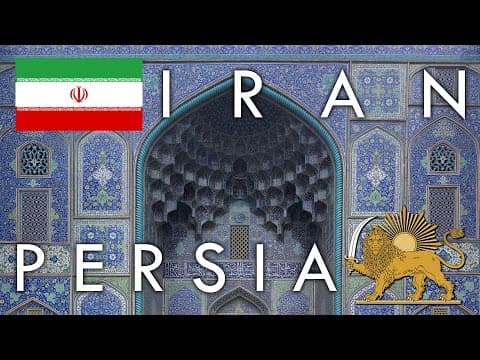
[1:43]In the heart of the continents, lies a land of mountains and deserts. A history as old and rich as any. It has endured the battering of invasions and competing influences over millennia to survive until the present day. This is the country that spawned the world's first great empire, and which later became a hotbed of artistic and scientific genius. It's a country now wrestling with controversy and revolutionary change. No matter what your opinion of it might be, it's one that cannot be ignored. This is the country of two names. This is Persia, this is Iran.
[2:50]Iran is a medium-sized country in Southwestern Asia, and is mainly home to the people of the same name, the Iranians. But both the country and its people have another name, that of Persia and the Persians. And these two names can be used interchangeably. The word Iran means Land of the Aryans in Farsi, the Persian language, while Persia is a Latin word derived from the ancient Greek Persis, and ultimately from the ancient Persian word Parsa, meaning Land of the Persian people. Iran has been the official name of the country since the 1930s, and has been the name that natives of this country have called it since ancient times, while Persia has been the term used by the outside world throughout the rest of its long history. And what a history that is. Only a very small number of countries and cultures still surviving today can lay claim to such a long past, and this feat is all the more impressive when one considers Iran's position at the center of so many invasion routes, competing empires, and cultural pressures. Like all history, Iran's earliest beginnings are shrouded in the mystery before people wrote things down. But archaeological sites indicate that people have been living in the area of Iran since at least 10,000 BC, with the earliest known clay vessels and human figurines being produced here around this time. The city of Susa, later the Persian capital, was one of the oldest cities in the world and founded as early as 4,395 BC. From around 900 to 600 BC, the Western part of the area was dominated by the Assyrian Empire, but this came to an end when the Medes people of the Iranian plateau united and destroyed the Assyrian capital Nineveh. The Medes and Persian people then united under the King Cyrus the Great around 550 BC, which began the Persian Empire that many of us know from history. Known by historians as the Achaemenid Empire, it expanded over the next 200 years under famous kings such as Darius and Xerxes, to become the largest empire in the world to date at that time, and even today ranks as one of the greatest empires in history, believed to have had up to 40% of the world's population at that time. It stretched from today's Turkey and Egypt in the West to Afghanistan and Pakistan in the East. It was this empire that featured so much in the stories of the ancient Greeks, who they failed to defeat, and the release of the Israelites in Babylon as told in the Bible. This empire succeeded due to many innovations, later copied by the Romans and others, including division of the empire into provinces, standardized coinage, long-distance roads, a postal service, and religious and cultural tolerance. Their inability to defeat the Greeks would be their undoing though, when generations later, Alexander of Macedonia in Northern Greece, with the Greek city states finally united under his father, then invaded the Persian Empire, twenty times its size. Beginning in 336 BC, the armies of Alexander the Great moved to the Empire and in two epic battles, Issus and Gaugamela, defeated the Persians and took over the remainder of the Empire just a decade after they started. Iran would never unite such a wide area of the Middle East again. Alexander died soon after, however, and the Empire was divided among his generals. The central and Eastern portions were taken by the Greek general Seleucus, and became known as the Seleucid Empire, but within 60 years, the Seleucids were expelled from most of their territory by the Parthians, a group of people native to Northwestern Iran. The Parthian Empire lasted for five centuries, far longer than that of the more famous Achaemenid Empire, although its geographical extent was not as great. This was the Empire that was the nemesis of the Roman Empire, and over the centuries many battles were fought between them in what is Modern Day Iraq. It was their ability while on horseback to turn and fire arrows while retreating, that gave rise to the phrase a Parthian shot, a final insult that one issues as one leaves an argument, later corrupted to parting shot. The Parthians were defeated by a revolt of the subject Persians in the third century AD, and these Persian kings went on to rule for another four centuries in what became known as the Sassanid Empire. Rome continued to be their greatest foe, later replaced by the Eastern Roman Empire that became known as Byzantium. The conflict between Rome and Parthia, Byzantium and Sasania, when viewed as a whole, lasted 700 years, and is regarded as the longest conflict in history. Talk about a stalemate. Despite the endless war with Rome, the Sassanid Empire flourished culturally and artistically. As had been the case since Cyrus the Great in the 6th century BC, and likely much earlier, the religion of the Iranians had been Zoroastrianism. This religion centered around the concepts of good and evil, a supreme being, judgment after death, and free will, was one of the world's great religions comparable to Christianity, Buddhism, Hinduism and Confucianism in terms of numbers of followers. But in the year 633, all this, and the path of Iranian history forever, would change. Just a few years earlier, on the Arabian Peninsula, a new religion had appeared, founded by the Prophet Muhammad in Mecca. Islam, as it became known, then expanded quickly and the Arabian armies invaded Persia, defeating them in a key battle at Al-Qadisiyyah in modern day Iraq, and over the next 20 years taking over much of the former Empire, and incorporating it into the Islamic Empire or Caliphate as it was known. Conversion to Islam was gradual over the next few centuries, with the result that today only a handful of Zoroastrians survive. While a form of Arabic became the written language of Persia, other attempts by the invaders to culturally dominate their subject peoples failed, and instead Persian influence spread in reverse throughout the Islamic world, significantly contributing to the Islamic Golden Age of the 8th to 14th centuries. The Arabs ruled unchallenged for more than a century, but this power waned and local Persian advisers to their Arab rulers, known as viziers, ended up wielding true power. The Caliphate fractured in the 9th century, with the Persians reasserting themselves in several regional dynasties, but these soon were overthrown by the Seljuk Turks who took over most of the Middle East in the 10th century and ruling for another two centuries. All this changed again, however, in 1219 when the Mongol Empire, spreading its terror across most of Asia, reached the Middle East. The Mongols burned, pillaged and massacred most that lay in their path, and their invasion of Iran was a catastrophe for those in the region, bringing to an end the centuries of flourishing art and prosperity hitherto. Iran would be under the heel of the Mongols and their successors for the next three centuries. The most famous of these was Timur or Tamerlane, as brutal as any Mongol in his military campaigns, but also notable for including and promoting Iranian architecture and poetry. After centuries of domination, the Iranians once again gained control of their lands with the emergence of the native Safavid Empire in the early 1500s, ruling until the early 1700s. with their greatest king or Shah being Abbas the Great. Iran was able to hold its own as a great power at that time, resisting European colonization, as well as invasion from the rival Ottoman Turkish Empire. A second Golden Age in Iranian architecture and art occurred at this time. The capital moved to Isfahan where new buildings were constructed on a grand scale. The enormous city square is today UNESCO World Heritage site and regarded by many as the finest display of Islamic architecture in the world. Shia Islam, which had grown in Iran over the preceding centuries over Sunni Islam, became the official state religion at the beginning of this period. From the 1700s onwards, however, under the Qajar dynasty, Iranian power weakened. The capital moved again from Isfahan to Tehran in an attempt to be closer to the state's territories in the Caucuses that were under threat by a rising Russian Empire. This move failed to prevent much territory being lost in the north, however. Meanwhile, British influence extended from their territories in India in the south of the country. Although never occupied or invaded by Britain or Russia at this time, the country came under the influence of both of these foreign powers, as they disputed this region in what became known as the Great Game. Foreign interest in Iran intensified when the massive extent of oil and gas reserves became apparent at the beginning of the 20th century. A new dynasty under Reza Pahlavi was established after a coup in 1921, and this new Shah went on to attempt a rapid modernization of the country in the same way that happened in neighboring Turkey under Kemal Ataturk. But his rule was considered oppressive by many, and new enemies were created within the clergy as the Shah attempted to secularize the nation. Reza was overthrown following the Anglo-Soviet invasion of the country in the middle of World War II, a preemptive move to prevent the Germans from seizing it and its rich oil reserves. He was replaced by his son, Mohammad Reza, who became the Shah that most people know today, ruling for the next 40 years. Mohammad Reza initially had a hands-off approach to power, allowing Parliament to assert its authority. But when, in 1953, that Parliament voted in favor of nationalizing the oil industry, which would have removed it from the control of British companies, the intelligence services of the United States and Britain instigated a coup, using black propaganda against the then Prime Minister, Mohammad Mosaddegh, ousting him and in turn, reasserting the power of the Shah, who became effectively a dictator, ruling with American and British support, and allowing foreign oil interests in the country to continue. The Shah instituted further reforms and modernization, attempting to Westernize the country further. This alienated many of the conservative religious elements in the society, and in combination with a growing discontent at his autocratic, corrupt and often brutal rule, led to the dramatic events of 1979. What became known as the Iranian Revolution or Islamic Revolution, took place in February of that year. After a year of mass demonstrations and street fighting, the religious leader, Ayatollah Khomeini, returned to Iran from exile, and the Shah was deposed. The absolute monarchy of the Shah was replaced by an Islamic Republic, and relations with the United States and Britain collapsed, especially after the staff of the United States Embassy in Tehran was seized and held hostage for over a year. Over the next few years, as many as 2 million Iranians who identified with the more Westernized regime of the Shah emigrated, with many continuing to live today in the United States, Canada, Germany, Britain and India, as well as the neighboring Gulf States. Iran turned away from the West and asserted itself as its own power, centered around Shia Islamic principles, in what is today the world's only significant theocracy, a government ruled by a religious authority. Although there is a constitution that allows for an elected Parliament and President, all major decisions must be approved by the Supreme Leader, who was the Ayatollah Khomeini, and since his death in 1989, is now Ali Khamenei. Such a change was welcomed by many Iranians, but hated by those who wanted a more progressive, Western lifestyle. This tension continues today with demonstrations against the religious leadership, a regular feature of Iranian cities, as are their often violent suppression by the authorities. Iran is a unitary state in that the central government holds supreme authority, as opposed to federal systems of states such as in Germany or Australia. The country is divided into 31 provinces, each administered by an appointed governor. These provinces are further divided into 267 counties. The effect of the Iranian Revolution globally was significant. A major economic and political power had turned from being a supporter of the West into an active enemy, with terrorist and fundamentalist Islamic groups such as Hezbollah being allegedly supported and funded by the country. Its promise to destroy the nation of Israel and its quest for developing nuclear weapons have continued to poison relations with the West. Because of the global influence of its greatest enemy, however, the United States, Iran has become effectively a pariah nation, with economic sanctions stunting any economic growth. Yet the inability of that global superpower to bring Iran to heal, demonstrates the power that Iran has, and is actually the latest echo in its 2,500 year history as a nation. That it has weathered the storm of so many invasions and external influences to survive and maintain its own identity to this day, is surely one of the most remarkable stories in world history.


