[0:00]In today's video, we will learn about the fan coil unit and its BMS sequence of operation.
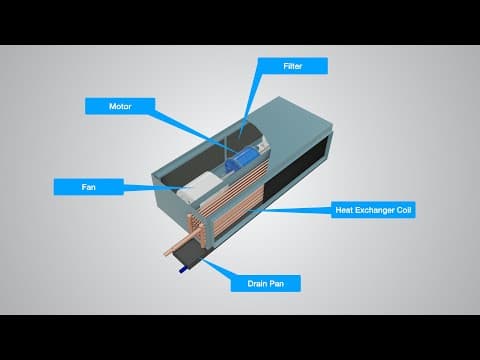
[0:10]Hello everyone, welcome to Engineering and Automation YouTube channel. Before going on to the video, if you like the contents of this channel, please consider subscribing to the channel and click the bell icon to enable notifications. Thank you. Fan coil unit is a simplified form of air handling unit with fan, heat exchanger coil and a filter. Unlike the air handling unit, which supplies, circulates and extracts air from the building spaces. The fan coil unit recirculates the internal air from the occupied space or room. In most cases, fresh air to the fan coil unit is supplied by a AHU. The fan coil unit then recirculates it inside the space. The basic components of fan coil units are heat exchanger coil, motor, fan, filter, drain pan. and electric heater if heating is required. In most of the fan coil units, the fan or blower is mounted before the heat exchanger coil. This type of fan coil unit is referred to blow through type, where the fan is connected straightly to the heat exchanger coil. Before the fan, is an air filter, which filters the air before entering to the heat exchanger coil. The heat exchanger coil can either used chilled water from building cooling plant or refrigerant gas from the DX unit. The fan coil units can be referred either of the following two types, based on the heat exchanger coil arrangement. First one is a two pipe system where one is supply pipe and other one is return pipe, which can be used for either cooling or heating application. Next one is the four pipe system where two pipes are for chilled water supply and return, and two pipes are for hot water supply and return, which can be used for both cooling and heating applications without affecting each other. A control wall is placed on the return line of the chilled water line to control the temperature of the space based on the design set point. The fan motor is typically a permanent split capacitor PSC motor. To use a single phase power supply, a PSC motor is equipped with two separate windings, main winding and auxiliary winding. With the main winding connected directly to the power supply and the auxiliary winding is connected to the main winding via a capacitor. When the power supply is turned on, the current flows first in the main winding and then with a short delay due to the capacitor into the auxiliary winding. This difference in the main and auxiliary winding currents takes the form of a phase difference. causing the peak magnetic field to alternate between the two windings and thereby generating a torque that starts the motor rotation. Typically, the fan coil motor is operated in three speeds, high, medium and low. The three speed operation of the motor is achieved by having three speed tappings on the auxiliary winding as shown here. The tapping allows to vary the voltage applied to the main and the auxiliary windings. At high speed operation, full voltage is applied to energize both the main and the auxiliary windings, resulting in high speed rotation of the motor. At medium speed, the auxiliary winding is tapped at intermediate point. So as to reduce the voltage impressed to the main and auxiliary windings which will result in lower motor rotations. Likewise, for low speed operation, the auxiliary winding is tapped at the lowest point, so as to reduce the voltage utilized by the main and auxiliary windings. Now, we can discuss about the BMS sequence of operation for the fan coil unit. In this example, a room is being served by the FCU, which is installed above the false ceiling with two discharge grills and three return grills on the ceiling. Fresh air supply and exhaust to the room is provided by an AHU. The main objective of this fan coil unit is to maintain the space temperature. To achieve this, a FCU controller is provided for each fan coil unit along with the space thermostat, which measures and feedbacks the space temperature constantly to the FCU controller. The FCU controller reads the space temperature and modulates the control valve via a PID controller. The PID controller output will decide how much the control valve to be opened or closed in order to achieve the desired space temperature set point. If the space temperature is more than the set point, then the control valve will be fully opened, and when the space temperature is less than the set point, then the control valve will be fully closed based on PID output. The optimum fan speed control of FCU can be achieved with the following configuration. When the temperature difference between the space temperature and the set point is more than 2 degree Celsius, the fan can be set to run at high speed. When the temperature difference is between 1 to 2 degree Celsius, then the fan shall run at medium speed, and when the temperature difference is between 0 to 1 degree Celsius then set point, then the fan coil unit shall run at low speed and continue to run at low speed even after achieving the set point. Also, the fan can be switched off when the space temperature is below the set point for a period of 15 minutes to save energy. Further, with additional features of BMS, like the time scheduler, the FCU can be turned on or off as per the building occupancy requirements. This may not be the correct sequence for the fan coil unit, however, this sequence provides better performance based on my experience. If you want to know more about the chilled water cooling principle and the PID controller, I recommend you to watch my AHU cooling principle and PID controller videos. That's all for today's video. I hope you guys have learned something useful from this. And thanks a lot for watching this video. Once again, if you guys liked the contents of this channel, please consider subscribing to our channel and click the bell icon to enable notifications. As always, please leave your feedback and suggestions in the comment section. Also, like this video, share this video with your friends and subscribe to our YouTube channel. Thank you.


