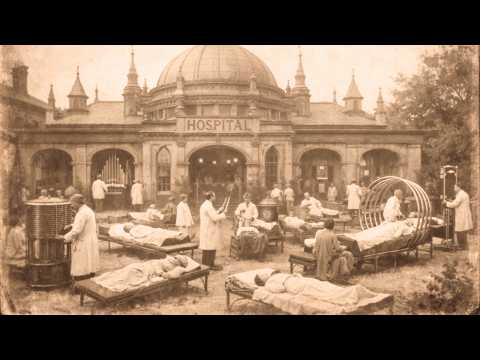
[0:00]For most of human history, a hospital was not a building, it was an idea, an obligation. The Romans built them on roadsides.
[0:09]Medieval monks ran them inside churches. Rich merchants funded them as acts of spiritual insurance. Healing was everywhere, and it belonged to everyone. Then, sometime around the turn of the 20th century, that changed, Mag. And most people never noticed it happened. Before we dive in, comment where in the world you are watching from and don't forget to click subscribe. To understand what was lost, you have to understand what actually existed before the modern hospital took over. In ancient Rome, the military ran a network of facilities called Valetudinaria. These were purpose-built structures positioned near the edges of Roman forts, designed to keep soldiers fighting. Archaeologists have found their remains along Hadrian's Wall in Britain, deep in what is now Germany, and along the Danube frontier. But the Roman sick could also find help at temples dedicated to Asclepius, the God of medicine. People traveled to those temples, slept on the grounds and waited for healing dreams. Priests interpreted those dreams. Herbal treatments followed. It was religion and medicine fused together, and it worked well enough that the model spread across the entire Mediterranean. The Romans were not alone. Indian texts from roughly 600 BCE described the Atra School of Medicine, which organized treatment into structured settings. The Arthashastra, written around 300 BCE, described state-funded hospitals as a responsibility of good governance. In Sri Lanka, the Buddhist king Pandukabhaya built hospitals for his subjects in the 4th century BCE. These were not accidents. They were policy decisions rooted in the idea that a ruler's legitimacy depended in part on keeping people alive. That concept traveled. When Buddhism spread across Asia, so did the idea of the healing institution. Chinese Buddhist monasteries maintained infirmities. Japanese Imperial courts funded treatment facilities beginning in the 7th century ACE. The logic was consistent across cultures. Healing the poor and the sick was morally required, and institutions existed to carry out that obligation. Most people picture the medieval period as a time of ignorance and suffering, with sick people lying in filth waiting to die. That picture is wrong, or at least dramatically incomplete. The medieval hospital was a real institution with a real structure and a real social function. The word itself comes from the Latin hospes, meaning guest or host. A hospital was a place of hospitality. It housed travelers, pilgrims, the elderly, orphans, the mentally ill, and yes, the physically sick. But the point was not cure, the point was care. Medieval medical theory inherited from Galen and the Islamic scholars who preserved his work, understood that the physician's job was to support the body's natural healing processes by managing the patient's environment. The Hotel Dieu in Paris, founded in the 7th century CE and still operating today, sat directly across from Notre Dame Cathedral. That positioning was not an accident. Healing the body and healing the soul were understood as the same project. The Islamic world ran parallel systems that were in many ways more advanced. The Bimaristan, a Persian word meaning House of the sick, spread through the Abbasid Caliphate starting in the 8th century. Within a century, Islamic scholars had developed hospitals that separated wards by condition, employed specialized physicians, maintained pharmacies, and conducted medical training as part of their regular operation. The Bimaristan Al-Argun in Aleppo, built in 1354, had dedicated sections for mental illness, fever, eye conditions and physical injury. These were not primitive institutions fumbling toward modern medicine. They were the products of sustained investment in an idea, and that idea was that organized, funded, socially embedded healing made societies stronger. Here is where the revisionist history comes in, because it is tempting to look at this tradition of charity hospitals and religious healing houses and think the story is simply about generosity. It is not. Medieval and early modern hospitals were economic actors. They received land grants, they accumulated property. A wealthy merchant who funded a hospital bed was buying spiritual insurance against damnation. Yes. But he was also buying social status, political influence and a permanent monument to his name. In Florence during the 15th century, the guild system funded hospitals as part of a broader civic identity. Project. The Hospedale de Innocenti, designed by Filippo Brunelleschi and funded by the Silk Guild, cared for abandoned children. It was also one of the most beautiful buildings in Florence. Beauty was a claim. It said that the people funding this institution were the right people to be running the city. Healing infrastructure was political power made visible in stone. When Henry VIII dissolved the monasteries between 1536 and 1541, he did not just destroy religious institutions. He wiped out the primary health care infrastructure of England in a single generation. St Bartholomew's Hospital survived because the city of London petitioned Henry directly and agreed to fund it. The logic had not changed. The people with money still needed to be seen providing care. The institutional form had just shifted from religious to civic. The decisive shift happened in the second half of the 19th century, driven by three things: Germ theory, anesthesia, and the professionalization of medicine. Louis Pasteur's work in the 1850s and 1860s and Robert Koch's discoveries in the 1870s and 1880s, established that infectious disease was caused by specific microorganisms. This was not just a scientific finding. It was a political and economic one. If disease came from identifiable biological agents rather than from bad air or moral failure, then the hospital's job changed. It was no longer a place to manage suffering in a controlled environment. It was a place to defeat specific pathogens in a controlled environment. Anesthesia, introduced in the 1840s, made surgery survivable. Joseph Lister's antiseptic techniques in the 1860s made surgery survivable at scale. By the 1880s, hospitals that practiced Listerian antisepsis, had dramatically lower post-surgical death rates than those that did not. For the first time, middle class and wealthy patients who had previously been treated at home, began to consider going to a hospital voluntarily. That shift in who used hospitals changed everything. When hospitals served only the poor, they could be funded by charity and administered by religious orders or civic guilds. When hospitals began serving paying patients, they became a business. The revenue model changed, the physical design changed, the staffing model changed. The professionalization of medicine accelerated this process. The Flexner Report of 1910 evaluated every medical school in the United States and Canada and recommended closing the majority of them. It called for hospitals to become the central institution of medical training and practice. After Flexner, American medicine reorganized itself around the hospital as the site of legitimate care.
[8:06]Everything else became peripheral. What was lost in this transformation was an idea rather than a technology. Before 1900, healing was a distributed function. It happened in homes, in churches, in guild halls, in spa towns, in workhouses, in private physician's offices. The institution was one option among many. Different populations used different options. After 1900, one model began to crowd out the others. The hospital, reorganized around a biomedical science and standardized procedures, became the default definition of legitimate health care. Midwifery, which had delivered the vast majority of babies in human history, was reclassified as an inferior substitute for hospital obstetrics. Herbal medicine was reclassified as quackery. Home nursing became a stop gap measure for people who could not access real care. This was not simply a scientific correction. It was an economic and political consolidation. The hospital model required capital investment, trained personnel and ongoing revenue. It could be owned, regulated and charged for in ways that distributed healing could not. The people who controlled hospitals controlled medicine. By the 1920s, American hospitals had shifted decisively toward paying patients. Charity care, which had been the founding purpose of most American hospitals, became a secondary concern. The voluntary hospital, built on the obligation of the wealthy to the poor, was being replaced by the proprietary hospital, built on the obligation of the patient to pay.
[9:47]Medicine achieved something almost unprecedented in capitalist societies. It became the only sector where the producers of a service could largely determine what counted as legitimate supply.
[10:04]Physicians organized through the American Medical Association successfully lobbied against national health insurance proposals in 1917 and again in the 1940s. They opposed the expansion of public health infrastructure that would have competed with private practice. The hospital became the tool for this consolidation. You could not practice legitimate medicine without hospital privileges. You could not get hospital privileges without completing an AMA approved residency. The system was self-reinforcing and extremely durable. What this meant in practice was that the United States spent the 20th century building the most expensive health care system in the world, while producing health outcomes that ranked consistently below those of countries that spent less. Other countries made different choices. Britain created the National Health Service in 1948, which nationalized hospitals and tied them to a universal access model.
[11:09]Canada built a single payer system through the 1960s. Scandinavian countries built systems where hospitals were public institutions embedded in a broader welfare state. These systems produced better average health outcomes at lower cost than the American model consistently over decades. The difference was not primarily medical. The drugs were the same, the surgical techniques were the same. The difference was in who the hospital served and who paid for it. The hospital was never just a building. For most of history, it was a political promise, a social obligation, a civic statement about who mattered. Then, in the span of two generations, it became a business. Healing that once belonged to everyone was quietly handed to shareholders and licensing boards. That shift was not inevitable. It was a choice, made by people with specific interests, and the rest of us have been living with the consequences ever since. If you found that interesting, the next video is on screen right now.


