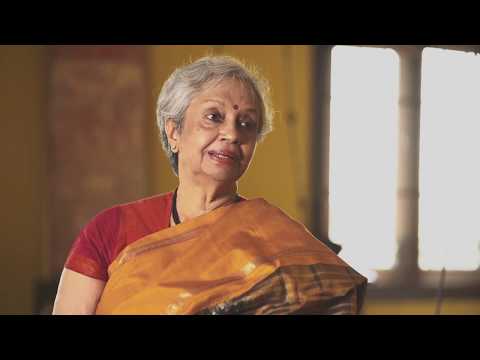
[0:26]I always consider the Kanchipuram saree a jewel among all the south Indian sarees. They're so special. I really can never forget my first Kanchipuram saree. I got married at 18 and this was part of my trousseau. It was a beautiful yellow saree with it had Hamsas on the border and it was a contrast. It was a Korvai though I didn't know much about Korvai then and I loved wearing it because every time I wore it I would get a compliment. Kanchipuram has been known as a city of thousand temples. There are temples everywhere and it's also known for its legendary silk sarees.
[1:20]Religion and weaving have always been melted together. The weavers consider themselves descendants of Sage Markandeya. When he was very young, from an early age, worshipped Lord Shiva and he became weaver of the Gods. So he is supposed to have woven the first fabric from lotus fiber which came out of the navel of Lord Vishnu.
[1:47]The earlier Kanchipuram sarees used to have one or double sided "korvai" borders, "reku" and "petni" techniques. The traditional colours were "arakku" red, mustard, purple, violet, navy and inky blues and off-white. It takes nearly 170 people to make a saree and I'm only one amongst them, a silk dyer.
[2:26]In the dyeing process, we first begin with degumming. We then add our colour of choice to boiling water.
[3:00]In the old days when you went to Kanchipuram or even now, you'll see the warp thread stretched across the streets everywhere. There would be two wooden structures and then starch is sort of applied on it and it's in the sun. And then it is taken and stretched tightly and then set up on the loom. The major part of the weaving always took place outside in the villages of Kanchipuram. Kanchipuram saree weaving is a household preoccupation and it involves the whole family and the loom occupies centre stage. Welcome. This is my father, he is reeling silk. Come on in. Meet my brother. He has been weaving for over ten years now. My sister-in-law helps him out. Let's go to my loom.
[4:07]I've been working on this for 10-12 years. My mother is working in the next room. Please come inside. This is my mother. She has been working here for the last 35 years. We aren't using the Jacquard method here. It's the plain method.
[4:35]This is my father's loom. He's been working on this for the last 45 years. His father and grandfather also worked on this.
[4:49]Most of the designs have been inspired by temple architecture and if you go to the temples you will see so many beautiful motives and things like that.
[5:04]In Kanchipuram sarees, there are around 114 designs. If we have an "annapakshi" or a flower, there is a supporting design for it. We first draw the design on a black or white sheet. It will be two or five inches depending on the motif and then transfer to graph paper by hand or computerised scanning.
[5:37]Then the graph paper designs are transferred onto punched cards. The punching takes place, the holes are there according to the graph. And why are these there? When they are set up, we have the weft passing through these holes. And as the weaver, you know there are pedals, he keeps pedaling them and then the weft keeps moving, the shuttle is thrown. So it's a kind of consolidated process where everything happens at the same time. Kanchipuram sarees are renowned for their uniqueness. It's always been said to be a part of the temple. I made this for my wife on our wedding. I wanted peacocks and mangoes on it, especially the peacock. There's something else that makes this special. "Balaji weds Viji" It isn't going to end with my generation. We want our kids to have an education but I don't know what they'll choose to do. It's not going to end, that's for sure. There'll always be weavers doing this even if I choose not to. Whether we like it or not, the power loom has come to stay and a lay person cannot differentiate. Because it's perfect, they like it, they say it's very well woven. But I am a traditionalist and I am lobbying for handlooms because if we turn to power looms, we will lose the craft which is so precious to our heritage. The handloom can be revived if we support it with technology. It will be a very big change. It'll change everyone's lives for the better. You know what can the lay people do? The lay people will have to buy handloom cotton, handloom sarees, spread the word and above all wear saree.