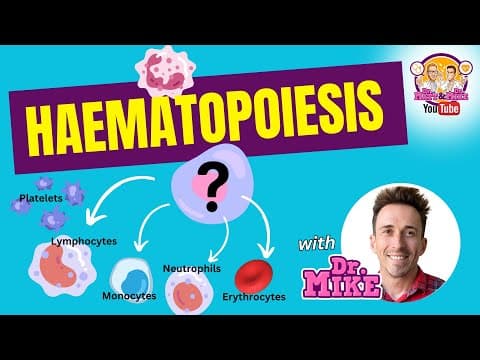
[0:00]Hi everybody, Dr. Mike here. In this video, we're taking a look at a process called hematopoiesis, which is the production of blood cells in the body. Not just red blood cells, this is termed erythropoiesis, which we will cover, but hematopoiesis are all the blood cells. Now, in actual fact, we should probably say formed elements instead of blood cells because platelets aren't cells, they're cell fragments, but we'll get to that point. So let's take a look at hematopoiesis.
[0:33]First thing you need to understand with hematopoiesis is it all begins with a stem cell. And this stem cell that we'll draw up here, we're going to term an hepatic a hemato poietic stem cell. All right, so if we have a look at this hematopoietic stem cell, what's important about this? Firstly, it's what we call plurpotent. It has the capacity to turn into a whole bunch of different cell lineages, or cell types. But the other great thing is that it also makes sure that even though it goes down these various lineages, it still makes copies of itself, so it maintains a stem cell population. That's very important. Now, the thing is that generally speaking as an adult, these hematopoietic stem cells are located to our in our red bone marrow. Red bone marrow. But the thing is, it's not always in our red bone marrow. So, if you think about it, inutero, or if we think about uh gestationally, at two weeks, two weeks gestational, it's in our yolk sac. This is where we have our hematopoietic stem cells. Then what we find is that at around about three months, gestationally, it's going to be in our liver and spleen. That's where we make these blood cells. And then by the time we are born, so at birth, it's going to be relegated to our red bone marrow. And we term this medullary hematopoiesis because it's located, if we have a look at our bones, we know that if I take a long bone, for example, and I draw a bone just like you'd see a bone on a cartoon, here's a long bone. Inside the shaft of the long bone is called the medulla. And in this medulla, where you can have red bone marrow. Now, at birth, most of our bones will have red bone marrow in the medullary cavity. And again, called medullary hematopoiesis. But as we become an adult, at around about 20 years old, probably close to 50% of the red bone marrow will turn into yellow bone marrow. Now, yellow bone marrow is basically just fat. It doesn't undergo the process of hematopoiesis, unless it's triggered due to some particular event, like it's really needed for whatever particular reason. All right. Now, the thing is that at adulthood, the red bone marrow, like I said, there's only like 50% of the bones, the bone marrow has red bone marrow in it. Now, what bones? This is generally relegated to the axial skeleton by adulthood. So, that's things like, so most of the red bone marrow by adulthood is axial skeleton. Axial skeleton. So that's things like the skull, think of the sternum, but then there's also things like the vertebral column, the pelvis, and then you're going to find it in the ends of the long bones such as the femur and the humerus. So, by the time you're in adulthood, that's where the red bone marrow is located, and that means that that is where the process of hematopoiesis occurs. Now let's take a look at this particular process. Hematopoiesis, we're starting off with, like I said, that stem cell, the hematopoietic stem cell, and it generally goes down two lineages, two lines. So the first that I want to go through is that where it creates what we call lymphoid precursor cells. Or let's call them lymphoid progenitor cells. There's a whole bunch of different names. Sometimes they're called common lymphoid progenitor cells, common lymphoid precursor cells. They're all the same thing. The other lineage it can go down is the myeloid precursor cells. Or myeloid progenitor cells. Let's be consistent. All right, there are the two pathways it can take. Let's draw the cell up just so we know what's going on. Okay, I want to start with the lymphoid progenitor cells. What this ultimately will produce are our TNB cells. So what I want to do actually is let's draw a blood vessel here. Let's draw a blood vessel that's going all the way along here. Because some of these red blood cells are going to be in the blood vessel, some of they're going to go into the tissue, and then out here we'll got the tissue. So I'm going to write blood vessel here. Blood vessel. And then down here I'm going to write tissue, and I'm going to write tissue here. Perfect. All right. So, let's look at the lymphoid progenitor cells. What they will turn into are a couple of things. Firstly, they can turn into, and let's do this in black. So, they can turn into what we call NK cells. Now, NK stands for natural killer cells. And these natural killer cells are part of the innate immune system. And what they do is they're really good at targeting infected cells and simply just killing them off. So we've got these NK cells. Right, simple. The other thing it can do is it can turn into what we call lymphoblasts. Now, blasts as a suffix tells you it has the capacity to turn into something, right? It's immature. And so lymphoblasts can turn into T cells, and it can turn into B cells. So these are what we call our lymphocytes. Right? And so remember this thing though, right? The B and the T is telling you where they mature. So the B cells mature in the bone marrow. Now, where are we right now with all this process happening? This is the bone marrow. So I've got blood vessel here, tissue here. Let's write bone marrow because that's where we are. We're in the specifically the red bone marrow. So these B cells, they stay in the bone marrow to mature. And then once they're matured, they can be tossed into the bloodstream. All right, I'll get back to that in a sec. But T cells, the T stands for thymus, this is where they mature. And so what happens is these T cells will go into the bloodstream, but they'll move out of the bloodstream, and they will go into other tissues such as the thymus and lymphoid tissue. So we've got lymphoid tissue here, right? And this is where the T cells will mature. Now, what do they mature into? They can turn into T helper cells, and they can turn into cytotoxic T cells. Now, what happens here at the thymus, for example, is it gives them glycoproteins. They it modifies them. And it modifies them by giving them these little signals on the surface, and for example, T helper cells get this uh CD4 positive glycoprotein on the outside, and the cytotoxic T cell gets this CD8 positive on the outside. And now they're more mature. And so what they can now do is they can now jump back into the bloodstream. And they'll interact with B cells. And as we know, B cells can also feed these lymphoid tissues as well. And what B cells can do is B cells can turn into plasma cells. And plasma cells produce antibodies. Perfect. And we know that from my immune lecture that T helper cells, cytotoxic T cells, they work with the plasma cells or the antibodies, and they all work together to signal each other, call in uh either each other, or they will call in other cells of the complement system, for example, um to help with fighting infection. So as you can see, this is the lymphoid progenitor side. Let's take a look at the myeloid progenitor side. This turns into a number of different things. First thing I want to focus on is the myeloid progenitors turning into or going down the lineage of red blood cells. So first is something called a pro erythroblast, pro erythroblast. So, we know they're called erythrocytes, red blood cells. But the blast means immature, pro means it's an early version of an immature erythroblast. So a pro erythroblast will actually turn into an erythroblast. And there's actually a number of different stages after this, but I'm going to cut a couple out and show the most important ones. Erythroblast will turn into a reticulocyte. Reticulocyte. Now, reticulocyte is not a mature red blood cell. It jumps into the bloodstream. Out of the bone marrow into the bloodstream. Now, a reticulocyte in the bloodstream, Okay, firstly, what's it look like? Right? It looks like a red blood cell basically, but the reticular refers to reticulation network. It's got ribosomal components inside of it. So it hasn't fully gotten rid of all of its intracellular organelles yet. Once it does and it's fully emptied itself of a nucleus and organelles and so forth, it now has the capacity to pack itself with hemoglobin. And this takes around about one to two days in the bloodstream. Once it does, it is now a mature erythrocyte. It's now a mature erythrocyte, which we call a red blood cell. And we have around about 5 million erythrocytes per microliter. Why is it important to highlight these two particular points? Well, it's important because we, if we take blood, we can measure both reticulocytes and erythrocytes. And that can give us an indication of possibly the origin of certain types of anemias. For example, if the erythrocyte levels are low but the reticulocyte levels are high, it's telling us that this process is fine, but the red blood cells are getting killed off when they're mature. Likely something called hemolytic anemia. Or if both are low, maybe it's a problem with the production. And when what we know is when it comes to the production of red blood cells, there's a couple of really important things we need early on for the process to occur. These things that we need include folate, B12, and iron. Now, all of these we get from our diet. So if we're deficient in these, we will not have hemolytic anemia, right? We can have anemia, but it's happening from an earlier stage. So that's important point. So we've got the uh erythropoiesis, so let's write this down. So this is erythropoiesis, this process. I'll do an asterisk. Erythropoiesis. I'm going to go back and talk more about it shortly. This here is called lymphopoiesis. Lymphopoiesis. All right. What else do we create here from this myeloid progenitor cell or common myeloid precursor cell? So, we also have myeloblasts. So here, I'll move it more across. We got heaps of room.
[12:45]We can have myeloblasts. Now myelo refers to bone marrow, which is where we are. And this is interesting because you could argue that erythroblasts are myelo and the other ones I'm going to talk about shortly are myelo. But we've got myeloblasts here and they make a number of different important cells. Firstly, the myeloblast can turn into granulocytes. Granulocytes. So these are cells that have granules inside of them. There's actually three that it makes. Right? The three granulocytes that it makes are going to be neutrophils, basophils, and eosinophils. Eosinophils. All right. Now the granulocytes. Now what granulocyte means is that if you stain it and look inside, they got granules inside. Those granules are important in fighting off infection. So neutrophils, basophils, eosinophils. Now I didn't draw up an erythrocyte. I'm going to go back to it, but there's a red blood cell. I'll get back to that in a sec. That's the granulocyte. Neutrophils are the first cell type that's called in upon infection. And they form pus after a while because what they do is they start to clean everything up and they basically die and their remnants remain and that's the pus. Basophils and eosinophils are important in allergic response and parasitic infection, right? So these are the granulocytes that have come from myeloblasts. But myeloblast can also produce another blast cell, which is called a monoblast. A monoblast. And what a monoblast can produce is a monocyte. And a monocyte is now floating through the bloodstream. Here's the thing though. Monocyte, so you've got an infection, neutrophils are called in first. Second are monocytes. Now monocytes are the name that they're given when they're floating through the bloodstream. But once a monocyte leaves the bloodstream, it turns into a macrophage. Now, a macrophage is a big eater. So it gobbles things up. So you'll have macrophages at the tissue level, gobbling things up. They can also seed various tissues and become sort of like century cells and become dendritic cells as well. Which also act like macrophages. Okay? So that's the monocytes. Mono meaning one, site cell, so it's just got this one intracellular component when it's stained, that's what it looks like. All right, what else are we left with? The myeloid progenitor cells can also produce what we call a mega karyoblast. Now, mega karyoblast, really big, right? Turns into a mega caryocyte. Mega caryocyte, more mature. And this is a big cell. What it does, this is interesting. Remember that bone marrow, it's ability to go into uh the general bloodstream through little holes. Remember you got capillaries, right? And there's different types of capillaries. You can have little holes, you can have, you know, these porous holes, and you can have sinusoidal, which are bigger ones. So you got these sinusoidal holes, right? So this megakaryocyte is like this big blob, and it throws like an arm out, an extension of its cytoplasm. And it throws it into the bloodstream, and what happens is it gets chop, chop, chop, chop, chop. And what it produces are all these little products, and these products are called platelets. And so now we have these platelets floating through the bloodstream. Platelets are also known as thrombocytes, thrombocytes. And hence this process is called thrombopoiesis. Thrombopoiesis. Now this one is going to be called, well, here we've got monocytopoiesis. Monocytopoiesis, and this one is called uh granulopoiesis. Granulopoiesis. So platelets, we know are really important when it comes to blood clotting.
[17:20]So when you have a damaged blood vessel, platelets come in, form a plug, but then also release a whole bunch of important chemicals that allow for clotting to occur via the clotting cascade. Watch the clotting hemostasis video for more information. All right. So these are all the cells, and I should say formed elements because platelets we know are now just broken parts of the cytoplasm of a megakaryocyte. This these are the cells that are made through the process of hematopoiesis. I want to talk a little bit more about the red blood cells for a second. Because they're red blood cells are obviously really important. They carry oxygen, they carry carbon dioxide. So we need to understand what regulates the process of erythropoiesis. Importantly, there's a chemical that does this. And this chemical is called EPO. Interestingly, it's called erythropoietin. Erythropoietin stimulates erythropoiesis. Erythropoietin is released by the kidneys. Weird, right? You got your kidneys and your kidneys control how many red blood cells you're making. Hmm. Why? Why would we relegate the the control of red blood cell production to the kidneys? The reason why is because the kidneys must filter blood, all must filter 120 mils per minute, regardless of what's happening, it must do this. So it's always getting a taste and snapshot of the blood. So it's a really great way to determine what the concentration is of red blood cells and oxygen. So what it does is it's able to taste and measure the oxygen content. And if the oxygen content is low, it releases EPO. EPO travels to the bone marrow, binds to receptors on precursor cells, and that will stimulate the lineage to go down this particular path to produce more pro erythroblasts. Now, once the red blood cell quantity goes up, you've got more oxygen carrying capacity. That signal is inhibited, this is perfect negative feedback. And it's controlled by the kidneys and the hormone EPO. So, I think that is covering the overview of hematopoiesis and erythropoiesis. So I hope that makes sense. Hi everyone, Dr. Mike here. If you enjoyed this video, please hit like and subscribe. We've got hundreds of others just like this. If you want to contact us, please do so on social media. We are on Instagram, Twitter, and TikTok at Dr. Mike Todorovic, @DRMIKETODOROVIC. Speak to you soon.


