[0:05]The human spirit is a candle that flickers but does not break. It is a voice that speaks softly in the storm, a quiet resolve that remains when all else has been stripped away. We often walk through life lost in the noise of ambition and the pursuit of pleasure, forgetting that true meaning is not something to be found in the world but something to be created from within. We are not defined by what happens to us, but by our response to it. But today we are not speaking about the world, we are speaking with a man who was stripped of everything, yet found the light in the darkest of places. He is a guide who taught us that even in the face of immense suffering, we hold the power to choose our attitude, to find a purpose and to live a life of meaning. He is the one who took the human spirit's measure and found it to be infinite. Brief biography. Born in Vienna, Austria in 1905, Viktor Emil Frankl was a neurologist and psychiatrist whose early life was marked by an intense intellectual curiosity and a deep passion for understanding the human condition. He developed a keen interest in existentialism and psychoanalysis, founding what would become known as logotherapy. His life was forever altered by the Second World War, during which he was imprisoned in four different Nazi concentration camps, including Auschwitz. He survived the unimaginable horrors of the camps, but his entire family, including his pregnant wife, perished. It was during these profound years of suffering that Frankl's theories were put to the ultimate test. He observed that those who had a sense of purpose, a reason to live, were more likely to survive. He saw that the will to meaning was the most powerful human motivator. After his liberation in 1945, he wrote his seminal work in just nine days, a testament to the urgency and clarity of his message. His experience and subsequent writings cemented his legacy as a beacon of hope and resilience. Now, welcome to a dialogue that transcends time. Our conversation today is centered on a single powerful idea that even in the most despairing of circumstances, life can have meaning. We are joined by the man who gave this idea a name and a voice. Our discussion will explore his masterpiece, Man's Search for Meaning, a book that combines his personal account of survival with the foundational principles of his school of thought, Logotherapy. This work is not merely a historical document. It is a timeless guide to finding purpose in our own lives, a message that is more vital than ever in a world often feeling adrift. Dr. Frankl, thank you for joining us. Your journey is of course inseparable from your work. Could you begin by explaining the core difference between your approach, logotherapy, and other schools of psychoanalysis? The fundamental difference is that logotherapy is not concerned with the pursuit of pleasure, as Freud's psychoanalysis was, nor the will to power as an Adler's individual psychology. Instead, it is centered on the will to meaning. We believe that the primary motivational force in humans is a striving to find a meaning in one's life. This search is what drives us, so a person's life is not driven by the past, but by a future purpose. Precisely. I have often said he who has a why to live can bear almost any how. It is about a pull from the future, not a push from the past. When a person finds that why, they gain the strength to endure immense suffering. In man's search for meaning, you described your observations in the concentration camps. You wrote about the psychological phases a prisoner went through. Can you elaborate on the second phase, apathy, and how a prisoner might overcome it? Apathy was a necessary protective shell, a kind of emotional death to survive the physical death all around. To overcome it required a fundamental shift in perspective. Instead of asking, what can I expect from life, a person must begin to ask, what does life expect from me? This is the core of our responsibility. What kind of meaning could a prisoner possibly find in such a place? We found that meaning could be found in three ways, by creating a work or doing a deed, by experiencing something or encountering someone, and most importantly, by the attitude we take toward unavoidable suffering. The third way is the most profound, for it is in the face of despair that we exercise our ultimate freedom to choose our response. You speak of unavoidable suffering. This is a difficult concept for many today. Indeed. But suffering ceases to be suffering at the moment it finds a meaning. We cannot avoid suffering, but we can choose how we respond to it. That is the final human freedom. If a person finds a reason to accept their suffering, whether it is for a loved one, a future goal, or a deeper purpose, that suffering becomes an achievement, rather than a mere burden. You often mention the importance of a task or responsibility to someone or something. Why is this so crucial for survival? A person who sees their life as a provisional existence is lost. The moment a person feels they have nothing left to live for, their physical and mental state rapidly deteriorates. I saw this in the camps, those who had a future task, a manuscript to finish, a child to see again, a community to rebuild, they were the ones with the best chance of survival. Life was not about to lose its meaning, it was about to be given its meaning by them. Let's discuss your concept of self-detachment. How does humor, for instance, play a role in finding meaning? Humor is a powerful tool for survival. It is an expression of self-detachment. By being able to rise above a situation and look at it with a sense of humor, we detach ourselves from it and gain a measure of control. It allows us to step back and realize that we are more than our circumstances. We are the masters of our inner world, even when we are prisoners in a physical one. What advice would you give to someone today who feels a profound sense of meaninglessness, a state you called the existential vacuum? The existential vacuum is the result of not having a clear path. My advice would be to stop asking, what is the meaning of life and start asking, what is life's mission for me at this very moment? Your mission is not to be found in grand abstract ideas, but in the small concrete tasks of your daily life. Listen to your conscience, for it is the voice of your purpose. Doctor Frankl, if you were to look upon the world today, a world of immense comfort and endless distraction, what would you see as our greatest challenge in finding meaning? I would observe a world where freedom is often confused with aimlessness. People have the means to live, but often have no meaning to live for. The greatest challenge is not a lack of resources, but a lack of purpose. It is the temptation to simply react to life, rather than to choose our path. To fill the existential vacuum, we must not seek to satisfy our desires, but to fulfill our responsibilities. The story of Viktor Frankl is a powerful reminder that our ultimate freedom is not the freedom from suffering, but the freedom to choose our response to it. His experience in the concentration camps showed us that even when stripped of all dignity and hope, we can still find a purpose, a reason to live, and a will to meaning. His timeless message resonates today, challenging us to look beyond the superficial and to ask ourselves what life is asking of us. For in a world where we often feel like victims of our circumstances, Frankl reminds us that we are the authors of our own meaningful existence.
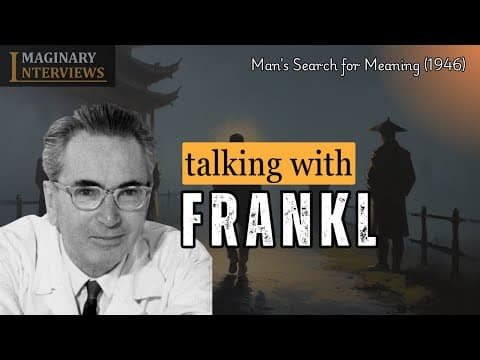
VIKTOR FRANKL | The Man Who Found Meaning in Suffering: A Conversation with Viktor Frankl
IMAGINARY INTERVIEWS
8m 42s1,351 words~7 min read
YouTube auto captions
Transcript source
YouTube auto captions
This transcript was extracted from YouTube's auto-generated caption track. The transcript below is server-rendered so it can be read, searched, cited, and shared without opening the original YouTube player.
Pull quotes
[0:05]It is a voice that speaks softly in the storm, a quiet resolve that remains when all else has been stripped away.
[0:05]We often walk through life lost in the noise of ambition and the pursuit of pleasure, forgetting that true meaning is not something to be found in the world but something to be created from within.
[0:05]But today we are not speaking about the world, we are speaking with a man who was stripped of everything, yet found the light in the darkest of places.
[0:05]He is a guide who taught us that even in the face of immense suffering, we hold the power to choose our attitude, to find a purpose and to live a life of meaning.
Use this transcript
Related transcript hubs
Watch on YouTube
Share
MORE TRANSCRIPTS


