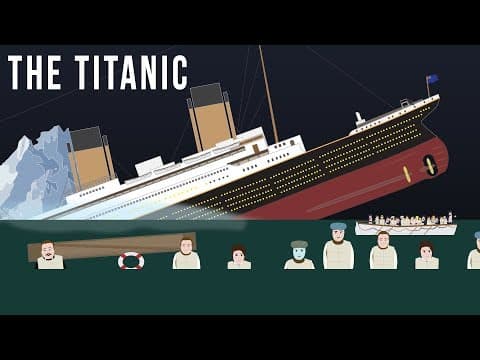
[0:01]The sinking of the Titanic, 1912. The luxury British passenger liner, RMS Titanic, began construction on March 31st, 1909, in the Harland and Wolff shipyard in Belfast, Ireland. and was completed three years later in 1912. As one of three Olympic class ocean liners, it was designed to be the largest luxury passenger ship in the world and would cost $7.5 million to build. It had a length of 882 ft 9 in, or 269.1 m, a height of 175 ft or 53.3 m, and a width of 92 ft 6 in, or 28 m, and it weighed 46,328 tons. Below the waterline was the Orlop Decks for cargo and the tank top where the engines, boilers, turbines, and electrical generators were. At the very top was the boat deck, where the bridge and wheelhouse were, as well as the lifeboats. In between were the decks for passengers with first, second, and third class cabins. The level of luxury was so high that second class was comparable to first class on any other ship. The 2,240 passengers would be from all walks of life, from millionaires and celebrities to poor immigrants looking for a better life in America. The ship would act like a floating hotel, featuring a grand staircase, which allowed first class passengers to move from deck to deck, and had a dome skylight to allow natural light in. The ship also featured a gymnasium, dining saloons, a reading room, a barber shop, a squash court, a Turkish bath, and a swimming pool. The ship carried 20 out of a possible 64 lifeboats, therefore, there were only enough for half the ship's population. However, this was within legal requirements. Lifeboats were only intended for carrying passengers to rescue ships and not keep the entire ship population afloat. As a result, the company who owned the Titanic, White Star Line, felt complacent enough to keep the number of lifeboats low, so the deck wasn't cluttered. Many claimed the Titanic was unsinkable because its hull was divided into 16 watertight compartments. It was said that if up to four of these flooded, the ship would still stay buoyant. All of these qualities drew the press to frequently talk about the new passenger liner. Disaster. In the morning of April 10th, 1912, passengers began boarding the Titanic in Southampton, England, with large crowds gathering to watch the ship depart. At noon, the Titanic set sail under command of Captain Edward Smith, beginning her maiden voyage. It would stop at Cherbourg, France, and then Queenstown, Ireland, to pick up more passengers, and then began its journey across the North Atlantic Ocean towards New York City. On April 14th, 1912, warnings were coming in of icebergs from other liners. So Captain Smith had plotted a new course and continued to steam at full speed, which was standard practice. As it became dark, the temperatures were dropping to below freezing and there was no moonlight or waves, making it difficult to see approaching icebergs. At 11:40 p.m. ship's time, the ship's lookout, Frederick Fleet, spotted an iceberg from the Crow's Nest. He rang the warning bell and telephoned the officers at the ship's bridge shouting, "Iceberg, right ahead." Fleet had spotted the iceberg with his eyes, as the Crow's Nest binoculars were locked away. The key's owner, Officer David Blair, had been removed from the Titanic's crew at the last minute and forgot to hand over the key. The officers on the bridge quickly turned the ship away from the iceberg, but it was too late. The Titanic grazed the iceberg along its side, ripping several holes in its hull below the waterline, with fragments of ice hitting the deck. At first, everyone felt relief, the lookouts and the passengers didn't even feel the collision. 11:50 p.m. Captain Smith and the ship architect, Thomas Andrews, went to inspect the damage. They knew the ship would start sinking, and by this time, six of the watertight compartments at the front of the ship's hull were already breached and began flooding. 12 a.m. The captain sent out a distress call over the radio in the hopes that there were other ships nearby and gave the order for the Titanic's passengers to board the lifeboats. He knew there were only enough for half the population of the Titanic. At 12:25, the lifeboats began their loading with women and children first, as this was the protocol at sea. Many passengers still did not understand what was going on, and confusion and disorganization meant that the first lifeboat to leave had only 28 women and children aboard, when it could carry 65 people. First Officer Murdoch took the order to mean women and children first, then men if they were there, while second Officer Lightoller took it to mean women and children only. The Carpathia, which was 58 miles away, heard the distress call and began sailing towards the sinking Titanic to rescue the passengers. Distress flares were shot into the sky to help locate the sinking Titanic. By 1 a.m. with the lower decks flooded, the bow of the ship began to sink below the water's surface. Water was pouring in 15 times faster than it could be pumped out, which was not helped by the fact that many of the passengers had left their portholes open. The unsupported stern and its propellers rose out of the water into the air. Panic and chaos set in as lifeboats were running out. Some people pushed their way to the lifeboats, while others accepted their fate and stayed behind or gave up their spots to more vulnerable passengers. Many did not want to survive the disaster and be branded a coward back home. By 2:05 a.m., the last lifeboat had left, but 1500 people were left on the ship. The deck was now at a steep height, and many passengers fell into the freezing icy waters. At 2:17 a.m., the captain announced, "Every man for himself." The stern, smashing into the water surface, became level and soon started to fill with water,
[6:43]sinking nearly 4 km beneath the surface of the ocean. Many died as a result of drowning, but the main cause of death was hypothermia in the freezing waters, which occurred within minutes. Some of the lifeboats returned, but only four survivors were found. At 3:30 a.m., the distress flares from the Titanic were spotted by the Carpathia. The Carpathia arrived to the scene at 4:10 a.m. and picked up the lifeboats. Only 705 passengers would survive the disaster, with over 1500 people losing their lives.
[7:20]Subscribe and click the notification bell for more history videos.
[7:32]Thank you guys for all your support on the Simple History YouTube channel. If you enjoy it, please consider visiting our Patreon page. There, you can show us your support for the channel by donating and make a huge difference in what we're able to create for you. Plus, you can get early access on upcoming videos. So let's keep it growing, and thank you for being part of this amazing community.


