[0:00]How to sound more polite in English with hedging language. Hello guys, my name is Josh and welcome to English speaking 360. Today, we are dealing with hedging language, but some people may call it softening language, cautious language, or polite language, but it's all the same. I have a story for you, a few weeks ago, someone wrote this comment on my YouTube channel. There is a mistake. You are wrong. Well, needless to say, I wasn't too happy about getting that message because it is a very, very strongly worded message. And also, there wasn't a mistake in my presentation. The guy was wrong. Now consider this, if the person had written this, I think there might be a mistake. I'm not sure this is right. I would have been much happier getting that message. So today, I am showing you how to change your language to make it softer. What is hedging language? Hedging is using words that make your ideas sound more careful or less direct. Why use it? To be polite, or to be more professional. To avoid sounding too strong or rude. And also to show that you are not 100% sure. Hedging can be done with modal verbs. So modal verbs can definitely help soften your statements. For example, might, it might rain tomorrow. Instead of saying, it will rain tomorrow, it might rain tomorrow, shows that you are not 100% certain. May, this may be a mistake. Instead of saying this is a mistake. Could, he could be the one who broke it. It's much softer than saying, he is the one who broke it. Would, I would think this is enough, much more polite. Should, this should be correct. This YouTube channel might very well be the best ever, so don't forget to subscribe. Might very well be is also a great sentence to soften what you want to say. Instead of saying, this YouTube channel is the best ever, I said might very well be. So I'm being very professional and I'm not boasting too much. Hedging can also be done with adverbs. So careful adverbs can help soften your language. Probably, it's probably the best option. Possibly, we're possibly looking at a delay. Generally, this generally works well. Apparently, apparently, she's moving next week. Likely, it's likely that he'll say yes. Hedging with phrases. If you add soft phrases, it can help you sound a lot more polite. So instead of saying they didn't fully understand the instructions, you can start with, it seems that they didn't fully understand the instructions, much softer. There is a chance that the delivery will be late. The delivery will be late is very strong. There is a chance that helps you soften your language. It is possible that the numbers were entered incorrectly. You entered the numbers wrong, it's not very polite, but it is possible that the numbers were not entered properly is much softer. As far as I know, the meeting is still scheduled for 3 p.m. As far as I know. To the best of my knowledge, she has already left the office. To the best of my knowledge, shows that you are not 100% sure. Hedging in questions. Hedging makes questions less direct and a lot more polite. Here are some examples. Would you happen to have a pen I could borrow? Instead of saying, can I borrow your pen, or could I borrow your pen, would you happen to have a pen I could borrow is much nicer. Could it be that we misunderstood the instructions? Could it be that, instead of we misunderstood, could it be that, is it possible that we misunderstood the instructions? Do you think it might be better to wait? Instead of, it might be better to wait, or it's better to wait, that's the worst case scenario. Do you think it might be better to wait is wonderful? Is there a chance we made a mistake here? Is there a chance? Would it be possible to reschedule the meeting? Instead of saying, can we reschedule the meeting, or let's reschedule the meeting, it's a little too strong. Would it be possible? Wow, you have a lot more chances of the person saying, yes, we can reschedule the meeting. And one last example. I was wondering if you could help me with this. I was wondering if is one of the best sentences to learn as an English student because it shows that you are very, very polite. Now, hedging by using positive language. Change negative words for positive ones. So try not to use negative words too much. For example, that's a bad idea. So you see here bad idea is not good. So you might want to say, that might not be the best option. So you're changing bad idea for best option, but you're adding a not. That might not be the best option. It means your idea totally sucks, but I'm very polite, so I'm saying it's not the best option. You're wrong. You may not be 100% right about this. This is a problem. A problem is also a negative word. This could be a challenge. A challenge is something positive. Challenge accepted. That's impossible. That might not be easy to achieve. You did it wrong. There may be a better way to do this. Wow, that is so polite. And the last one, I disagree with you. I know that many of you use this sentence, right? I disagree with you is great basic English, but disagree is very strong. I'm not so sure about that. I'm not sure that you're right about that. It's quiz time, guys. Now, I'm going to give you a rude sentence and you have to try to come up with possible alternatives, okay? So the report is incorrect, oh, very, very strong. What would you say instead? I'm going to give you more polite options, so you can compare what you said to the options I have here, and you can check and you can see if your answer resembles one of mine. Some parts of the report may need revision. Oh, that's very nice. You're not saying that the whole report is wrong. Some parts may need revision, so you're using a modal verb also. It seems there might be a few issues to fix. Aha, a few issues, just a few, no problem there. Also, it seems, so I'm not 100% sure. And once again, you're using a modal verb, there might be a few issues to fix. There could be a few small errors in the report. There could be, I'm not sure, there could be. It's possible, but just a few small errors. It's not a big problem. So how about your answer? Does your answer kind of match with what I said here? If it does, fantastic. Here's another rude sentence, change the schedule. Ah, you want the person to change the schedule, but just saying change the schedule is very rude. So what would you say instead? Here are some more polite options. Would it be possible to adjust the schedule? Would it be possible to change the schedule, but instead of change, adjust is much softer also. I was wondering if we might revise the schedule. Revise, I was wondering if excellent sentence, we might, so you're using a modal verb right there, it's wonderful. Could we maybe consider changing the schedule? Could we maybe consider, so you're being extremely polite. If you use this in a business setting, you're going to sound wonderful. Here's another one, I don't like this plan. Your plan sucks. More polite options. I'm not completely sure about this plan. Very nice. This might not be the best fit for us. I think we could explore other options. I think we could explore other options is something people say usually when they hear a bad idea. How about this one? You made a mistake. More polite options. What would you say? I would say, there may have been a small misunderstanding. Oh, very nice, there may, maybe yes, maybe not, 50%, right? There may have been a small misunderstanding, not a big mistake, not a big misunderstanding, just a small one. It seems something might not be quite right. Aha, not quite right, and might also is your modal verb. And at the beginning, on top of that, you're using it seems, super soft. I think there may be a slight error. How about this one? This product will fail. Give it a try. Ready? I'm going to show you mine. There's a possibility this may not succeed. So succeed instead of fail, you're using a positive word. There's a possibility this may not succeed. It could be challenging to get the results we want. It could be challenging. I'm not saying that we're going to fail, but it's not going to be easy. It might not perform as expected. There's something you should keep in mind, though. Today, I'm teaching you these sentences. Of course you're going to say, but this is very complicated, but like I said, if you use them, it's going to help you sound a lot more professional and a lot more polite. Great job, guys. If you want extra practice, visit my website, Englishspeaking360.com. I hope to see you next time and remember, don't send me rude messages.
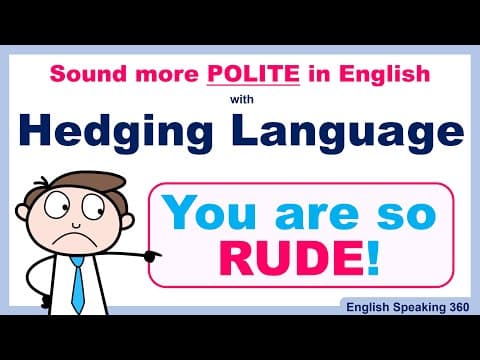
Sound More POLITE and PROFESSIONAL in English | Hedging Language Explained Clearly with examples
English Speaking 360
12m 18s1,576 words~8 min read
YouTube auto captions
Transcript source
YouTube auto captions
This transcript was extracted from YouTube's auto-generated caption track. The transcript below is server-rendered so it can be read, searched, cited, and shared without opening the original YouTube player.
Pull quotes
[0:00]Today, we are dealing with hedging language, but some people may call it softening language, cautious language, or polite language, but it's all the same.
[0:00]I have a story for you, a few weeks ago, someone wrote this comment on my YouTube channel.
[0:00]Well, needless to say, I wasn't too happy about getting that message because it is a very, very strongly worded message.
[0:00]Now consider this, if the person had written this, I think there might be a mistake.
Use this transcript
Related transcript hubs
Watch on YouTube
Share
MORE TRANSCRIPTS


