[0:00]Dear students, This morning, I would like to discuss a new topic oxides and oxoacids of halogens. Myself Dr. Digna Varghese. Contents. Oxides of halogens, structure of chlorine dioxide, oxyacids of chlorine, its structure and acidic strength only. Oxides of halogens. Halogens form many oxides with oxygen. All the oxides of halogens are powerful oxidising agents. Some of the oxides are stable only at low temperatures. The oxides which are stable at ordinary temperatures decompose on heating. Most of the oxides are unstable and are liable to explode. Fluorine forms oxides like OF2 and O2F2. In these compounds F has -1 oxidation states.
[1:17]We know fluorine shows only -1 oxidation states because it is a the most electronegative element. Chlorine, bromine and iodine showing different oxidation states form a range of oxides.
[1:38]Now we are discussing about the oxides of fluorine. Fluorine reacts with oxygen gives fluorides actually because F is the most electronegative element than Oxygen, But most commonly it also regarded as oxides. Difluorine oxide F2O. It is prepared by passing fluorine gas over sodium hydroxide giving difluorine oxide sodium fluoride and water. It's a pale yellow gas. Difluorine oxide is a pale yellow gas and which is used as a rocket fuel. And its structure is V-shaped structure or bent structure having bond angle is 103.1 degree and it in this oxygen is in the sp3 hybridized state. F2O2 difluorine dioxide which can be prepared by applying electric discharge on a mixture of fluorine and oxygen at very low temperature forming difluorine dioxide. It is an unstable yellow orange solid. It acts as a very good fluorinating and oxidizing agent. And the structure is contains two planes, in which one plane the oxygen fluorine oxygen bond angle is makes 87.5 degree and other one is 109.5 degree.
[3:36]And two different bond length like oxygen fluorine give 157.5 picometer and oxygen oxygen bond length is 121.7 picometer. Oxides of chlorine. First one is dichlorine oxide. Its molecular formula is Cl2O. And it is prepared by passing chlorine gas on freshly precipitated mercuric oxide and forming dichlorine oxide. It is an orange liquid. It is also known as the anhydrous of hypochlorous acid. Its formula is HOCl. When removing water from hypochlorous acid we will get dichloro dichlorine oxide. Its structure is angular structure and oxygen intercours sp3 hybridization and the bond angle between ClOCl is 110.9 degree and bond length of oxygen and chlorine is 170 picometer. Chlorine dioxide. Molecular formula is ClO2. It can be prepared by treating chlorine on silver chloride give chlorine dioxide silver chloride and oxygen.
[5:13]Another method of preparation is applying chlorine gas on sodium chloride, we will get chlorine dioxide and sodium chloride. It is a paramagnetic yellowish green gas. Chlorine dioxide appeared as yellowish green gas. And it acts as a powerful oxidizing and chlorinating agent. It dissolves in water exothermally.
[5:47]Structure of chlorine dioxide. Angular structure or bent molecule with O-Cl-O bond angle of 117.6 degree. Bond length is 147 picometer (1.47 Å). It is an odd electron molecule. A molecule containing an odd number of electrons. In order to account for the odd electron, it was postulated a special 3-ene-bond in addition to a normal electron pair bond (the molecule alongside a normal covalent bond).
[6:59]Since both the Cl-O bond distances are equal.
[7:07]That is, we know 1.47 Angstrom or 147 picometer. Its structure is believed to be a resonance hybrid of the two structures. That is, it can be like this or at a next time or next moment, it appeared like this.
[7:29]So it's a resonance hybrid of the two structures which is shown in figure.
[8:02]Three electron bond occurs for the shorter bond length and its paramagnetic character. So the molecule is paramagnetic. Structure is angular structure, bond angle is 117.6 degree and the bond length is 147 picometer and the same for the same bond length it acts as a resonance or the structure is believed to be a resonant hybrid of two structures which is shown in figure.
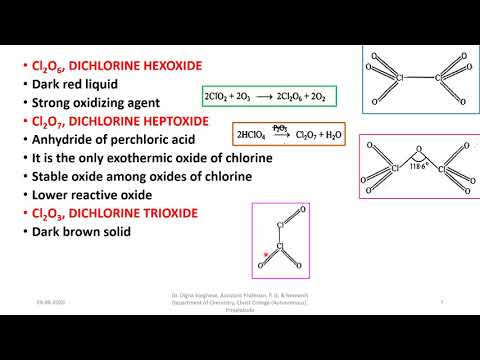
[8:38]Dichlorine hexoxide. Its molecular formula is Cl2O6. It is prepared by mixing chlorine dioxide with ozonised air at 0 degree Celsius giving dichlorine hexoxide. It's a dark red liquid and it acts as a strong oxidizing agent. And its structure is like this and has chlorine shows sp3 hybridization. Dichlorine heptoxide molecular formula is Cl2O7. It is prepared by dehydrating perchloric acid with phosphorus pentoxide giving chlorine heptoxide.
[9:31]P2O5 is a good dehydrating agent, phosphorus pentoxide. Dichlorine heptoxide acts as an anhydride of perchloric acid. This means that on dehydration perchloric acid get dichlorine heptoxide. It is the only exothermic oxides of chlorine. It is a stable oxide among oxides of chlorine. Otherwise it is known as the lower reactive oxide, so it is highly stable.
[10:15]Its structure is like this and it shows a bond angle there is an oxygen bridges bridging between the two chlorine atoms and the bond angle is 118.6 degree. One oxygen acts as a bridge and other other oxygens six oxygens act as terminal oxygens. In the case of dichlorine trioxide molecular formula is Cl2O3. It's a dark brown solid. It is unstable and structure of dichlorine trioxide is like this. In this chlorine chlorine bond and three oxygen atoms act as terminal.
[11:10]Dichlorine tetraoxide Cl2O4 is its molecular formula and it's also an unstable oxide and has yellow pale yellow liquid.
[11:24]It has a pale yellow colour and is in the liquid state. Its structure is shown here.
[11:39]Oxides of bromine. Bromine forms a number of oxides. First one is dibromine oxide. Br2O its molecular formula. And it is prepared by dropping bromine over dry mercuric oxide and forms dibromine oxide. It is a dark brown liquid and it is also known as the anhydrous of hypobromous acid, that is HBrO. When HBrO on dehydrating we will get dibromine oxide. Its structure is angular. Bromine dioxide is the next oxide of bromine. Its molecular formula is BrO2. And it can be prepared by ozonolysis of bromine at low temperature giving bromine dioxide.
[12:39]It is an yellow solid and its structure is also angular.
[12:47]Bromine trioxide. Molecular formula is BrO3. It can be prepared by electric charge discharge applying on a mixture of bromine and oxygen at very low temperature forming bromine trioxide. It is a white crystalline solid and it is a acts as a strong oxidizing agent and its structure is like this.
[13:22]Oxides of iodine. Iodine forms three main oxides. First one is iodine tetraoxide, that is I2O4. Second one is tetraiodine nonoxide, that is I4O9. Both these are unstable oxides of iodine. And the third one is iodine pentoxide, I2O5. It is a most stable oxide of iodine. And it can be prepared by treating heating iodic acid at 240 degree Celsius giving iodine pentoxide. It is a most stable oxide. It has a white colour and it is in the solid state.
[14:14]It acts as a strong oxidizing agent. The structure of iodine pentoxide is shown in the figure.
[14:26]By the structure the IO2 units or each iodine contains connected to three oxygen atoms IO3 links by a common and the iodine atoms connected by a common oxygen atom.
[14:50]Oxides of halogens. Fluorine shows only -1 oxidation states in all of its oxides like oxygen difluorooxide, difluorine dioxide, difluorine trioxide, difluorine tetraoxide.
[15:09]In all the oxides of fluorine, it give -1 oxidation states. And OF2 have a pale yellow colour and it is in the gaseous state. And O2F2 as an yellowish orange colour. It is in the solid state. O3F2 is a blood red colour and it is in the liquid state. O4F2 is a reddish brown colour and it acts as a or in the solid state.
[15:46]Okay, the most stable among all the fluorine oxides is OF2 and O2F2. In the case of chlorine, forms Cl2O, the oxidation state is +1. And it has a orange colour.
[16:07]It is in the liquid state. Chlorine dioxide, in which the chlorine has +4 oxidation state. It is a yellowish green liquid. And Cl2O6 the chlorine has a +6 oxidation state. It's a dark red liquid. And chlorine heptoxide has a +7 oxidation state. It's a colourless liquid. And bromine forms bromine dibromine oxide having +1 oxidation state and it is a dark brown liquid. And bromine dioxide is a in which the bromine is in the +4 oxidation state and it acts as a yellow solid. Bromine trioxide in which the bromine is in the +6 oxidation state. It appeared as a white solid. Iodine forms several oxides and first one is iodine tetraoxide. In this iodine is in the +4 oxidation state. And iodine pentoxide iodine exist in the +5 oxidation state. And it is a white solid. Iodine heptoxide and iodine occurs in the +7 oxidation state. Iodine fluorine shows only -1 oxidation state. Other halogen form oxides which shows different oxidation states. And among the oxides ClO2, chlorine dioxide and BrO2, bromine dioxide are odd electron molecule, that is paramagnetic. That contains three a special three electron bond. Okay.
[18:00]Next topic is oxoacids or oxyacids of halogens. Oxoacids of halogens, due to high electronegativity and small size of fluorine atoms, fluorine forms only one oxoacid, that is hypofluorous acid, HOF.
[18:19]And oxidation state of fluorine is -1, other one is +1 oxidation state.
[18:50]Because fluorine is the most electronegative element. And in the case of halous acid, that is the one is hypochlorous acid, HClO2, having the oxidation state +3, here. And halic acid having oxidation state +5. And chloric acid, bromic acid, iodic acid forms perhalic acid, oxidation state is +7.
[19:27]Perioidic acid is also known as metaperiodic acid. And other iodine other oxyacid formed by the iodine is orthoperiodic acid.
[19:42]It has the formula H5IO6.
[19:49]Oxoacids or oxyacids of chlorine. First one is hypochlorous acid or chloric acid. In which the oxidation state of chlorine is +1.
[20:06]And the molecular formula is HOCl. It is a weak monobasic acid. Only exists in aqueous solution. And the ionization in aqueous solution of hypochlorous acid is given here. HClO in water giving hydronium ion and OCl- ion. So it can donate only one proton, so it acts as a monobasic acid. It has an angular structure, HOCl. And the bond angle is 103 +-3 degree approximately. And its bond length is OCl is 169 picometer.
[21:06]And OH bond length is 97 picometer. Chlorine atom is connected to oxygen only. So it has an sp3 hybridized state.
[21:20]Structure of HOCl or hypochlorous acid. Central atom is chlorine and chlorine atom to be in a state of sp3 hybridization. The chlorine atom, the ground state having the outer electronic configuration is 3s2 3p5. And here the vacant, sorry, half-filled configuration in the ground state. So it has connected to the oxygen atom and forming a sigma bond. This 2p orbital of the oxygen atom connected to the hydrogen atom and forming the structure HOCl having bond angle approximately equal to 104 degree.
[22:12]In this chlorine molecule, chlorine atom has a three sp3 hybridized lone pair. Okay? 1 2 3. That is shown here.
[22:30]Next one is hypochlorous acid, that is also known as chloric three acid in which chlorine is in the +3 oxidation state and the molecular formula is HClO2. And it acts as also a weak monobasic acid. It exists only in aqueous solution. And the ionization of HClO2 is given here. That is HClO2 plus water giving hydronium ion and ClO2-.
[23:12]Structure. The structure by the chlorine ground state is shown here. 3s2 3p5. And for the excitation the electron for the for the excitation state, that is 3s2 3p4 3d1. And two oxygen atoms are here. HClO2. The chlorine atom is connected to two oxygen atom.
[23:45]And one forms a 3p, sp3 hybrid orbital to p orbital of oxygen. And forming a sigma bond. And the other one sp3 hybrid orbital of chlorine atom to another p orbital of oxygen atom forming other sigma bond. And there is one pi bond between chlorine and oxygen. That is by the d orbital of 3d orbital of chlorine atom and to the 2p orbital of oxygen atom forming a d pi p pi bond.
[24:40]And sp3 hybrid orbitals forming two sigma bonds with two oxygen atoms and one pi bond with one oxygen.
[24:55]And there is two lone pairs. One is this and one is this. And here the one hybridized sp3 orbital containing one lone pair. And here the one hybridized sp3 orbital of chlorine atom forms a sigma bond with the oxygen atom.
[25:34]And the structure is like this. Chlorine is attached to two oxygen atoms.
[25:44]One is forming a sigma bond only and the other one is forming sigma and pi bond. And there is two lone pairs of electrons on the central atom chlorine. And the structure is shown in this figure.
[26:04]Next one is chloric acid. That is also known as chloric five acid in which the chlorine atom is in the +5 oxidation state. It is a strong monobasic acid. It exists only in aqueous solution. And the ionization of HClO3 is given as HClO3 in aqueous solution giving hydronium ion and ClO3-. So it acts as a monobasic acid, only one hydrogen or proton is donated to aqueous solution. The acid undergoes disproportionation reaction yielding perchloric acid. And HClO3 that is the reaction is chloric acid undergoes disproportionation giving perchloric acid, chlorine sometimes we will get chlorine dioxide instead of chlorine and oxygen and water.
[27:07]Okay. And the structure of chloric acid. That is the chlorine ground state is 3s2 3p5. Chlorine excited state is 3s2 3p3 3d2. And the oxygen atom has 2s2 2p4. And the hybridized state is sp3 having one lone pair. And it is connected to three oxygen atoms and forming three sigma bonds.
[27:42]And unhybridized 3d2 orbitals containing attached to or undergoes side wise overlapping with the two oxygen atoms. And forming d pi p pi bonds. And the structure is pyramidal. Here the chlorine attached to the two oxygen atoms and forming two sigma bonds and two pi bonds. And here one oxygen atom and forming one sigma bond.
[28:16]And the molecule contains one lone pair on the central atom.
[28:25]Perchloric acid is also known as chloric seven acid. That means in this chlorine is in the +7 oxidation state. And its molecular formula is HClO4. And it acts as a very strong monobasic acid. It is the most stable oxoacid of chlorine. It is colourless, oily hygroscopic liquid. Its ionization in aqueous solution showing it acts as a monobasic acid. And HClO4 under in water giving hydronium ion and ClO4-. It decomposes as chlorine dioxide, water and oxygen. Its structure is of the perchloric acid is in which the chlorine is the central atom. And it's a ground state configuration, 3s2 3p5. And the chlorine has the excited outer electron configuration 3s1 3p3 3d3. And it is combined or overlapping with the oxygen atoms, three different oxygen atoms. And forming three sigma bonds and three pi bonds. And the hybridization for the chlorine atom is sp3. It is connected to three oxygen atom, oxygen atom.
[29:48]And it is connected to three oxygen atom through d pi p pi bond. And the structure is tetrahedral.
[30:03]In this chlorine is connected to four oxygen atoms. Okay, in this one oxygen atom is here also.
[30:16]That can forms only sigma bonds. Here only sigma bonds and here also sigma bonds. Here also sigma bond. These three oxygen atoms can form pi bonds with the d pi p pi bond. And the structure is like this, that is tetrahedral structure. A comparison of the acidic strength of the oxoacids of chlorine. Acid strength of oxoacids of chlorine increases with increase in the oxidation number of chlorine. That is perchloric acid is highly acidic than chloric acid, then chlorous acid and then hypochlorous acid. The oxidation state of chlorine in different oxyacid is shown in the table that HClO having +1 oxidation state. In HClO2 chlorine has +3 oxidation state. And in chloric acid it has +5 oxidation state and perchloric acid it has +7 oxidation state. The order of the acidic strength of the oxoacids of chlorine may be explained on the basis of relative stability of conjugate bases (anions) that result after the proton removal in accordance with the following ionisation equilibrium.
[31:53]That is, the conjugate acid is sorry, base is formed by the ionization reaction. The perchloric acid is undergo hydrolysis in giving hydronium ion. So it acts as a monobasic acid.
[32:11]And conjugate base ClO4-.
[32:30]The greater the stability of conjugate base, that is shown generally here ClO_n-, the lower will be its basic strength and the stronger will be the acid HClO_n. This is because the conjugate base of a strong acid is weak and vice versa. If the stability of the acid or conjugate base is high, the stronger will be the acid. But the and the stronger will be the acid. This is because the conjugate base of a strong acid is weak. Okay, and vice versa. The stability of conjugate bases is in the order.
[33:14]That is in the same order as that of the acid. That is ClO4- greater than ClO3- greater than ClO2- greater than ClO-.
[33:47]And here the stability is directly proportional to the strength of acid. We can say basic strength of conjugate base is inversely proportional to the strength of acid.
[34:09]The acidic strength of acid increases in the order. HClO4 greater than HClO3 greater than HClO2 greater than HClO. And among the oxoacids of chlorine, perchloric acid is the most strong acid. And the hypochlorous acid is the least strong acid.
[34:35]We can summarise the oxides of halogens and oxoacids of halogens. In our syllabus oxides of halogens only specified oxide is chlorine dioxide and its structure is angular. And the different oxyacids of chlorine and it gives hypochlorous acid, chlorous acid, chloric acid and perchloric acid.
[35:10]Among them, the most stable and most stronger acid is perchloric acid and the least one is hypochlorous acid, according to the oxidation number of chlorine and also the stability of the conjugate base. Thank you for your attention and interest.