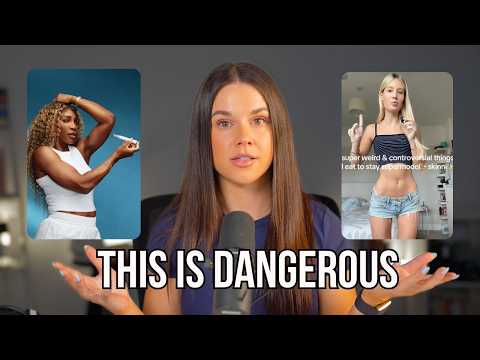
[0:00]The fitness industry has been lying to you for decades. Some of these lies are harmless, but many are genuinely unhealthy and even dangerous.
[0:09]These days, it feels like anyone with a fit body is suddenly a fitness expert, but that's far from the truth.
[0:15]Between social media trends, celebrity quick fixes, and influencer advice, it's hard to know what's real anymore.
[0:22]So today, I'm breaking down the most dangerous fitness trends, and what you actually need to know to stop sacrificing your health, your time, and your money.
[0:32]Let's dive in. First up, we have skinny talk and starvation.
[0:35]favorite thing to be is skinny. talk for super weird and unexpected things that I eat to stay supermodel skinny.
[0:44]Here are some skinny girl rules that I live by. nothing tastes as good as skinny feels.
[0:50]Skinny but kinda personal, but I need motivation.
[0:55]When I was growing up, we used to do this thing where you'd take a photo of your legs and you would write hot dogs or hot legs.
[1:03]And I don't know if you remember that. That just might. Did you ever do that, Becky?
[1:10]Mortifying. And it's coming back. Skinny to me is almost a toxic word.
[1:16]It's becoming trendy again and I do have a few assumptions as to why this is the case, which we'll get into that later.
[1:23]I nearly died when I saw this one. What I eat in a day? A thousand calories.
[1:34]Someone commented, You're forgetting to track the oil. And she said back, what's the point of counting oil?
[1:39]I'm not drinking it. This is why we stay off TikTok.
[1:43]What I eat in a day, 1,000 calories. Like, that is just so low. This has 2,930 saves.
[1:51]Oh, you know, low calories isn't that bad. Yeah, well, when you're normalizing it to women who are probably no older than 23, like, do they realize the damage that they could be doing to them, metabolism, the precious years of building bone and muscle that they're not maximizing or capitalizing on at all?
[2:09]It is so 1994. I grew up in the early 2000s as a teenager and that was when having a thigh gap was cool.
[2:16]Skinny jeans were in and look, it's no surprise that eating disorders, body dysmorphia and the mental health crisis that we're noticing at the moment, especially in women, is everywhere.
[2:31]Comparison is everywhere and it's because people are looking at these Pilates princesses and being like, well, that's the ideal physique and that's what I should strive towards.
[2:41]Whenever I speak with a lot of women in their 20s coming into coaching, I'm always saying to them, I know you're not thinking about bone health. I know you're not thinking about your muscle mass right now.
[2:49]Like I'm always been like, look, I totally get it because I remember I I could not care. I was like, I was going to be shredded.
[2:56]Striving to build muscle, build strength, eat more food, drive my calories up, like all of those things are the best thing you could be doing in your 20s and even when you're younger.
[3:05]So getting back into this trend of skinny is pushing us in the wrong way. And for a lot of women that did get stuck in this trap, 1,200 cal diets, jumping around in group fitness and avoiding weights because they're scared of being bulky, their health is suffered.
[3:22]And I know this because we have a lot of women in their 40s and 50s inside coaching. They're struggling with things like osteoporosis, or maybe they've never had control over their diet and their entire life.
[3:33]They're still trying to undereat and overtrain when it comes to cardio, and it's the wrong strategy.
[3:39]We are even seeing more research around Alzheimer's and dementia being more common in women than men, and they're starting to link it back to a lot of these lifestyle decisions.
[3:49]Around 80% of osteoporosis cases occur in women, and that's directly linked to chronically undereating, low muscle mass, and years of trying to shrink instead of strengthen.
[3:59]Next up, we have GLP-1 weight loss medications.
[4:03]They say GOP ones for weight loss is a shortcut. It's not. It's science.
[4:08]After kids, it's the medicine my body needed. GOP one helped me lose 31 pounds. One app to hit my goals. This is health care.
[4:21]There was a lot of controversial conversation around this campaign. Serena has been such an icon and such a powerful role model for a lot of women, especially in sport.
[4:31]She has always been so open and public about being strong and loving her body and preaching body acceptance and positivity that I think the contrast of then coming out with advertisement like this that it was fixing her body that was broken from having children.
[4:47]goes to show how powerful celebrity endorsement really is.
[4:57]Ah, as a nurse, um, everyone hates needles, but all of a sudden, it's becoming cool again and we've just, we've just gotten over that one fear of injecting.
[5:07]As a registered nurse who used to work in a bariatric ward where we performed a lot of weight loss surgeries.
[5:13]I fully support the use of drugs like Ozempic when they're prescribed appropriately and monitored properly.
[5:20]I also want to acknowledge my own privilege here as well. As a white, healthy female who's never had significant struggles with body weight, I totally understand what it might look like.
[5:30]But I have been seeing some pretty alarming things that I did want to raise. GLP-1 medications are a relatively new class of drugs used to treat obesity.
[5:39]They work by slowing down digestion, controlling appetite, and influencing blood sugar and insulin levels, all of which can lead to fat loss.
[5:47]They were originally designed for people with type 2 diabetes, but now they're being prescribed for weight loss and management.
[5:54]The problem I'm seeing now is the growing dependence on these medications. This is dangerous for so many reasons.
[6:00]When medication becomes the main plan, instead of just a supportive one, people never learn the habits and skills that actually keep the results.
[6:10]I can see a world where strength training will become less popular and less desirable. We obviously need more research and understanding how to use GLP-1s for weight loss and weight management.
[6:24]Obviously, being obese is the number one risk factor for poor health. Of course, we want to do that. It's going to not just save so much pain and suffering on an individual level, but also on the public health care system, which is flooded and inundated with many preventable diseases.
[6:44]And obesity is one of the contributing factors to all the leading causes of death in the Western world. We have a lot of women that come to us that are not obese, they're not overweight.
[6:52]Many of them are actually in a healthy BMI that have been prescribed these drugs or never followed up on. And I'm asking, I'm like, oh, do you have sort of a plan? Do you have some follow-up?
[7:00]Are you working with a nutritionist? Like what does this look like? And there's none of that. Do you think that everyone obviously can do whatever the hell they want with their body, but I would love to know. Do you see any risks with weight loss medications?
[7:13]Or do you think it's fine for everyone to use? Let me know in the comments.
[7:17]Next up, we have hormone misinformation. This one drives me absolutely crazy because it's sold as empowerment, but it's the complete opposite.
[7:26]Do you have cortisol face where your face is round? It's coming from stress, not your diet. When your body has too much cortisol, it robs the proteins from your legs and your butt and turns it into fat around your midsection.
[7:41]It also puts it around the face, giving you this roundish face. One of the best antidotes to lowering cortisol is something called L-theanine.
[7:49]Oh, shock. It's a supplement. It increases alpha brain waves to help calm you down. Oh my God. I just one quick look at the comments.
[7:58]Oh, look, everyone, where do I get more of this this thing that you're selling? Just 7 hours of quality sleep is probably more effective.
[8:05]Cortisol is supposed to fluctuate. The more intense training you do, the more intense cortisol spike you might see, but that's like saying don't run too fast because your heart rate will get too high.
[8:19]Well, that's a natural response. I think what's happening online is people are borrowing from health conditions like Cushing's syndrome where you have chronically elevated cortisol.
[8:31]You get cortisol face and cortisol belly. People want to tell you you have a problem that you don't have, and then sell you some sort of supplement to, you know, balance your cortisol.
[8:41]None of those work because you don't have a cortisol imbalance, and if you do, then you need to see an endocrinologist. You don't need some supplement.
[8:48]Scroll online for five minutes and you'll see cortisol belly, stop lifting weights, it's raising your stress, cycle sinking workouts, menopause, ruining your metabolism, do Pilates to balance your hormones.
[9:02]And the truth is, people are being sold that their hormones are broken instead of being taught how hormones actually respond to stress, sleep, training, nutrition, and even age.
[9:14]The biggest myth is that your hormones need fixing, balancing, or sinking with special workouts or supplements. But that's all a lie.
[9:22]Just because you see someone with authority, or a following, don't believe everything that they say, because especially when it comes to hormones, people know that you will spend money.
[9:34]And people are desperate, and when we're desperate, we're struggling, we're frustrated, we're being trying all the things, it's really easy to go, you know what?
[9:41]My face does feel a little bit puffy today, and I haven't been sleeping. I'm overdoing it, and I've got cortisol face.
[9:48]It's, you know, it's really easy to fall into those traps when we feel like we've been working really hard, but the truth is, we're often just working really hard in the wrong direction.
[9:56]We need to be addressing a lot of these things from a lifestyle perspective, not a supplement perspective, and it should really be under proper guidance, too.
[10:07]Not self-diagnosed, not come across on TikTok, and not resolved with a supplement. Next up is the obsession with metabolic resets, carnivore diets, and extreme fads.
[10:16]Most people still think that fiber is necessary for good digestion and healthy poops, but it's been six No, it's just essential for preventing cancer in the bowel.
[10:24]six years since I've had a single vegetable or fruit. My chronic bloat from veganism is not only completely gone, but I now only poop once a week instead of twice a day. And when I do, they're always smooth as butter and scentless.
[10:32]So carnivores claim that we don't need fiber because meat contains all the nutrients that we need for good health.
[10:40]And apparently, the fact that there is no waste, aka poop, is evidence that our body is utilizing all of those nutrients. And apparently, that's a good thing.
[10:49]The reality is that fiber in plant foods isn't fully digested, which is why it comes out the other end.
[10:57]And fiber isn't just for producing waste or good poop. Research suggests that getting in like 30 grams per day and a diverse range of plant-based foods helps to reduce the risk of heart disease, type 2 diabetes, colorectal cancer, neurodegenerative diseases, and so much more.
[11:17]In fact, one review of the literature found that people whose diets were low in fiber and high in animal protein, aka carnivore diets, had guts with an obesigenic ratio of high bacteriods to low levels of forties.
[11:31]So even if you look less bloated because you're not eating any fiber at all, you might actually be shifting your microbiome in a way that makes weight gain a lot more likely over time.
[11:42]This is one of the biggest lies that will keep you stuck. Every few months, the internet finds a new magic solution to fix your slow metabolism, detox your way to health, or help you drop belly fat overnight.
[11:55]And while some of these protocols can create short-term changes, the benefits are almost always overhyped or misunderstood.
[12:03]It all sounds scientific until you actually look at the science. When you stop eating a lot of food and fiber, or when you cut out carbohydrates or entire food groups, you're going to lose a lot of weight, but it's water weight.
[12:16]A lot of it is just fluid leaving your body, and when you reintroduce those carbs again, or even just start eating normal, because those diets are so unsustainable, you're just going to gain all that weight back on, and end up in the starting position, but just more frustrated.
[12:31]I didn't think that I would have to preach the importance of plants, fruit and vegetables in 2025.
[12:38]But look, here we are, and I I know that obviously there's a lot of people out there that do preach carnivore diets and really low carb, uh, but no one should be really saying that fiber's not important.
[12:50]Like, that's actually really damaging advice. For the majority of people, the basics are really all that matters.
[12:57]And those who are attracted to these extremes are often the ones that need to stop chasing them. We're not even considering the mental effect of this.
[13:04]How can you switch from like, yeah, I'm having my stick of butter and my shank for breakfast, over to, oh, now I've got to go out for dinner with my partner and my in-laws.
[13:14]Like, how can you mentally go from that to that? Well, you can't, right? You just become isolated.
[13:19]Next up is bodybuilding and the obsession with idolizing performance enhanced physiques.
[13:25]Is bodybuilding healthy? Competitive bodybuilding, one of the most unhealthy sports. Uh, let's, let's be real.
[13:30]If you're forcing your body to build as much muscle as possible by every any means necessary, including, you know, anabolics and all that stuff.
[13:38]Then you starve yourself and you get on stage, and it's just, and they die. They die early. We're, we're seeing this all the time.
[13:43]Yeah. Like some of the disciplines that go into it, I think you can turn that into healthy practices. Um, especially the awareness around like how food affects your body, how you can optimize recovery.
[13:56]There's elements of it in there that I think that you can learn that you can apply for longevity.
[14:02]I got so much from competing that it's hard for me now to look at what it's become.
[14:08]The unfortunate reality in my opinion is that it has really gone the wrong way. There's a lot of fake natties, uh, a lot of people that are using performance enhancing drugs that just simply should not be.
[14:18]I mean like first year of first show. It's like bloody hell. Like just have a have a crack without them.
[14:25]Uh, and then in the female space specifically, it's almost become something just to tick off the bucket list.
[14:31]When that happens, it does attract a demographic and a population that probably shouldn't ever compete. It's it's a sport and it's not for everyone.
[14:40]Like I'm not going to become an Olympic swimmer, am I? No, I'm 5'4, I'm small, but people don't look at bodybuilding in that way.
[14:47]Now, there's like 16,000 categories to make sure that everyone can fit into something. as well. There's a lot of pressure on people in the fitness industry that, well, if you're not a pro, if you haven't done bodybuilding, and if you're not competing, like, what sort of reputation do you have?
[15:01]Like, do you really care? Are you really disciplined? Okay, here's everything I ate four days out from my bodybuilding show. I'm going to put a screenshot of all the measurements at the end, since the amount of food is changing daily at this point.
[15:10]I'm currently down to 8% body fat, which is definitely the lowest I've been in any other prep.
[15:16]Healthy amounts is 20 to 25% body fat. This is a scary sport and this was done hopefully with the help of a doctor.
[15:25]Not to be sexist, we're in a different camp when it comes to this. Like we do need to maintain a higher body fat percentage to be healthy as women, because there are extreme consequences of losing your menstrual cycle.
[15:36]And a lot of people don't talk about this enough, but we're starting to now see some of the repercussions and consequences of women not having menstrual cycles.
[15:46]And this is impacting their bone building years, which is why women contribute to 80% of osteoporosis.
[15:52]very serious thing. A lot of people think bodybuilding is healthy, but what are the unhealthy side effects that no one talks about?
[15:58]Hair loss. My hairline tragic. Something that I was not expecting was extreme social anxiety. When I wasn't stressing about what people were thinking about me bringing my tupperware meals everywhere I went.
[16:08]I was stressing out about being around other people's regular food. Next, body dysmorphia. Huge. I checked myself in the mirror for abs maybe like 10 times a day.
[16:16]Don't even get me started on what a complete brain bender it is to see yourself at your absolute smallest and then gaining any weight at all. We also got the normalization of eating disorder.
[16:26]For me, it was the binge eating, but there are so many behaviors that are normalized like smelling your food or only eating food with baby utensils.
[16:32]Next, extreme energy loss. Fun fact, side note, I was a D1 cheerleader the entire time I was a competitive bodybuilder. One time I literally got a concussion as a cheerleader, but I thought that it was just my low energy levels due to my bodybuilding training.
[16:45]And then we have the classics. I think a lot of people forget about, I lost my period. I had absolutely no sex drive, and my ego made me think I was always the most important person in the room.
[16:53]This was all for me to look like this and still hate myself. Bodybuilders are often seen as the top pinnacle of fitness, but that couldn't be further from the truth.
[17:04]As someone who used to be a bikini pro, I saw behind the curtain of what really happens in the bodybuilding world.
[17:10]And while there are definitely healthier ways to prep or to compete, the reality is that it's still far from healthy.
[17:17]From the extreme dieting, the rebound cycles, even the pressure to use drugs, it's a world built on extremes, body dysmorphia, and unrealistic expectations.
[17:27]Performance enhancing drugs aren't just like injecting yourself with testosterone. There is lots of different types and things that people can take, everything from like extreme fat burners, uh right up to like microdosing just little bits orally.
[17:39]Each to their own, I honestly could not care. I think the sport to a certain level almost requires it.
[17:46]I think a lot of people think steroids and they look at like the Hulk or Arnold, or they like look at these big icons, but like not in the female space.
[17:53]There are many people that say they're natural that aren't natural. A lot of people are not transparent, and I don't think that they need to be because obviously drugs are illegal, so people aren't going to be like, hey guys, like I'm just here's my stack and my lineup.
[18:07]But I do think that people just need to be aware that it's very unlikely the person that you look up to, that you follow, and that you set as your fitspo is natural, and that the body that they have is achieved naturally.
[18:19]Those are my top five, but I'd love to hear from you. Drop the worst fitness trend you'll ever seen online in the comments, and maybe I'll break it down in part two.