[0:05]Just about every man and his dog has seen Scarface, or at the very least, knows that line. The film is well and truly embedded into popular culture, and Al Pacino's performance as Tony Montana is so iconic, it feels almost untouchable. But for all the love this movie gets, few people talk about how masterfully directed it is. When Scarface first hit theaters, it wasn't met with universal praise. Critics were put off by its betrayal of excess and violence. Maybe that's why director Brian De Palma never got the recognition he deserved. The man knows how to orchestrate a scene, that's evident from any of his films. But nowhere is his direction more deliberate, more unnerving and precise than in the infamous chainsaw scene. A sequence that's less about the action itself, and more about how cinema can make you feel violence. De Palma deserves recognition for he achieved here. His craftsmanship is on full display. Every shot, every sound, every movement of the camera, it's all working towards a single goal: to make the audience feel trapped and helpless. In this video, I want to unpack what makes this sequence so effective, and give De Palma the praise he's long overdue. And just a quick side note for context. This scene is tame by today's standards, but we have to remember Scarface was released in 1983. Violent scenes like this weren't nearly as common or graphically portrayed as they are now. To see something this raw, this unflinching, was huge. All right, here's the setup for the scene. Tony's just arrived in Miami after receiving a green card for killing a government official in Cuba. He's a Cuban immigrant with nothing but ambition and a willingness to do whatever it takes to climb. We see from the very beginning he's driven by pride, a man who refuses to be small in a world that keeps trying to make him feel that way. Sick of cleaning dishes, he and his friend Manny are thrown a bone by Omar Suarez, right-hand man to mid-level drug boss Frank Lopez. He sends them to make a cocaine deal with some Colombians. The location: a streetside motel. It's meant to be simple. Tony and Angel go inside and purchase the drugs. Manny and Chi-Chi wait outside in the car for backup. Quick and simple, but it turns out to be anything but. From the very beginning of the scene, the opening shot sets the tone. It isn't your standard wide establishing shot of the location. Instead, De Palma holds on a single, 1 minute and 14 second take that quietly lays the foundation for the tension. The shot establishes the space, follows Tony and his friends as they pull up and park, then begins tracking forward as Tony gives orders. The camera pans as he and Angel cross the street and climb the stairs to the motel room, but it never follows them. It stays back, watching them drift further into the frame. That distance makes us uneasy. The slow creeping camera feels alive, like it's stalking them. De Palma is priming us, using time and restraint to stir discomfort before they even get into the motel room. Tony enters the motel room, and the staging and blocking immediately puts us on edge. Tony asks for the door to be kept open, so Angel knows everything is okay. Inside, we meet Martha, laying on the bed watching TV, which instantly feels out of place. Pair that with the introduction of a detached and cold, and the tension begins to build. The main Colombian introduces himself as Hector, and De Palma lands on a wide shot that breaks every rule of pleasing composition. Normally, filmmakers follow what's known as the Rule of Thirds when framing up an image. A visual guideline that divides the frame into nine equal parts, placing subjects along the intersecting lines to create balance. But here, it's purposefully balanced different. Tony's pushed to the far left of frame, Hector to the far right, and an ocean, no pun intended, of empty space sits between them. This massive gap is extremely confrontational, and it's a measure of how tense the room is. Angel is wedged into the far right edge of the frame, far from Tony, boxed in by the doorway, almost like he's being marked, possibly a deliberate foreshadowing. The only person who sits neatly on one of those intersecting lines is Martha, and that's deliberate. The frame is quietly saying, don't rule this young woman out. Tony and Hector talk about the money and the drugs, both admitting they don't have them on hand, but close by. The exchange becomes this tense back-and-forth ping-pong game as we cut back and forth. Their coverage is profile as they size each other up. We don't know who's lying and who's not, so we're denied their full faces. In Tony's profile shots, he's positioned directly in front of the bathroom door, a visual foretell of what's coming next. In Hector's coverage, De Palma uses a split diopter to keep both Hector and Angel in focus. For those that don't know, a split diopter is a lens attachment for a camera that allows a single shot to have two separate planes of focus, one in the foreground and one in the background. We see Angel in the background through the same doorway, and De Palma has opted to have him in complete focus as the back-and-forth unfolds. Here, the effect is unnerving. It locks our attention on two planes at once. In this sense, De Palma denies us the comfort of shallow focus. We can't just rest our eyes on Hector, and this is stressful for the audience. We begin feeling uneasy. Add in the ambient sounds of the TV show Martha is watching, and it all just feels off. The back and forth is interrupted by the sound of a car horn from the street below. We cut to a quick POV from Angel, checking out the noise. We look down to Manny, who's trying to charm a woman passing by, which is funny because we've got this tense scene building up in the motel, and Manny, true to his character, can't help himself but chat up a woman. De Palma is showing us that the people who could help if something goes wrong are becoming distracted. He's creating the isolation around Tony and Angel through sound, something he builds on brilliantly a few moments later. Tony's had enough of Hector's games and turns hostile. Where are you from, Tony? What the fuck difference does it make when I'm from, man? He snaps at him and more or less tells him to stop playing games. The standoff finally breaks. Angel is grabbed at gunpoint by two Colombians who rush in from outside and shove him into the room. And Martha, who sat clearly at a point of interest in the wide frame, springs up, revealing a silenced Uzi and aiming it on Tony. Hector moves in and disarms him. It all happened so quick. The slow, uneasy rhythm of the scene snaps in an instant, like a rubber band releasing after being stretched too far. The camera immediately switches to handheld, cementing the unstable situation Tony and Angel are now trapped in. De Palma doesn't cut though. Instead, the camera drifts in a slow semicircle around the back of Martha before pushing in on Tony and framing Angel perfectly in the bathroom behind him. Most filmmakers today would try to create this chaos through rapid cuts, using editing to simulate panic. De Palma does the opposite. He goes handheld and choreographs the tension through movement and staging. Hector threatens Tony, and classic Tony tells him to shove his head up his ass. This whole scene actually serves to reveal the true depth of Tony's character, but more on that at the end. Hector moves to a suitcase to retrieve a chainsaw. Ironically, the cocaine is in there too. He forces Tony into the bathroom, which bleeds into one of my favorite shots in all of cinema. Martha bends down and turns up the volume on the TV, a chilling gesture meant to drown out the noise they're about to make. The camera then pushes in towards the window. We cut outside to that same window as the camera pulls back and pans across. We're now looking at the easy calm of Miami Beach. It's a perfect day, a total disconnect from the horror taking place just a few feet away. The camera slowly descends to the street. The muffled sounds of the motel fade out and are replaced by the outside ambiance. We hear seagulls, the ocean breeze, waves, traffic, and the music playing from Manny and Chi-Chi's car. We land on the two of them, the men who should be watching the deal, and they're completely unaware. Manny's flirting with the woman, Chi-Chi's lost in the music. We hold for a few seconds. De Palma then reverses the move, bringing the camera back up towards the window. The sound shifts again. Outside fades as we pull further away. The television takes over, and the hum of chainsaw creeps in as we pass through the glass and reenter the bathroom. Any other filmmaker, especially in the 80s, would have just cut down to the car to show the distraction and cut back. De Palma draws it out, milking every second, letting the audience feel the distance between safety and danger. The payoff is the sound, that seamless transition that makes the audience go, oh shit. It's such direct, on-the-nose filmmaking. We know exactly what De Palma is trying to communicate to the audience, but it never takes us out of the moment. Instead, the atmosphere created completely draws us in. We enter the bathroom, and the camera pulls back slowly, revealing the grim situation about to unfold. It's actually a stunning shot, not because of what's happening, but because of how one by one each character is brought into frame as the camera glides back. It's a heavy moment, especially for 80s cinema, so De Palma grants the audience enough time to read the characters' emotions one by one, and process the scene before we get the full picture. And we get that full picture when the shot ends on a wide shot that, funnily enough, is perfectly composed. After all that visual imbalance earlier, everything now aligns neatly on those intersecting points. There's no display in the framing anymore, because Tony and Angel are completely inside Hector's world now. Now, as most people know, Hector starts by cutting Angel's arm off, and it's all the display meant for Tony. He's trying to break him, to get him to give up the money. The chainsaw never connects with flesh. We only hear the sound, see the blood, and watch Tony's face, and that's what sells it. Pacino's performance here is unreal. He's a man who's supposed to be ruthless, who fears nothing and bows to no one. Yet here, even though he doesn't break, he's visibly shaken. We see him fighting every instinct to stay composed. Those three elements, the sound, the blood, and Pacino's face, are what sell the violence. If you think about it, the room is silent and it's just some special effects person next to camera splattering fake blood onto Pacino. Add the chainsaw sound later in post, and you get a scene that was considered so extreme at the time, it nearly earned the movie an X-rating. But at its core, it's simple filmmaking. It's horror built entirely through suggestion. Hector finishes off Angel by cutting off his leg. We hard cut down to Manny and Chi-Chi, who finally realize it's been too long and decide to check on Tony and Angel. Cut back to Tony, now being chained up in the bathroom, hands above his head, his turn coming. And in true Tony fashion, even in this position, he tells Hector to go fuck himself. The hard cuts between Manny moving toward the motel and Tony's peril start to build a rhythm. The editing now becomes the pulse of the scene, each cut another beat closer to the breaking point. The camera's showmanship is gone, it's all momentum now. We're locked in, waiting to see if Manny will get there in time. The camera dollies backwards, out of the bathroom as Hector tries to restart the chainsaw. As it pulls away, the television comes into frame, showing a house collapsing in the program Martha is watching. It's a sly bit of visual irony from De Palma, almost prophetic. The image mirrors what's about to happen. This scene, all of it is about to come crashing down. Manny reaches the motel door, presses his ear against it, hears the chainsaw, and... De Palma cuts the tension with pure chaos. The quiet dread that's been building for minutes explodes into gunfire, breaking the suffocating rhythm. Manny gets shot. Hector makes his escape, oddly enough, taking the chainsaw with him. Tony fights and kills another Colombian. Now comes what I consider to be two of the most revealing moments of Tony's character in the entire film. First, after the chaos, he checks on Manny to make sure he's okay, but before running out after Hector, he tells Chi-Chi to grab the drugs. Even in that moment of blood and panic, his mind stays locked on the score. That's Tony in a nutshell. Ambition constantly on his mind. He then chases a bloodied and limping Hector out onto the street. He doesn't just shoot him the second he sees him from this position here. He circles around him, makes sure Hector can see exactly who's about to kill him. That's the second character-defining moment. We cut briefly to a confrontational wide shot of the two facing each other again, and look, they're framed almost exactly as they were at the beginning when they first met. Neither sits neatly on those intersecting points, but this time Tony claims the balance by executing Hector. And he does so pure execution style, in broad daylight, in the middle of Miami, in front of an audience. This whole scene is a showcase of control. Made in the early 80s, long before digital tools or the shorthand filmmaking knowledge we take for granted today. De Palma built tension purely through camera movement, blocking, and sound. It's proof that mastery of film language is about how well you understand what you have. One fitting takeaway I like about this scene is that this is the only scene in the entire film where Tony's actually referred to by the name of the film, where he's actually called Scarface. Metaphorically, it's as if the name is being branded onto him. It's rebirth through violence. What makes it even more unsettling is the setting itself. All of it happens in broad daylight, on a busy Miami street, right by the water. That contrast between pure terror and idyllic normality gives the scene a strange kind of realism. De Palma didn't just direct a violent scene. He orchestrated one of cinema's most pioneering displays of violence, a sequence that still feels dangerous today.
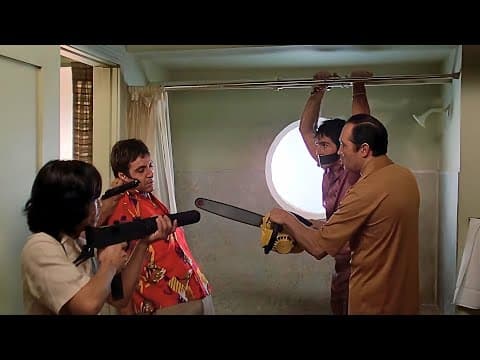
It's THIS SCENE that makes Scarface a masterpiece
From The Screen
14m 47s2,544 words~13 min read
YouTube auto captions
Transcript source
YouTube auto captions
This transcript was extracted from YouTube's auto-generated caption track. The transcript below is server-rendered so it can be read, searched, cited, and shared without opening the original YouTube player.
Pull quotes
[0:05]Just about every man and his dog has seen Scarface, or at the very least, knows that line.
[0:05]The film is well and truly embedded into popular culture, and Al Pacino's performance as Tony Montana is so iconic, it feels almost untouchable.
[0:05]But for all the love this movie gets, few people talk about how masterfully directed it is.
[0:05]But nowhere is his direction more deliberate, more unnerving and precise than in the infamous chainsaw scene.
Use this transcript
Related transcript hubs
Watch on YouTube
Share
MORE TRANSCRIPTS


