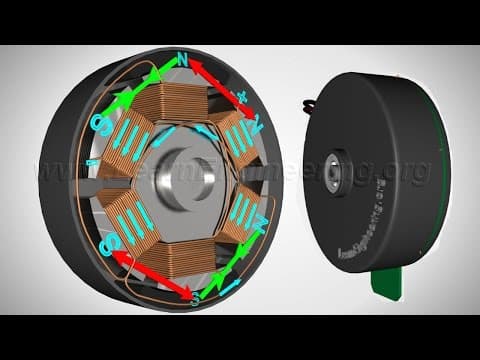
[0:00]In order to make the operation more reliable, more efficient and less noisy, the recent trend has been to use brushless D.C motors.
[0:12]They are also lighter compared to brushed motors with the same power output.
[0:20]The brushes in conventional D.C motors wear out over the time and may cause sparking.
[0:26]Thus, the brushed D.C motor should never be used for operations that demand long life and reliability.
[0:33]Let's see how a brushless D.C motor works.
[0:37]The rotor of a B.L.D.C motor is a permanent magnet.
[0:43]The stator has a coil arrangement as shown.
[0:52]By applying D.C power to the coil, the coil will energize and become an electromagnet.
[0:59]The operation of a B.L.D.C is based on the simple force interaction between the permanent magnet and the electromagnet.
[1:09]In this condition, when the coil A is energized, the opposite poles of the rotor and stator are attracted to each other.
[1:17]As the rotor nears coil A, coil B is energized.
[1:23]As the rotor nears coil B, coil C is energized.
[1:30]After that, coil A is energized with the opposite polarity.
[1:35]This process is repeated and the rotor continues to rotate.
[1:43]A humorous analogy to help remember it is to think of the B.L.D.C operation like the story of the donkey and the carrot.
[1:53]where the donkey tries hard to reach the carrot, but the carrot keeps moving out of reach.
[2:02]Even though this motor works, it has one drawback.
[2:07]You can notice that at any instant, only one coil is energized.
[2:11]The two dead coils greatly reduce the power output of the motor.
[2:17]Here is the trick to overcome this problem.
[2:22]When the rotor is in this position, along with the first coil, which pulls the rotor, you can energize the coil behind it, in such a way that it will push the rotor.
[2:32]For this instant, a same polarity current is passed through the second coil.
[2:39]The combined effect produces more torque and power output from the motor.
[2:51]The combined force also makes sure that a B.L.D.C has a beautiful constant torque nature.
[3:02]With this configuration, two coils need to be energized separately.
[3:07]But by making a small modification to the stator coil, we can simplify this process.
[3:12]Just connect one free end of the coils together.
[3:17]When the power is applied between coils A and B, let's note the current flow through the coils.
[3:29]It's just like the separately energized state.
[3:38]That's how a B.L.D.C works. But you might have some intriguing doubts in your mind.
[3:45]How do I know which stator coils to energize?
[3:49]How do I know when to energize it so that I will get a continuous rotation from the rotor?
[3:55]In a B.L.D.C, we use an electronic controller for this purpose.
[4:00]A sensor determines the position of the rotor, and based on this information, the controller decides which coils to energize.
[4:12]Most often, a Hall effect sensor is used for this purpose.
[4:22]The B.L.D.C design we have discussed so far is known as the out-runner type.
[4:29]In-runner B.L.D.C design is also available in the market.
[4:33]We hope you had a nice introduction on the working of B.L.D.C motors. Thank you.


