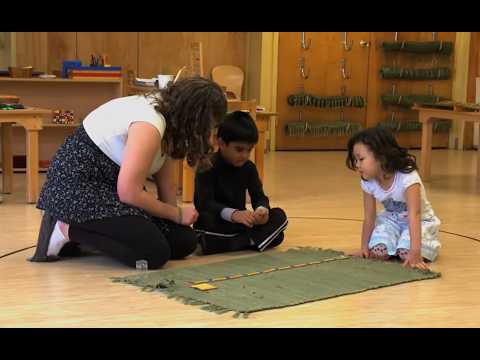
[0:05]Everyone in a community has a vested interest in everyone else's children, because everyone else's children determine the next adult population that makes for a successful society.
[0:21]Built into our biology is the need to have responsive interactions with adults.
[0:29]Neglect for children is when they don't get what the brain is expecting to get, what the child is expecting to get, what we are biologically prepared and waiting for, which is input from those around us.
[0:41]It's this back and forth serve and return interaction that literally shapes the architecture of the brain.
[0:48]Serve and return begins when a child looks at something, or observes something, makes an utterance, and that represents the serve.
[0:58]And the return is when the parent notices the child doing these things and responds to the child.
[1:07]Under conditions where servant return is broken, you literally are pulling away the what is the essential ingredient of the development of human brain architecture.
[1:21]And it was a really compelling series of experiments where they started by videotaping the mother and the baby engaging in cooing and smiling.
[1:30]And then they asked the mother to basically put on a blank face and not respond at all.
[1:40]When a baby is not attended to, that is a sign of danger to the baby, biologically.
[1:47]So the stress systems become activated.
[1:55]in a brain that is constantly bathed in stress hormones, not this up and down that comes with normal development, certain key synapses, the connections between nerves fail to form in critical regions of the brain.
[2:09]So neglect both fails to provide the stimulation that's needed to develop the basic architecture and when it's at a certain level is one of the most potent activators of the stress biology of a young child.
[2:22]So you get a double whammy.
[2:27]Science points to four categories of this spectrum of neglect.
[2:33]The first category would be what's called occasional inattention where children experience responsiveness most of the time but occasionally adults don't respond.
[2:44]There's no harm in that, and in fact, there's probably some benefit.
[2:47]A child can learn to self-soothe and explore the environment, and all of those opportunities build brain architecture.
[2:58]The second category, scientists would call chronic under-stimulation, is where on a regular basis children have less interaction with the adults around them than is needed for healthy development.
[3:10]Those children typically when provided with enriched learning opportunities and more typical levels of serve and return, will show catch-up.
[3:20]The third category is what science would call severe neglect in a family where not only are there prolonged periods of inattention, but often also associated with not being fed enough, not being bathed enough, not having basic needs met.
[3:41]Neglect is a huge problem in the US.
[3:45]Children are much more likely to be neglected than they are to experience any other kind of maltreatment.
[3:54]We see the child really being at risk for much more substantial kinds of deficits down the road that don't necessarily get easily fixed or ameliorated.
[4:05]This is where we really need to think about more complicated and often more intensive strategies to help undo those effects.
[4:11]The fourth category called severe neglect generally found in institutional settings is the result of children living in kind of warehouse-type situation in orphanages.
[4:21]And it doesn't have to even be as extreme as orphanages.
[4:26]It can be experiences that are regretfully occurring in many, many parts of our country.
[4:30]Often institutional care in this country is under the euphemistic name of transitional care, or temporary care, or assessment facilities.
[4:40]If you think about what institutional or residential care would look like for an infant, where there's somebody new coming on to the shift every 8 hours, it really alters the development of the child's brain architecture and other aspects of the child's development.
[4:57]We have the potential to change children's developmental trajectories.
[5:02]Interventions can apply to parents, to foster parents, or adoptive parents, child care settings, head start settings, and other kinds of settings.
[5:11]And really, what they're about is attuning people to the serve and return process.
[5:18]Neglecting young children is neglecting the foundations of of a healthy next generation.
[5:27]The community pays a huge price later in terms of the problems of the next generation.
[5:34]Whether it be educational achievement, economic productivity, good citizenship, the ability to parent the next generation.
[5:44]All of the things that have to do with a healthy, prosperous, society.


