[0:00]In the name of the Father, and the Son, and of the Holy Spirit. Amen. Greetings, beloved 'Living the Word' community. Today we remember St. Anicetus, a Syrian pope from Emesa, who served from 157 to 168 AD. His papacy was marked by his commitment to church unity and his stance against early heresies like Marcionism and Gnosticism. Notably, during his time, he engaged in Easter controversy, allowing St. Polycarp of Smyrna to maintain their traditional Easter observance despite differing views. Celebrated on April 17, St. Anicetus's dedication to ecclesiastical harmony and doctrinal integrity continues to inspire faith and unity. May we emulate his resolve in our spiritual journey. St. Anicetus, born in Emesa, Syria, served as the Bishop of Rome from around 157 AD until his death in 168 AD. His tenure as pope coincided with significant theological debates that shaped the early Christian Church. Anicetus is best remembered for his efforts to uphold orthodoxy against the rising heresies of Martianism and Gnosticism. These heresies challenged the canonical structure of the church and the authenticity of the scriptures, promoting instead a dualistic view of the world. Anicetus actively combated these teachings, working to preserve the unity and doctrinal integrity of the Church. A critical issue during his tenure was the controversy over the date of Easter, which underscored the differing practices between the Eastern and Western Churches. The debate centered on whether to celebrate Easter on the 14th of Nissan, following the date of the Jewish Passover, as was the tradition in the East, and practiced by Polycarp of Smyrna, or on a Sunday, as was customary in Rome. Saint Polycarp, a disciple of John the Apostle, visited Rome to discuss this issue with Anicetus. The two did not agree on a common date, but Anicetus conceded to Polycarp and the church of Smyrna the ability to retain the date to which they were accustomed. The controversy was to grow heated in the following centuries. Anicetus's contributions to the church extend beyond these theological disputes. He is also noted for his pastoral care and the administration of the Church, welcoming several prominent Christian figures of his time, including Hegesippus, a noted Christian historian. This period marked a time when the authority and primacy of the Roman Sea were becoming more recognized and solidified. The exact details of Anicetus's death are not clear, but he is venerated as a martyr, suggesting he may have died for his faith. His feast day is celebrated on April 17, and he is remembered for his dedication to the Church's unity and purity of teaching. There is no specific record of a formal canonization process for Anicetus, as his sainthood predates the establishment of the formal procedures we associate with canonization today. Like many early saints, his recognition as a saint was affirmed by the tradition and veneration of the faithful over time. Let us pray: In the name of the Father, and of the Son, and of the Holy Spirit. Amen. Heavenly Father, we seek the intercession of Saint Anicetus, your faithful servant and guardian of Church unity. Grant us the courage to uphold truth and wisdom to foster unity in our Christian journey. May his dedication to preserving Your teachings inspire us to live in harmony with Your will, facing challenges with grace and striving for the unity of Your Church. Through his prayers, help us to fully and serve You with unwavering devotion. Anicetus, pray for us. Amen.
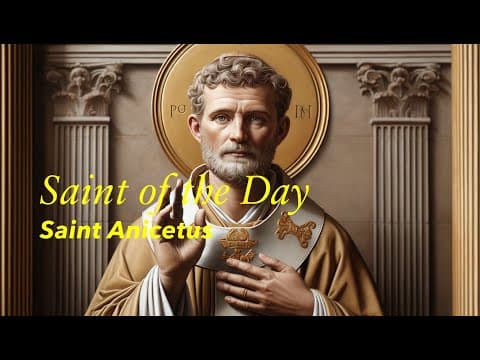
Saint of the Day: St. Anicetus | April 17, 2024
Living The Word
3m 41s577 words~3 min read
YouTube auto captions
Transcript source
YouTube auto captions
This transcript was extracted from YouTube's auto-generated caption track. The transcript below is server-rendered so it can be read, searched, cited, and shared without opening the original YouTube player.
Pull quotes
[0:00]His papacy was marked by his commitment to church unity and his stance against early heresies like Marcionism and Gnosticism.
[0:00]Polycarp of Smyrna to maintain their traditional Easter observance despite differing views.
[0:00]Anicetus's dedication to ecclesiastical harmony and doctrinal integrity continues to inspire faith and unity.
[0:00]Anicetus, born in Emesa, Syria, served as the Bishop of Rome from around 157 AD until his death in 168 AD.
Use this transcript
Related transcript hubs
Watch on YouTube
Share
MORE TRANSCRIPTS


