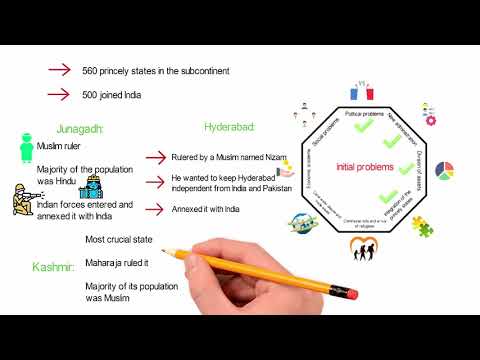
[0:07]This lecture discusses the initial problems faced by Pakistan after independence. Everything had to be built from scratch. The initial problems of Pakistan include political problems, new administration, division of assets, integration of princely states, communal riots and arrival of refugees, canal water dispute and trade issues, economic problems and social problems. Let's discuss each of these in a little more detail. First is political problems. Pakistan faced political problems due to lack of experienced law makers. They were mostly feudal lords. Next is the problem of new administration. In the new country, there was a shortage of human power, especially senior officers.
[1:06]The senior officers did not want to come to Pakistan as it was underdeveloped. There was a lack of building for the administrative workers, lack of furniture and equipment. Next is division of assets. When the assets were to be divided, the actual share of Pakistan was 750 million. Military assets were also divided. Six armoured divisions were given to Pakistan, while India got 14. Eight artillery divisions were given to Pakistan, while India got 40. And eight infantry divisions were given to Pakistan, while India got 21. Another problem was regarding the princely states. There were 560 princely states in the subcontinent before independence. Almost 500 joined India. Three of them were discussed in detail in the lecture. Junagadh had a Muslim ruler and the majority of the population was Hindu. Indian forces entered and annexed it with India. Hyderabad was ruled by a Muslim named Nizam. He wanted to keep Hyderabad independent from India and Pakistan. However, India again seized it. Kashmir was the most crucial state. A Maharaja ruled it, while the majority of its population was Muslim. After the war in 1948, Kashmir was split into two parts. India has half of Kashmir, which is called Indian occupied Kashmir, and the other half is under Pakistan, known as Azad Kashmir. Communal riots and refugee crisis. After the independence, when the Muslims were migrating towards Pakistan, they were attacked by extremist Hindus and Sikhs, and thousands of Muslims were massacred. The people who reached Pakistan alive were the refugees. It was quite challenging for the new country to cater to several needs of the refugees. Water dispute. Another problem was the water. In 1948, there was a water dispute between India and Pakistan, as India stopped the water from Ravi and Sutlej. It was a threat to the already fragile economy of Pakistan. This matter was taken to the World Bank. In 1960, the Indus River Treaty was signed, according to which Ravi and Sutlej and Beas came under India. And Chenab and Jhelum and Indus came under Pakistan. Economic problems. Pakistan faced many economic problems at the time of independence due to its weak economy. The war in Kashmir, the issues of refugees, and the water dispute created problems for Pakistan. The economy was weak as the industrial enterprise was 10%. Industrial workers were 0.5%. Electrical capacity was 5%, and mineral deposits were 10%. Social problems. Many groups imposed social pressures at the time of formation of Pakistan. These included Pakhtuns, Balochis, Sindhis, Punjabis, and Bengalis.


