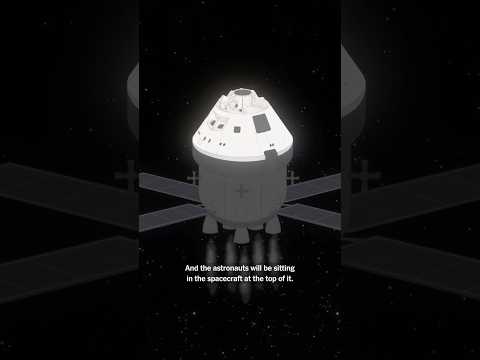
[0:00]The U.S. is trying to get back to the moon. I was strolling on the moon one day. No one's been to the moon since 1972. And so the first big goal of the Artemis program is to land astronauts back on the moon. And that includes designing and building the spacecraft to take them there. Each mission is building toward a moon base and a future where living and working on the moon is no longer extraordinary. But we're not there yet. We're here, at the Artemis 2 mission. During this 10-day mission, four astronauts will go farther than anyone has gone since the end of the Apollo missions more than 50 years ago. This will be the path that the Artemis 2 astronauts will be taking. Artemis 2 is launching from the Kennedy Space Center, Florida, and for the first day, it's going to make two orbits around the Earth. And the main point of this is that NASA wants to make sure that everything on the spacecraft is working properly. The rocket that gets the astronauts off the ground is called the Space Launch System, or S.L.S. After liftoff, the first two pieces to fall away will be the two solid rocket boosters. The central stage will continue burning its hydrogen and oxygen, pushing the rocket up higher, until it uses up its fuel. Then it, too, will drop away. And the astronauts will be sitting in the spacecraft at the top of it. That's called the Orion capsule. After a few days of coasting toward the moon, they'll be swinging around the moon and they'll be flying over the far side of the moon. During this time, the four astronauts will be looking out the window. They'll be taking pictures. They'll, in fact, probably be looking at parts of the far side of the moon that no one has ever seen with human eyes before. And when they emerge, the moon's gravity will sling them on a path right back to Earth. And then the part of Orion that's called the service module is thrown away, and it's only the capsule that will re-enter the atmosphere. So the Earth's gravity will be pulling them back home. For them, this is probably the most boring part of the trip. They've already seen the moon, and they're just waiting to get back home. As they re-enter the atmosphere, the heat shields can be heated up to thousands of degrees. They have to slow down enough to release the parachutes, and the parachutes have to work so that they can land safely in the Pacific Ocean. That's when everyone knows that the mission has been a success. If Artemis 2 works well, then NASA will have to have a quick turnaround for Artemis 3. It will stay in Earth orbit and allow the astronauts to practice docking with the lunar landers that are being developed by Space X and Blue Origin. That sets up Artemis 4 and Artemis 5, when NASA will attempt to land astronauts on the moon at least once, maybe twice, in 2028. Those could be the Neil Armstrong moments for the 21st century. That's one small step for man, one giant leap for mankind.
NASA’s Mission Back to the Moon
The New York Times
2m 59s539 words~3 min read
YouTube auto captions
Transcript source
YouTube auto captions
This transcript was extracted from YouTube's auto-generated caption track. The transcript below is server-rendered so it can be read, searched, cited, and shared without opening the original YouTube player.
Pull quotes
[0:00]And so the first big goal of the Artemis program is to land astronauts back on the moon.
[0:00]Each mission is building toward a moon base and a future where living and working on the moon is no longer extraordinary.
[0:00]During this 10-day mission, four astronauts will go farther than anyone has gone since the end of the Apollo missions more than 50 years ago.
[0:00]Artemis 2 is launching from the Kennedy Space Center, Florida, and for the first day, it's going to make two orbits around the Earth.
Use this transcript
Related transcript hubs
Watch on YouTube
Share
MORE TRANSCRIPTS


