[0:00]The Commonwealth is a voluntary association, currently made up of 56 independent states. United by this membership, they work on shared goals of peace, democracy and development. Together with mutual dependence and respect, this family of nations strives towards a better future. Known in full as the Commonwealth of Nations, its origins come from Britain's former empire, which began under Tudor Queen Elizabeth I. It reached its peak in the 19th and 20th centuries, known as the empire on which the sun never sets. Many countries in the Commonwealth were historically under British rule. The modern Commonwealth began in 1949. From then on, countries could be part of it without owing allegiance to the British monarch. India was the first to establish this, becoming a Republic whilst still being in the Commonwealth. More recently, countries such as Mozambique have joined the Commonwealth without having a direct historical link to Britain. Member states that make up the Commonwealth are independent and equal, regardless of size or wealth. For smaller states, this allows their voices to be amplified on a global stage. All states agree to uphold the Commonwealth Charter, a single document explaining the values and aspirations that unite them. Three intergovernmental organizations and a network of over 80 companies support Commonwealth countries, which cover 1/5 of the Earth's landmass and are home to around 2.7 billion people. These initiatives vary from protecting the environment to building relationships through sport at the Commonwealth Games. Nations, rather than individuals, choose to join the Commonwealth, and can choose if and when to leave, which is why the number of countries varies. Most of these nations are republics, some have their own monarchs, and 14 nations, known as Commonwealth realms, have the British monarch as their head of state. Why is Westminster Abbey talking about the Commonwealth? His Majesty King Charles III holds the title of Head of the Commonwealth, and the Abbey is a Royal Peculiar, responsible not to the Archbishop of Canterbury or any Bishop, but to the monarch alone. Throughout the year, Evensong is attended by High Commissioners, who are senior diplomats for Commonwealth countries, based in Britain. During the service, prayers are said for their governments and citizens, and the High Commissioner reads one of the day's Bible readings. As a sign of respect, their national flag is flown on top of the Abbey on the day when a High Commissioner is present. Since 1972, an annual service to mark Commonwealth Day has been held at Westminster Abbey, attended by members of the Royal Family. They join 2,000 people in the congregation for a commemoration which is broadcast worldwide on the second Monday in March. Flags of all the Commonwealth nations are processed through the Abbey. The service is a chance to listen to inspiring speeches and watch incredible performances that showcase the people and cultures of the Commonwealth. It's a celebration with the Abbey's choir and musicians from around the world filling the church with music. Theologically, this is a Christian service that welcomes those of all faiths and none. Representatives across many churches and faith communities offer words of blessing alongside Christian prayers, reflecting religious diversity around the Commonwealth. From challenging origins to a celebratory present, the Commonwealth looks ahead to a hopeful and youthful future. With 2/3 of all Commonwealth citizens aged 29 or under, young people today will shape its goals looking forward. What will the future look like for them?
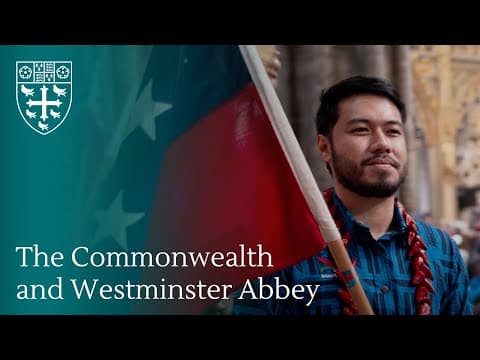
The Commonwealth and Westminster Abbey
Westminster Abbey
3m 54s575 words~3 min read
YouTube auto captions
Transcript source
YouTube auto captions
This transcript was extracted from YouTube's auto-generated caption track. The transcript below is server-rendered so it can be read, searched, cited, and shared without opening the original YouTube player.
Pull quotes
[0:00]The Commonwealth is a voluntary association, currently made up of 56 independent states.
[0:00]United by this membership, they work on shared goals of peace, democracy and development.
[0:00]Together with mutual dependence and respect, this family of nations strives towards a better future.
[0:00]Known in full as the Commonwealth of Nations, its origins come from Britain's former empire, which began under Tudor Queen Elizabeth I.
Use this transcript
Related transcript hubs
Watch on YouTube
Share
MORE TRANSCRIPTS


