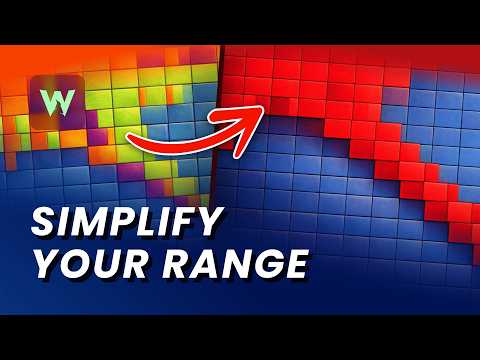
[0:00]Check out this GTO pre-flop chart. It is a cacophony of mixed frequencies and complexity. Now, check out this simplified version. This is my own home brew. It's very easy to play, implement, easy to memorize. The beauty is that this home-built strategy is equally as good as this complicated mixed strategy. The solver says they have the same exploitability and win the same amount of money against the best possible opposing response. In today's video, I'm going to show you how you could transform your own pre-flop charts, six-max, nine-max, you name it, into something human implementable like this beautiful chart. Let's get into it. A simple strategy executed well will invariably outperform a complex strategy implemented poorly. Take a look at this beautifully complex chart on my right. This is a button versus big blind single-raise pot. So here's how big blind defends facing a raise. It's very complex. We have lots of different hands doing lots of different things. And while this is kind of beautiful in its own right, it's too hard to learn. There's way too many mixed frequencies, and in reality, people don't memorize this, they kind of just vibe it. So, in today's video, I'm going to show you how we can make concrete, memorizable pre-flop strategies using GTO Wizard. It's worth first asking, why is it this complex in the first place? Why doesn't GTO just make something easier? Well, the truth is that to a computer, complexity is a free resource. It doesn't care if it's complicated. But to a human, this matters, because if it's too complex, then you can't really implement it properly. So in today's video, I'm going to show you how we can trade some theoretical EV for simpler implementation. So how do I create simplified pre-flop strategies? Well, the method is very simple, it's just guess and check. So essentially, what I do is I start with a GTO solve and then I node lock some caveman simplification in there. And then I say, hey Mr. Solver, here's my really dumb strategy. Uh, how many big blinds does it lose? And it says, wow, Tom, that's a really bad strategy. I can exploit it for this much. I say, hm, mm-hm, okay, let me try something else. And then I just do that over and over and over again, quickly iterating until I get something that's pretty close to unexploitable, while being simple enough to memorize. Now, admittedly, this is a time-consuming and tedious process, but the beauty is you only need to do it once per spot, and then you've got a simplified strategy that lasts for the rest of your life. So, let's take a look at the tools of the trade. GTO Wizard AI comes in two flavors, Elite, which allows heads-up solving, and Ultra, which allows multi-way solving. Now, you may be wondering, why haven't you seen these simplified pre-flop strategies before? That's mainly just due to the fact that this process of guess and check takes forever with a traditional solver because you have to re-solve it every single time you try a new strategy. However, GTO Wizard AI is extremely fast and efficient, so it allows you to iterate very quickly and build out these pre-flop strategies, as I'll show later in the video. So first of all, how do we know a simplification is good? Well, we use exploitability or Nash distance, which represents the maximum EV you could lose against a perfect counter-attack. Now, exploitability is just measured as your GTO EV minus your simplified EV if your opponents are perfectly exploiting you. And importantly, you don't just measure at the node you're simplifying, you need to measure at the root node or the first non-folded node on the street you're working on. As an example, if you are simplifying a big blind response to a button open, you measure EV when it folds to the button, not facing the open. And the reason is that button could change their opening strategy depending on what you're doing. So you get like weird conditional logic that's going to screw you up. So again, measure EV at the root node. Now, here's a really important point that people overlook. Uh, exploitability is not real, it's theoretical, right? Real opponents won't and can't maximally exploit you. So, what we're measuring is, well, look, it's the only objective measure we have. So we really don't have any other quantifiable objective way to say how good or bad a strategy is, so we have to use this. But take it with a grain of salt that an exploitability of let's say, half a percent is not actually going to lose you half a percent. Next, many people want to know, what's a good pre-flop exploitability target? Um, and this is a difficult question to answer because it kind of depends on where you are as a poker player. However, I can try and give you a good answer based on my time in this field. Firstly, if you're within 0.1% pot of GTO, just stop. You're close enough. You are already there, right? You don't need to try and get anything further from this. Um, now if you're within 0.2 to 0.3% pot, this to me is the sweet spot. This is where I think you should aim if you're like a professional player, um, or if you're making charts for professional players. If you're beyond 0.4% pot, I believe you can probably do better with a few more iterations. Um, but it's actually fine to go much higher than this if you're making charts for like recreational players, um, if you're trying to go ultra simplified. You can go way, way higher than this, it's fine. Uh, like I said, exploitability is uh theoretical concept anyway. As I do this, you're going to notice that it becomes harder and harder to make progress as you get closer and closer to GTO. Uh, and there's this kind of hidden complexity power law where the more accurate you try to make your strategy, the more complexity the solver will demand of you. You see, in GTO, at first, in order to get from, let's say, 5% to 1% exploitability, uh, you only really need to solve like macroscopic problems. Like, you're folding too much, you're not putting in enough money with these types of hands. Um, these are like big picture leaks that are practically exploitable. But as you try and go from like 0.2% to 0.1%, these are microscopic leaks that are only really exploitable at the machine God level. Like, it's trying to solve the fact that you don't have enough six of spades on this specific run out in this specific line, like stuff that's the information transfer is so slow, it's not a real concern. Um, now, this chart on the right, it's completely made up, the complexity is in vibe units, but it represents a scale which I believe is somewhat real, and that is that as you get closer and closer to GTO, the required complexity of your strategy explodes, uh, according to some power law. And you can see the scale here is not linear, it's logarithmic. So, going from plus four to plus five is like ten times harder. Um, so hopefully that kind of demonstrates how I think about this scale. But it also asks a very interesting question. What's the difference between like real or practical exploitability and theoretical exploitability? Well, I think big picture, practical exploitability is stuff like hand selection. You know, can you value bet this hand? Um, should you be continuing with this hand? And it's stuff like range frequencies, like is your overall bluff to value ratio correct? Uh, these are things that are kind of easier to detect and exploit, um, these are like practically exploitable, so someone in practice can detect this and punish you for it. Um, and there's many, many strategies that are practically exploitable. But then there's something that's like theoretically exploitable but not practically exploitable. So this is like a subset of it. A theoretically exploitable strategy has like, you know, subtle coverage imbalances or they're leaks that are so noisy and hard to detect that they're not real in practice. Alright guys, next, I'm going to show you some examples in GTO Wizard. So, here's this exact same heads-up spot I showed you at the beginning of the video. This is uh, two players dealt into the pot. So small blind, big blind node locked, simple. Now the way you actually measure exploitability is you go to the first non-folded node, which is just going to be the first node. And here is the GTO strategy. You can see the expected value of big blind is 53.8%. And here, in the node locked strategy, which you can see denoted by this little lock icon, is also 53.8%. Despite the fact that my strategy looks like this. Okay. Now again, the reason you measure at the root node and not at the big blind node is because small blind can change their opening strategy if you're changing the big blind strategy. Like they might anticipate it and change what they're doing. So always measure at the first non-folded node. Um, now, I realized you guys don't actually want to see me simplify a heads-up pot. You're probably more interested in like a, like a six-max cash game spot, so that's what I'll solve. Um, I'm going to go ahead and click edit solution. Um, here we're going to scroll up. Pre-flop, let's go six players in. Now, to be clear, you can solve, um, you know, should be VM TT, Spin & Go, Heads-up cash, six-max cash, nine-max cash, whatever you want. I'm going to solve cash just because it's like, uh, I think what most people watching this show play. So, I can choose my rake here, but I think I'll just go like five and everyone, this is kind of like mid stakes rake. Um, next up, set the stacks and make sure that the raise sizes down in the tree editor are good. So, I want to solve a big blind versus button spot. First thing I'm going to do is change this three-bet size, 14 is a little bit for my test. I like 12.5. It's going to let me play a little more linear. Um, and this, this size is too big. Now, keep in mind, it's not actually like choosing optimal sizes here, it's just like a pre-made tree, so go ahead and change this to something more appropriate. I'll give it the shove, the old four-bet shove, as well as this. Um, so I'm pretty happy with this tree. Now, next, what I'm going to do is switch this from fast to classic. Now you can use either. I'd like to iterate with fast, um, but I think classic is a little bit better for measurements. Uh, I think they're both pretty good. If you're doing like a four-bet pot or something, you'll definitely want to use classic. If you're doing like an RFI, you'll almost definitely want to use fast. But this is really like up to you. It depends on how much time you have. Okay, here we are. This is the original GTO strategy that we're going to try and simplify. Now, the first thing I'm going to do is right-click my tab and select duplicate. Now, if you don't have this in your browser, you can instead click saved spots or M and then just save it in here. Regardless, you need to be able to refer back to it to benchmark your strategy. So again, I've copied it. This will be my GTO to benchmark to. Uh, and then this is my new strategy. So, first thing we're going to do is take inventory of the pures. So what's a pure strategy? Well, I can see that these hands are pure folding. Uh, and I can see that like tens plus, ace jack suited, ace king are pure raising. It's important to take note of this because these are the only hands which strictly prefer raising over calling. And so they should always take this action. And similarly, there are hands in our range that strictly prefer folding over calling or raising. And so we want to take note of the pure strategies and lock those first. Um, so let me start with this. Ding, ding, ding. And I'm going to, some of these that are like just a sliver, I'm going to lock these two.
[11:48]Okay. And you don't have to get this right on your first try, mind you. You can, you can mess this up, it's fine. Uh, and then from my pure raises, let's go, tens plus, Ace Jack suited, Ace King, King Queen. These are my pures. I'm going to go ahead and click range frequency, drag this slider to the left, and that's going to clear my slate.
[12:19]And take away all of the mixed raises. Now, this is going to take a little while for me because I'm using classic mode. Again, if you're using fast, this will go by in just a couple seconds. Okay, there we go. Uh, so, first things first, let's try and get my fold frequency correct. Right now, I'm folding 53% of the time. Here, it says I should be folding 55% of the time. So, let's go ahead and throw in some more folds. What are some good folding candidates, maybe A6, maybe King 8, 10 8, maybe some of these suited or off-suit connectors?
[12:52]Okay. So, hand frequency, fold, um, let's get rid of 10 8, A6 is already gone. What are we at now? We're at 54. Let's throw out King 8. I'm a kind of a sucker for these off-suit connected hands. Um, but overall, I'm at 55% now, so this is a pretty good overall defense. Um, okay, next up, let's try and get the overall raise frequency correct. So, I'm going to go ahead and use a mixed strategy. But and I'm always going to 50/50. If a hand's going to mix, it's going to 50/50. So let's see what hands want to 50/50 in here. Well, uh, the first thing I notice is that all of these broadways seem happy to mix some stuff in there. Um, and then for suited connectors, it seems to have a strong preference for like 9X, 8X, and these uh, suited connector type hands. So, let's go ahead and throw some of these in. Oops, that's GTO. Uh, all right, so, I'm going to make just really simple, easy to remember strategy that that is 50/50 any Broadway, any suited connector, and any suited wheel ace. This is kind of like the caveman strategy, that that puts me at 11%. I need a few more. I remember these hands like Jack 9, Queen 9, uh, 9X, 8X, these hands seem to like to raise a bit. Um, I need a few more. Let's just connect the dots with King 7 and King 6.
[14:31]And that seems, seems okay, right? Uh, next up, I'm going to hit lock. And see this little button down here, you'll want to make sure you select, uh, don't lock previous nodes. It's very important. I want Button to be able to adapt to my caveman strategy and attack it. Now, how did we do? Remember this is a tempt number one. It doesn't have to be good. Um, so I'm going to go back to the root node, the first non-folded node, and I'm going to note that my EV was 53.7%. And in GTO, my EV at the root node was 54.2%. So I'm about 0.5% away from the best possible solution. Which I think is actually pretty good, like a lot of players I think could even stop here. But we can do better with a little bit of iteration. So there's a few methods I like now to try and figure out how to improve my current strategy. Um, first of all, I like to look at my opponent's response. So in GTO, when I three-bet, how are they responding? They're folding 61%, calling 29, raising tens plus.
[15:48]And here, um, now 61% to 64.4%, so they're folding a little bit more, which indicates I'm maybe being a little nitpicking and they're raising a little bit less, which maybe indicates I'm a little too strong in the Broadway. So, um, here, I'm also going to show you another technique, go to compare EV, click compare raise versus call. And here it becomes kind of clear what's going on, right? So, these grayish hands are kind of close to indifferent between raising and calling, but all of these green hands prefer raising. Um, and if we look at my overall frequencies, it's it's obvious, I'm kind of like not raising enough, and I'm raising too strong. Okay, so, what needs to happen is probably I need to get rid of some of these broadway hands and replace them with weaker hands. So, first thing we're going to do is right-click duplicate. And this just saves this spot. So this is my best attempt so far. It's my only attempt, but it's also my best. We're going to save it, open a new tab, and work on this one. Okay, so, first thing I'm going to do is go to hand frequency. Um, go ahead and change some of these to call, and then instead of this, what I'm going to do is have some raises with these suited gappers. Now, are suited gappers okay to three-bet with? Let's double check. In the GTO strategy, it does three-bet with these hands, indicating that it is indifferent with them. Um, and I can also see a preference for some of these hands. So maybe we should throw, um, you know, maybe we should make like some of these hands pure. And you know what, we're still not quite raising enough, so I'm also going to make, um, Ace Queen off-suit pure. I think that looks like a pretty good second attempt. Uh, maybe nine's and eights can raise a little more actually. Yeah. Maybe I'll just do nines. That seems okay. Let's see how it ends up. Okay. Attempt number two. Again, if I go over to the root node, I'm now at 54.2%, and my GTO strategy was 54.2%. So, we're there, guys. Like, I kind of luck boxed this, uh, luck boxed this, getting, uh, this accurate right off the bat. That doesn't usually happen, but, um, yeah. It's good enough. So, that's kind of my process. Um, I'm going to show you some other techniques that I use sometimes. So, just to, it's not usually that easy. Um, but I'll, I'll show you some stuff I'll do here. So, for example, a really useful technique that I found is to unlock just a few combos. So, for example, Ace 4 here, um, I'm not so sure about, so I'm going to go ahead and unlock just this hand. Like so. So everything else remains locked, but now I can adjust just this one hand. And we'll see how it does. Okay. So, here you can see that it actually prefers to raise Ace 4 off-suit half the time. Um, and so I think I'm going to lock this in as my simplified big blind strategy versus the button open. Uh, and so when you're ready, you go ahead and just save this spot with a little floppy disc, and we can say, uh, simplified blind versus button 100 big blind cash, mid stakes, something like that, right? Um, yeah, that seems good enough. And now I can go and find this later. Alternatively, you might also want to take a screenshot and save it to whatever place you save your screenshots of ranges too. Uh, but yeah, this to me is a good enough simplification. It loses basically no EV, it's too small to measure, and I can pretty easily memorize this strategy. Like, this is not particularly difficult. Now, let's compare that to this, uh, absolute monstrosity that we started with. So this is very, very hard to, uh, to try and improve. So, yeah, that's the technique, guys. I use a combination of the compare EV feature and by the way, even when you get it perfectly simplified, you're still going to have hands that like, are doing one thing that don't like that thing. Like here I'm raising Ace Queen, but it doesn't like raising Ace Queen. Um, you can try and fiddle with this, but the, the fact of the matter is that, um, you can have the overall range beyond exploitable, but individual hands have the wrong incentive because this is not a Nash Equilibrium, this is a caveman equilibrium, right? There's a difference. So, just keep in mind that you're never going to get a perfect. Um, the goal is to not be a perfectionist actually, it's to just get something good enough and then move on to the next spot, because frankly, there's a lot of spots to simplify. So, that's basically how I do this, guys. Hopefully that lesson was instructive. Yeah, let me know if you have any questions in the comments. Alright guys, here's the secret sauce. I'm going to recap my simplification recipe. First of all, pick one spot and one spot only. Don't try and simplify everything under one tree, that's just going to create problems. Um, once you've chosen your spot, solve GTO and measure EV at the root node. Use this as a baseline from which to compare to. Then, you're going to node lock pure strategies. So, we're going to say, like, in the GTO strategy, some hands were always raising or always calling or always folding. Those should stay the same. So node lock those pure. Then, mix the indifferent hands until you match the overall GTO range frequencies. I like to use a 50/50 mixture just because it's easy to remember and it's really easy to RNG. Like, you can just go like, you know, is the high card on the left or right? Or use some suit RNG, whatever. It's very simple to do in game. Um, but it's important that you try and approximate the same overall range frequencies. So if you were, you know, three-betting 10% of the time before, you should be three-betting 10% of the time with your simplification. That's going to make it much easier to make progress. Once you've node locked your simplification, it doesn't have to be good, it just needs to be something. You're going to go and again measure EV at the root node and compare it to GTO. Okay. And that's how you evaluate how good your node lock was. Now, as you're doing this over and over and over again, you're going to save your best simplifications as you go. You can either just right-click duplicate or press M. And this way, if you try something and it doesn't work, you can just go back to your high score and just keep iterating on that one at a time until you achieve a new high score. And a new high score. Uh, so that's that's kind of the the workflow. Now, in between solves, when I'm like deciding how I want to alter the strategy, I like to use a combination of first of all inspecting villain's response, because that's going to be very telling. Like, if I'm three-betting and they're way over-folding to my three-bet, that indicates I'm under-bluffing, right? So, seeing how they react or even how they anticipate you is going to be a useful thing to figure out how to change your strategy. Secondly, you can use the compare EV feature in GTO Wizard, that one's really useful. So you can see like the EV difference between raising or calling and, you know, if every hand wants to raise, then you're probably not raising enough. Also, a really useful tool is to allow partial unlocks to see how the solver wants to make minor adjustments. So I don't unlock the entire strategy, just a few hands at a time to see like, okay, if it is going to three-bet more, it's going to add these types of hands. Or maybe it's going to fold these types of hands. Um, so partial unlocks very useful for this process. Now, as you're doing this, you're going to keep adjusting your node lock. You're going to keep re-measuring at the root node and just repeat that iterating on your best attempt until you get to about 0.2 to 0.3% exploitability in fast mode to be practically unexploitable. Um, but if you really, really must be extra then 0.1% in classic mode to get theoretically unexploitable. Again, I don't believe you need step 10. I believe 0.2 to 0.3 is more than enough. I hope it helps you in your game. I hope it helps you, um, crush the stakes you're playing, and as always, happy grinding.


