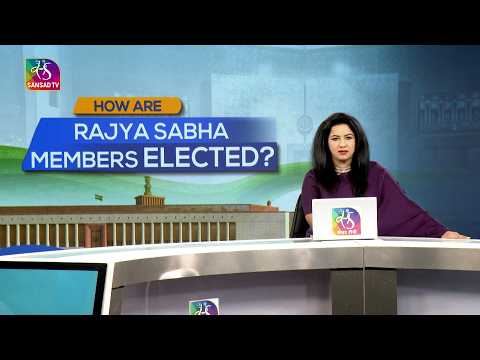
[0:05]Hello and welcome viewers. You're watching in-depth with your host Kriti Mishra. Unlike the directly elected Lok Sabha members, members of the Rajya Sabha are chosen indirectly, elected by members of state legislative assemblies.
[0:18]Through a carefully crafted system of proportional representation by means of the single transferable vote. Why this unique method? Why does one third of the house retire every two years?
[0:29]How does this system preserve stability while reflecting political shifts in the states? Well, we'll decode everything in this edition. Come along.
[0:49]India has a bicameral legislature.
[0:52]Our Constitution provides that Parliament shall consist of the President and the two houses, known respectively as the Council of States or Rajya Sabha, and the House of People or Lok Sabha.
[1:04]The power to summon and prorogue either house of Parliament or to dissolve the Lok Sabha vests with the President.
[1:12]The Rajya Sabha is a permanent house and is not subject to dissolution.
[1:17]However, nearly one third of its members retire every second year.
[1:21]Being a federal chamber representing states and UTs, the Rajya Sabha occupies a significant place in the parliamentary and constitutional setup of India.
[1:30]The Rajya Sabha has possibly seen more stalwarts from various walks of life, from business and sports to culture.
[1:38]Than any other political institution of this country.
[1:41]The upper House of Indian Parliament has been playing a pivotal role in India's much cherished parliamentary democracy.
[1:48]Keeping the bicameral structure alive, setting new records and creating history since its inception.
[1:55]2003 mein, jab is sadan ke 200 saal hue the, tab bhi ek samarambh hua tha.
[2:04]Aur tab bhi sarkar NDA ki thi.
[2:09]Aur Atal Bihari Vajpayee ji Pradhan Mantri the. Toh us 200 mein, satra ke samay jo aadaraniya Atal ji ka jo bhashan tha, bada interesting tha. Unki baat karne ka apna ek lehja tha.
[2:26]Unhone kaha tha ki hamare sansadiya loktantra ki shakti badhane ke liye, second chamber maujood hai.
[2:37]Aur, unhone yeh bhi chetavani di thi, ki second house ko koi secondary house banane ki galti na kare.
[2:50]Yeh chetavani Atal ji ne di thi. Is second house ko kabhi bhi secondary house banane ki galti na kare.
[2:58]Atal ji ke un baat ko jab mai padh raha tha, toh mujhe bhi laga ki kuch toh isko, aaj ke is sambandh mein, kuch naye tarike se agar prastut karna hai, toh mai kahunga, ki Rajya Sabha second house hai.
[3:14]Secondary house kabhi bhi nahi hai.
[3:18]Aur, Bharat ke vikas ke liye, ise supportive house bane rehna chahiye.
[3:34]Jab hamari sansadiya pranali ke 50 saal hue the, tab Atal ji ka ek bhashan hua tha.
[3:41]Sansadiya pranali ke 50 saal par.
[3:44]Aur us bhashan mein, bade kavi bhav se unhone ek baat batayi thi. Unhone kaha tha, ek nadi ka pravah tabhi tak accha rehta hai, jab tak ki uske kinare majboot hote hain.
[4:02]Aur unhone kaha tha ki Bharat ki sansadiye jo pravah hai, woh hamara jo loktantrik prakriya hai, ek kinara Lok Sabha hai, dusra kinara Rajya Sabha hai.
[4:18]Yeh do majboot rahenge, tabhi jaa kar ke loktantrik paramparao ka pravah bahut hi satik tarike se aage badhega. Yeh baat aadaraniya Atal ji ne us samay kahi thi.
[4:36]Yeh ek baat nishchit hai ki Bharat federal structure hai, vividhatao se bhara hua hai.
[4:43]Tab yeh bhi anivary shart hai ki hame rashtriya drishtikon se Ojan nahi hona hai.
[4:54]Rashtriya drishtikon ko humne hamesha hi Kendravarthi rakhna hi hoga.
[4:59]Lekin, hame rashtriya drishtikon ke saath, kshetriye jo hit hai, iska santulan bhi bahut satik tarike se banana padega, tabhi jaa kar ke hum us bhav ko us santulan ke dwara aage badha payenge aur yeh kaam sabse acche dhang se kahi ho sakta hai, toh is sadan mein ho sakta hai, yaha ke manye sadasyon ke dwara ho sakta hai, aur mujhe vishwas hai ki woh kaam karne mein hum nirantar prayasrat rahenge.
[5:35]The makers of our constitution, while establishing Rajya Sabha as second chamber of our Parliament, envisaged a distinct role for it in our parliamentary system.
[5:46]The Rajya Sabha is meant to provide a second look at the legislation passed by the other house, as also to prevent hasty legislation, but not to prove a clog either to legislation or administration.
[6:01]Besides, it aims at providing opportunities to the season and eminent persons who have distinguished themselves in diverse fields, such as literature, science, art and social service to serve the country.
[6:12]It is designed to give representation to the states in the apex democratic decision making.
[6:19]Members of Rajya Sabha are expected to be more experienced and learned and less influenced by the ebb and flow of popular opinion.
[6:27]As House of Elders, it is expected to hold dignified and quality debates on issues of public importance and legislative proposals and to ensure the accountability of the executive to Parliament.
[6:40]The Election Commission announced biennial elections for 37 seats of the Rajya Sabha in 10 states.
[6:47]Seven seats in Maharashtra, six seats in Tamil Nadu, five seats each in Bihar and West Bengal, four seats in Odisha, three seats in Assam, two seats each in Telangana, Chhattisgarh and Haryana, and one seat in Himachal Pradesh are falling vacant.
[7:04]The notification for the polls was issued on 26th of February, and nominations will be filed till 5th of March.
[7:11]Polling will be held on 16th of March.
[7:15]The Election Commission has directed that only integrated violet colored sketch pens of prefix specification provided by the returning officer shall be used for the purpose of marking preferences on the ballot paper.
[7:29]The Commission has also said that no other pen shall be used for marking preferences in the Rajya Sabha elections.
[7:35]The poll body also said that adequate measures for close monitoring of the election process by appointing observers shall be taken to ensure free and fair election.
[7:50]The Fourth Schedule of the Indian Constitution provides for the allocation of seats in the Council of States.
[7:55]The number of members varies from state to state depending on the population.
[8:00]In 1950, when the Constitution came into full force, the Rajya Sabha had 216 seats, but over the years with reorganization of states, the strength of the Rajya Sabha has increased.
[8:14]What is the maximum strength of Rajya Sabha? Well, 250, of which 238 are to be elected and 12 are to be nominated by the President of India.
[8:25]What is the actual strength of Rajya Sabha? The actual strength is 245, of which 233 are elected and 12 are nominated.
[8:35]How many members does each state have in Rajya Sabha?
[8:39]Well, let's take a look at the number of seats. Andhra Pradesh, 11. Arunachal Pradesh, 1. Assam, 7. Bihar, 15. Chhattisgarh, 5. Goa, 1. Gujarat, 11. Haryana, 5. Himachal Pradesh, 3. Jammu and Kashmir, 4. Jharkhand, 6. Karnataka, 12. Kerala, 9. Madhya Pradesh, 11. Maharashtra, 19. Manipur, 1. Meghalaya, 1. Mizoram, 1. Nagaland, 1. NCT of Delhi, 3. Odisha, 10. Puducherry, 1. Punjab, 7. Rajasthan, 10. Sikkim, 1. Tamil Nadu, 18. Telangana, 7. Tripura, 1. Uttarakhand, 3. Uttar Pradesh, 31. and West Bengal, 16.
[9:34]Currently, how many members are elected from union territories?
[9:37]In total, eight members are elected from the Union territories (3 from Delhi, 1 from Puducherry and 4 from Jammu & Kashmir). Other Union territories are not represented in Rajya Sabha.
[9:50]Why is Rajya Sabha called a permanent body?
[9:54]Rajya Sabha is not subject to dissolution; as nearly as possible, one-third of its members retire every second year.
[10:04]What is the term of a member of Rajya Sabha? It is six years; but a member elected in a bye-election serves for the remainder of the term of the vacancy caused.
[10:16]Eligibility. Article 84 of the Constitution lays down the qualifications for membership of Parliament.
[10:20]To be eligible for the Rajya Sabha, a person must be a citizen of India, take an oath or affirmation before a person authorized by the Election Commission as per the Third Schedule, be at least 30 years of age, and possess any additional qualifications prescribed by Parliament through law.
[10:43]Here's how the members of the Rajya Sabha are elected by elected representatives of states and UTs.
[10:49]Let's take a look at the process for election.
[10:52]Election mechanism. Members are elected by Indirect Election by the elected members of Legislative Assemblies of States and UTs respectively, in accordance with the system of proportional representation by means of the single transferable vote.
[11:09]Under this mechanism, MLAs do not vote for a single candidate but instead rank candidates in order of preference (1, 2, 3, etc.) on a ballot.
[11:21]To be declared elected, a candidate must secure a specific quota of votes.
[11:28]Electoral College. Only the Elected Members of Legislative Assemblies (MLAs) of the States and UTs.
[11:35]Domicile Requirement. Pre-2003: A candidate had to be a resident of the state from which they were contesting from. Post-2003: A candidate can be an elector from any parliamentary constituency in India. (Removed by the Representation of the People (Amendment) Act, 2003).
[11:50]Open Ballot System. Voting is not secret for MLAs belonging to political parties. Every MLA from a political party must show their marked ballot to the party's authorized agent before dropping it in the box, aiming to prevent cross-voting and corruption (money power). Independent MLAs do not show their ballot to anyone.
[12:11]Anti-defection. The Election Commission clarified in July 2017 that the anti-defection law, are not applicable to Rajya Sabha elections. Therefore, political parties cannot issue any whip to their members for Rajya Sabha elections, and members are not bound by party instructions in these elections. The party can take disciplinary action (suspension/expulsion), but the MLA retains their assembly seat.
[12:38]NOTA. The Supreme Court scrapped the 'None of the Above' (NOTA) option for Rajya Sabha elections in 2018 (Shailesh Manubhai Parmar vs. Union of India). NOTA defeats the principle of proportional representation and the single transferable vote.
[12:52]Being the Members of the House of Elders, our dharma is to work with commitment to fulfill the people's rightful aspirations.
[13:03]Rajya Sabha has been the cradle of many profound debates and discussions, which have helped in shaping the destiny of our nation.
[13:14]Each time we enter this Temple of Democracy, we should pledge to ourselves to follow the basic principles of parliamentary democracy, which are dialogue, deliberation, debates and discussion.
[13:31]The Rajya Sabha is the Council of States, reflects the federal character of our Republic.
[13:37]This House is also blessed with the knowledge and expertise of nominated members.
[13:45]Together we showcase the collective wisdom and diversity of our nation.
[13:52]Our country is marching forward as a leader at the forefront of development in every sphere.
[14:00]Citizens look up to the Parliament as the highest forum of wisdom and collective judgment to guide the nation.
[14:10]On this note, I am reminded of the words of the great Tamil saintly poet Thiruvalluvar, Solluga sollil, payanudaiya sollarka, sollil payanillai.
[14:23]Thiruvalluvar says, speak only words that are useful and meaningful.
[14:30]Avoid words that are not in the interest of the society.
[14:34]This simple, yet profound teaching holds immense relevance for all of us who shoulder the responsibility of nation building.
[14:48]Rajya Sabha has played a constructive and effective role in our polity.
[14:53]Rajya Sabha is a permanent house and is not subject to dissolution.
[14:57]A member whose elected for a full term serves for a period of six years. In addition, vacancies that arise due to resignation, death or disqualification are filled up through by-polls, after which those elected self for the remainder period.
[15:13]The term of office of a member whose elected or nominated to the Rajya Sabha begins from the date of publication of the notification of such election or nomination, as the case may be in the official gazette.
[15:26]While in the case of election of a member to the Rajya Sabha, notification is issued by the Ministry of Law and Justice. In case of nomination, the notification is issued by the Ministry of Home Affairs.
[15:38]Before taking his or her seat in the Rajya Sabha, every member elected either in by-election or by-election or nominated by the President is required to subscribe oath or affirmation.
[15:51]Over the years, the upper House has seen a memorable journey through lively debates, informed discussions and its ability to handle complex issues in the interest of the nation.
[16:02]Rajya Sabha has remained a vanguard for political and social values, a melting pot of culture and diversity and overall a relentless flag bearer of sovereign, socialist, secular and democratic Republic of India.
[16:21]Well, viewers, that's all we had for you in this edition. Thanks for watching and stay tuned to Sansad TV. Goodbye for now from my side.


