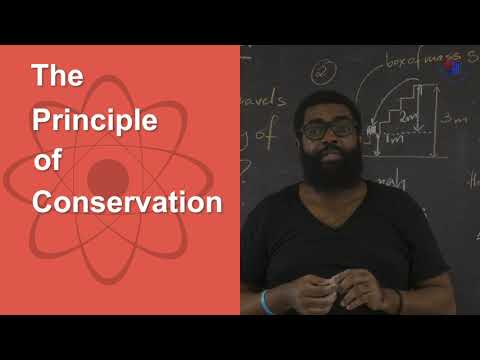
[0:00]Welcome to this episode of CSEC Physics with me Marvin Lee. In today's episode, we have to look at energy, work, power, and of course, the principle of conservation of energy. Not the principle of conservation of linear momentum, the principle of conservation of energy. We'll have to define terms, learn a few formulae and gain a better knowledge and understanding of the topics at hand. Grab a pen, grab a book, stay focused, and I hope you enjoy this episode of CSEC Physics with me, Marvin Lee.
[0:38]Continuing, we have to look at energy. Now, energy is simply defined as the ability to do work. Any task that is done requires energy. sitting up in bed, getting up off of your bed, lifting a spoon to your mouth, um sweeping, cleaning, especially at this jolly time of year. All of that requires energy. As long as work is done, energy is used up. Now, there are many different types of energy. There is chemical energy, there is electrical energy, there is gravitational energy, there is elastic potential energy. We have very, we have a a wide variety of energies. Now, we only look at two for for CSEC physics. Only two energies we we really look at. Our two types of energy. The first is potential energy. Now, potential energy is simply the energy an object has as a result of its position or state. Yes, I have it on the board, just making sure. Position or state. And we'll see the position part a bit later. But state can be, for example, um fuels. Fuels have energy that is released when they're combusted. Um, position could refer to energy stored in an object, for example, a rubber band. When you stretch a rubber band, I'm sure if you have had troublesome friends and you ever had a rubber band around your wrist, they would snap it and sting you or you, you know, put it between your thumb and your index fingers and you put a little piece of paper on it and you go around shooting people in class. We did that a lot in primary school. The reason you could launch your projectile was by stretching the rubber band, you actually stored energy in it and then when you let it go, that stored energy was released and your projectile flew off. We had too much fun in primary school with that and I remember our parents used to actually number the pages in our exercise books. I know it sounds weird, because we would tear out the pages and you know, you start off the week with a thick exercise book and at the end of the week, you got like four pages in the book because you tore out the rest to make bullets and shoot your friend. Yeah, I know. We were crazy as primary schoolers. So, potential energy is the energy an object or body has as a result of its position or state. Keeping on the point of position, we move to gravitational potential energy. Now, gravitational potential energy, sorry, or GPE, is the energy an object has as a result of its position above the earth's surface. Okay? Um, objects that are raised off the ground are raised against the pull of gravity. Gravity pulls down, you lift the object up. In raising the object up, the object does gain energy. Why, or how do we notice? Because when you let the object go, it it falls. Um, Yes, that might sound a bit too simple, but that is the truth. So, GPE is the energy an object possesses as you raise it off the ground. Okay? For those of you who go to um schools with multiple floors, it's easy to walk in the schoolyard with your backpack. Uh, you decide to walk upstairs with your bag. However, you tend to feel it, especially if you're on the top floor. QC students, Saints students, Bishop students, y'all could relate to this. Once you have to go fairly high up, you feel the weight of that bag and those books. Especially primary school students, I really feel sorry for y'all. Now, there is a formula for GPE. GPE, gravitational potential energy, is equal to m * g * h. Mass by acceleration due to gravity. Please do not say gravity. Okay? It's acceleration due to gravity * height. And this height is how far above the Earth's surface the object is. Now, since G is a constant, 9.8 or 10 m/s² when not stated, essentially, your gravitational potential energy depends on the mass and how high you raise it above the Earth's surface. Now, if you think about it, you can have a fairly light object, but if you carry it high enough, you will have a large amount of GPE. On the other hand, you can have a very heavy object. A very heavy object, but to raise it even a small height above the Earth's surface will cause it to gain a large amount of GPE. Now, gravitational potential energy, like all other forms of energy, is measured in joules, named after James Joule. Kinetic energy is the second energy we look at for the CSEC syllabus. And kinetic energy is the energy possessed as a result of an object being in motion. Please don't say kinetic energy is the energy of motion, um or energy in motion. When an object is in motion, it possesses kinetic energy. But to say that it is the energy of motion or energy in motion is a bit incorrect. Now, kinetic energy, KE, is equal to half mass by velocity squared. Mass by velocity squared. Do note, a bit of math, you're only squaring velocity, you're not squaring mass. So, it's mass, multiplied by whatever the value of velocity is squared. Now, again, kinetic energy, just like GPE, just like all other forms of energy, is measured in joules. So, to quickly recap this session or this section, rather, energy is the ability to do work. You need energy to do work. Potential energy is energy a body possesses as a result of its position or state. Gravitational potential energy is energy an object possesses as a result of its height above ground, or the Earth's surface, and kinetic energy is the energy possessed by an object in motion. This is all you need to know for energy. But I would advise you right now to grab a pencil, a book, because we have a few problems to work. Oh, and you may need a calculator as well. So, you grab your pencil, book, and calculator. I write my problems on the board, and we should do some work. Welcome back. Welcome back. Chalk problems. I hope you have your calculator, your pen or pencil, and your book. So, problem one. A car of mass 600 kg travels at a constant velocity of 4 m/s. What is its KE? Simple problem. I know. I know. Formula is kinetic energy is 1/2 mv². Mass, velocity. And that's all we need to know. So, it's 1/2 of 600 by 4². Now, you're only squaring the velocity. The velocity is 4. Half of 4². This is equal to 1/2 of 600 is 300. 4 4s are 16. And this is 4,800 joules.
[8:11]Again, mass 600 kg, velocity 4 m/s. 1/2 of 600 mass by 4² velocity, and you end up with 300 by 16 which is 4,800 joules. And that's it. That's how you use the formula. Please don't think all problems are going to be like this. Not necessarily the case. Okay. With that being done, we move on to a problem with my good friend, Mr. Stickman. So, Mr. Stickman is carrying a box of mass 8 kg up a flight of stairs 3 m high.
[8:52]How much GPE, GPE, sorry, does the box gain? Now, a rule of thumb is when not stated, when not stated, you take GPE to be, sorry, you take G, not GPE, acceleration due to gravity, to be 10 m/s². Okay? For ease of calculation. 10 is a very simple number to work with. So, again, the formula for GPE is mgh. But you might be saying, um, sir, you use the words gain. So, let me explain. If this box was here on the ground, it would have zero GPE. The higher it goes, the more GPE it gains. The GPE it ends up with is a product of its mass by the height at which it stops, 3 meters in this case, by acceleration due to gravity, mass by acceleration due to gravity, by height. Mass, we take acceleration due to gravity as 10 and height is 3. So, substituting into the formula, we have 8 by 10 by 3.
[10:00]8 10s are 80, 3 8s are 24. 240 joules. That's it. This is how we use the problem. So, please again, to note, just don't don't let the word gain confuse you. It's commonly used when in reference to GPE, and it just means what is the GPE at this point. Now, an interesting to note is there is a change in GPE, or there can be a change in both GPE and KE. Let's assume, let's assume just for the sake of argument, that this box, when it got to the top of the stairs, somehow it rolled down the stairs and it stopped somewhere here and this height is 1 m. Okay? 1 m. I could ask, or you rather could be asked, to find what is the change in gravitational potential energy. Okay? And there is a formula for that as well. Now, if you think about it, this box to fall from 3 m to 2 m, sorry, to 1 m, it would mean that the height it did fall. This distance here is 2 m. Because 1 + 2 gives us the total of 3. 1 + 2 gives us 3.
[11:28]So, the change in gravitational potential energy should the box fall to that height is given by this formula. Change in GPE is equal to mass by acceleration due to gravity by change in height. Change in GPE is mass by acceleration due to gravity by change in height. Looking at this, mass is still 8. G is still taken as 10 and the change in height, which is this, because it fell from 3 to 1. 8 10 and 2. I get 80 and I get 160. So, the change in GPE from here at 3 to here at 1 is 160 joules. Please remember this formula. Please remember MGH and please remember 1/2 mv². Those are the formulae that you will need to use. Okay? It's nothing complicated, it's not rocket science. Object go up, an object can come down as well. Also do remember that I did say, problems do get harder than this. All right? Just don't assume that this is as hard as they get. As you can see a little later, they can get a bit more tricky. Now, we have to move on to something else. Um, a principle that you probably can recite, and I'm sure you may remember. Excuse me. Um, this you might have heard it somewhere. It says the, well, it is rather, the principle of conservation of energy. Not linear momentum, principle of conservation of energy. And the principle of conservation of energy simply states that energy cannot be created or destroyed. It is simply converted from one form to another. Let me go over again. Energy cannot be created or destroyed. It is simply converted from one form to another. Classic example, classic example, electricity. Now, you have a fan. You plug your fan in, you turn your fan on. Electricity, which is the form of energy that you are, or yes, which is the form of energy that comes out of your outlet, and please don't tell me, sir, we get blackout. Electricity causes the fan to spin. So, your electrical energy is converted into mechanical energy. And that gives you breeze. It cools you down. That is a form of energy conversion. One energy form, electrical, is converted into mechanical. And that gives you the whole breeze thing going on there. Now, um, are there other energy conversions? Yes. For example, another example I should say, is um stoves, cooking. Your stoves should work with gas. Even if it's, even if it's kerosene, that still is a form of gas. Um, you you light it. You light your stove and whatever energy is stored up in that fuel, whether it be gasoline, kerosene, or did I say gasoline? Oh, father, forgive me. Kerosene or shell or salt. Whatever that is, is converted into heat as the bonds are broken down. Energy is released. And you get heat. So, chemical energy is converted into heat energy in, or via cooking. Um, electrical energy again is converted to heat in your curling iron, your iron, your toaster oven, all these things. Electrical energy is converted into another form of energy. Now, do note that in every energy conversion, there is um, there the conversion is not truly efficient. If you have, say, 100 joules of electrical energy, that does not automatically mean the next form of energy will be 100 joules. Every time there is a conversion, energy is lost. Okay? So, if you can have a process or anything happening with as few energy conversions as possible, that would improve the efficiency of the process. Efficiency we will look at later and you'll understand why. But remember, every time energy is converted from one form to the other, energy is lost. Now, we have to move on to another topic, which is work. I have to do some writing on the board, change the color of my chalk. You can close your book for now. You don't have any calculations to do just yet, but you may have some writing to do shortly. So, let me do my thing. Having changed my chalk and written some new stuff on the board, time for us to look at work. Now, as you can clearly see, work is done when energy is used up. Now, at this level, the assumption is, unless otherwise stated, that all the energy used up is converted into work. Or, yeah, that's the easiest way to say it. All the energy is directly converted into to work. So, if I use up, say, 6,000 joules of energy, the assumption is, I have done 6,000 joules of work. Now, this is not a practical assumption. It is just done for ease of understanding, I guess. But at this level, that is what we assume. So, work is done when energy is used up. That's the easy definition. The more technical definition is, work is done when a force produces motion in the direction of its application. And that gives us this little formula. Work is force by distance. Work, which I must mention is measured in joules, is equal to force which is measured in Newtons by distance which is measured in meters. And that's essentially what work is. You use energy, you probably did work. That's how it works. Didn't mean to use work in that sense, but I did anyway. Now, my two favorite characters, my my fancy car and Mr. Stick. So, to help you understand this, If Mr. Stick is trying to push his little yellow car in that direction, he only does work if the car moves in the direction in which he is pushing. If he is pushing in this direction, and the car decides to move that way, Mr. Stick is not really doing work. Mr. Stick only does work when the direction of motion of the car and the direction of his force are the same. So, if he's pushing in this direction, he only does work when the car moves in that direction. Any other direction would basically mean work is is not being done. So, let's put some numbers to this. Let's say Mr. Stick applies 80 newtons of force. And the car moves a distance of 12 m. The work Mr. Stick would do, would be force 80 by distance 12.
[18:40]And I do believe that this is 960 joules.
[18:50]960 joules. So, Mr. Stick would do 960 joules of work if he pushes with this force and the car moves that distance. This is essentially what work is. Now, having looked at energy, having looked at work, we must now look at power. Power has two definitions. You'll see why two. You'll understand why they're related shortly, and then it's time for us to do a few problems. We have to do some problems involving the law of conservation of energy. You will enjoy those, I promise. So, time to change my chalk, change what's written on the board. I changed chalk again. It's orange this time. And I wrote something new on the board. So, quickly, power is the rate at which work is done. Please note work or the rate at which energy is used up. Okay? So, power can be defined in terms of work done or energy used. Either works at this level. And the unit of power is the watt. Please note, um, you can't have 24 watt. You can have you can only have 24 watts. It's 1 watt, more than 1 watt. Just in case you're a bit confused. So, power is the rate at which work is done or the rate at which energy is used up. This being said, we have a formula. P is equal to E upon t or w upon t, energy or work divided by time. And that that's it. It's a very simple definition. Nothing complicated, easy to use. However, always supplied, it is a bit tricky at times. So, I have a little problem. It's the problem we used when we were looking at kinetic energy. A car of mass 600 kg travels with constant velocity of 4 m/s for 12 seconds. What is its kinetic energy? I should have put was there and what was its power? So, we found kinetic energy. I'll do it again just for the sake of um explanation. KE is 1/2 mv². Half of m, mass, is 600. Half of 600 is 300. V², 4 4s, 16. 300 by 16 gives us a total of 4,800 joules.
[21:31]Okay? This is the kinetic energy of the car. Okay? Now, what was its power? Power would be energy in this case of the kinetic kind divided by time. That means we divide 4,800 by 12. So, 4,800 divided by 12 gives us, let me see. 12 into 48, 400 watts. This is the power of the car.
[22:05]So, as long as energy is used up or work is done, we can have power. And this is a very simple example thereof. For this 12-second period, the power of the car was 400 watts. Also, the kinetic energy of the car again is 1/2 mv². These are the principles you need to know and remember. Now, you have to work a few problems on the conservation of energy. We will go back to this car example. Yes, it's very important. And we will also go back to the example with Mr. Stick and the 8 kg box. Two examples for the entire lesson and they work, nonetheless. So, again, changing my chalk, changing what's written on the board. This time you do need your calculator, your book and your pen or pencil so you can follow along. See you in the next section. Well, I I really didn't change my chalk. It's still orange, but I changed what's on the board. Now, I briefly discussed the principle of conservation of energy. However, I did not do any problems on it. So, I will start with Mr. Stick and his box, and then I'll go to this car. Now, the box weighs 8 kg. It goes to the top of a flight of stairs of height 3 m. And we did our calculations and we got a number for GPE. What I want to explain is not with the numbers really, but what happens? So, when the box is at the top of the stairs here, and like, say, you just put it down at the top of the stairs, it has GPE only because it's it's not moving.
[23:53]Now, it is true that the box is moving up the stairs. Yes, I totally get that. But I'm talking about when it's at the top of the stairs and it's perfectly at rest. As it moves, once it's in motion, it will have kinetic energy that cannot be denied. But when it's at the top of the stairs, the only energy possessed by the box, once you put it down at the top of the stairs, let me draw it in, is GPE. If the box fell from the top of the stairs, this would change. Now, if we remember the formula for GPE, GPE is m * g * h, mass by acceleration due to gravity * height. m * g * h. When this h becomes zero at ground level, it means that GPE is zero.
[25:09]So, now, where does this energy go? Because over here it has energy, but at the bottom, it doesn't. By the principle of conservation of energy, all of this gravitational potential energy that is possessed by the box at the top of the stairs, is converted to kinetic energy as it falls. Because as the object falls, it moves faster and faster and faster. That's why jumping off, if you stand on your bed and you jump off your bed, that's one thing. But if you stand on your roof and jump off your roof, that's something totally different. What has changed? Your height. Gravity hasn't changed. Your mass hasn't changed. Your height above ground has changed. That means you have far more energy. That's why you fall kind of harder from higher distances, because you have more gravitational potential energy, and that energy is converted into kinetic energy as you fall. Now, important points to note. First of all, the total energy of the system cannot, or the box, cannot be greater than this amount. So, doing our calculations, if we take G is 10, m is 8, and h is 3, we get 240 joules. This is the maximum amount of energy that this object will have, whether up here, halfway down, 3/4 down, or at ground level. Okay?
[26:35]The reason being is the system had this amount of energy, this amount of energy at the top, and it will not get any more energy as long as it falls under the effect of gravity alone. Now, it also means, if GPE at the top is converted to KE at the bottom, okay? GPE at the top is converted to kinetic energy as the object falls. At the bottom, the amount of kinetic energy possessed will also be 240 joules. Okay? Let me go over again. As the object falls from this height, this distance above ground decreases. As the distance decreases, GPE decreases. But then where does the energy go? The GPE is converted into kinetic energy, and that kinetic energy, is going to be at the bottom the same as the GPE was at the top. So, a question could be posed. And I will pose that question to you now. If this object falls, what is the kinetic energy of the object? Well, sorry, the velocity of the object, rather, just before it hits the ground? Like that split second before it hits the ground. So,
[27:48]very simple. We use the formula mgh and we find GPE at the top. And I'm doing it again, I know I did it here, but I'm doing it one more time. Mass is 8, we take G is 10 and height is 3. So, 8 10s 80, 3 8s are 24. And this is our answer, 240 joules. This 240 joules would be equal to the object's kinetic energy just before it hits the ground. But KE is 1/2 * m * v². Now, I asked you what is its velocity? Again, mass is 8. So, we just do some simple substitution. 240 is equal to 1/2 of 8 by v².
[28:38]Okay? Now, half of 8 is 4. 240 over 4 is v². 4 6s are 24. And 60 is our v². Therefore, the velocity is the root of 60. 7 7s are 49. I do not have a calculator on me at the moment. Hopefully, we will post the value on the screen. But it should be 7. something meters per second. Yes, I know, I don't have a calculator. Bad, horrible. But, do forgive me. Just just so you know, I actually do own calculators, but I end up giving my students, no, lending them and I don't ever get them back. So, everybody who's ever bought a calculator from me and never given me back, this this is your fault. I'm kidding. But, this is how we find the velocity of the object. GPE at the top is converted to KE at the bottom. We do the math, we follow the equations, and we get our value. Always remember that by the principle of conservation of energy, as the object falls, this GPE is gradually converted to KE. So, at the top, you're going to have GPE only. At the bottom, you're going to have KE only. And in between, you're going to have an ever changing mix of the two. The closer you are to the top, the more GPE you have. The closer you are to the bottom, the more kinetic energy you have. This is why, again, this is why the higher you are, the harder you fall is very true. There was this, I forgot his name. His name is so weird. But the human being, I I will just call him the human being, that broke the sound barrier while free falling. There's a reason he had to go that high. The reason he needed to go that high is because he had to generate an incredible amount, or build up rather, an incredible amount of kinetic energy. And then that KE was converted into, sorry, gravitational potential energy. I'm thinking too far ahead. He had to build up a massive amount of GPE, and that had to be converted to KE as he fell. If you ever go and look at the video, it was sponsored by Red Bull, if I remember correctly. Um, it, he literally went to the edge of space. And if you ever look at the entire video or even if you look at the point from which he jumped, he went so high, he could see the curvature of the Earth. He could like literally see space. And he literally had to wear a pressurized suit. He had to have oxygen. It was ridiculously difficult and dangerous. He did it, nonetheless. And again, the reason he went high is because he needed enough GPE to be converted into KE to ensure that his velocity was greater than 340 m/s. Yes, m/s, which is the speed of sound. So, GPE is converted to KE as we fall. The opposite can happen as well, which is why I did this. Suppose, suppose this is a fancy rocket car or a flying car. And the car's kinetic energy, which it has as it travels along the ground, can be converted into GPE which can take it up into the air. Suppose, we can live in a land of make-believe. We do the opposite of this. If we find out how much KE the object possesses, we can find out how high can this car go? So, again, KE is 1/2 mv². m is 600. V is 4. Um, 4 4s 16, 4,800 joules. Now, if I say or if I ask you or tell you, rather, this amount of kinetic energy is converted into GPE totally. How high can the car go? You can easily pull this off. What do you do? You equate the KE to GPE, because again, all of this is converted to that. So, this is equal to mgh. What is m? 600. What is g? 10. So, 600 by 10 by height. Doing the math quickly, we have 4,800 divided by 6,000. If I struggled to do this in primary school, Miss Miss Miss Edwards, I'm really sorry. I I give up on mental a while. Please, don't show up at my mother's house and complain. All right. 12 into 48, 4. 12 into 65. He really didn't get very high. He just got 0.8 m off the ground.
[33:40]So, it could work both ways. Um, again, by the principle of conservation of energy, KE can be equal to GPE. And this is how high the car goes. Now, there could be many other examples, for example, um, you could say, fuel produces so much energy.
[34:02]And if the fuel is is is, burnt at a certain rate. What is the uh amount of heat energy provided? There are so many other examples that can be done, but for simplicity sake, we choose to use um examples that more involved GPE and KE because again, those are the two energies we look at. So, when it comes to the principle of conservation of energy, just remember that any form of energy can almost be converted into any other, and you can do a bit of math to support it. Now, in conclusion, in conclusion, because this has been a fairly long lesson, I would believe. We looked at three things today. We looked at energy, which was defined as the ability to do work. We looked at the two types of energy, um gravitational potential, which varies with height off the ground, and kinetic, which varies with velocity. We looked at work. Work is defined as um being done when energy is used up, or work is also done when a force produces motion in the direction of its application. And finally, we looked at power. Power is essentially the rate at which work is done, or the rate at which energy is used up. And here, in these two very strange examples, we looked at the principle of conservation of energy, which states, energy cannot be created or destroyed, is simply converted from one form to another. And that's it for energy, work, and power. Next time you see us, we will have a lab for you and a few other definitions as well. So, for now, take care, stay safe, wear your masks, wash your hands, do your SBAs, and I will see you on the next episode of CSEC Physics with me, Marvin Lee. Peace.


