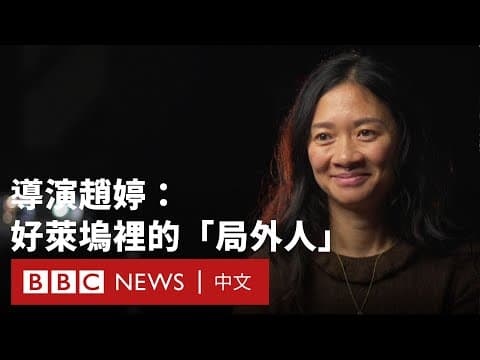
[0:00]So we're going to wait for the sun to to get a little more dramatic. starting there we go. Chloe Zhao is an Oscar-winning film director, but she's only one of three women to have won this award in nearly a century. To this day, she's also the only woman of color to get an Oscar for best director. Her films often focus on outcast communities, nomads, cowboys, indigenous people. Most recently, she's entered the Marvel Universe, and she's directed the most diverse film in their franchise. We've come here at Elstree Studios in London to talk to her about how the film industry in Hollywood is still shaped by men, what she's doing to change that, and how being an outcast is a superpower.
[0:59]Chloe, thank you so much for being part of BBC 100 Women in conversation. It's really good to be able to talk to you. Thanks for making the time. First, I wanted to ask you, you are the second woman to have ever received an Oscar for best director. And to this day, you are the only woman of color to have received that award. When you think about that now, what does that title mean to you? It's such an honor. That was the year of the pandemic, so it was the first time we were able to gather in person. And it wasn't at the Dolby Theater, it was at Union station, it's inside of a train station. So it felt like a small indie film festival. I really loved it. So you liked that it was more intimate. It was less scary, less less nerve-racking, I think, yeah. So we have chosen three clips from three films that you've directed in the past few years, and we'd like to show you those clips and ask you about them. Okay. Let's start with the first clip from Songs My Brothers Taught Me. Let's take a look.
[2:21]Oh, hello Jashon. Come on, Monkey, what are you doing? Are you leaving with Aurelia?
[2:32]What? No. Why would you say that?
[2:39]I heard you two talking about it.
[3:00]Are you really leaving me?
[3:13]Wait. Wait up, Jashon. I hate you.
[3:24]You've made this choice a few times in the movies you've directed to to cast people who are not actors, which is quite unusual. Can you tell me about that? Why do you choose to do that? Once I immerse myself in that place with these people, it was very it was very hard to find anyone who with with the very little bit of money we had, is able to go out there and spend that much time and to feel like there they could just be part of that world.
[3:59]And I had mentors in film school who said, well, if you can't afford someone that can go through the process to do that, then you might as well just get the real thing. And and then I realized that is not about professional or non-professional. It is about are you authentically in your body, present in that moment? That's where good acting comes. You've often chosen to represent outcasts, and you've seen this in Songs My Brothers Taught Me where you, you know, talk about the Native American community,
[4:39]you've done a whole movie about a cowboy. Why is it important for you to tell these stories? Where where does that urge come from? I feel like most of teenagers at some point feel like they're an outsider. There are some that don't, but but um, I was feeling very um, separated from from um, my environment when I was growing up. And in my teenage years as well, and I just remember feeling very lonely. I realized no matter where I am, I keep looking for this home and this belonging. And I tried many, many places. I was a cowgirl, you know, I was living on the reservation, I was living in a van, I did all of that. So you did that while filming those? Yeah, I mean, they they it was I wasn't sure what life and and fantasy and reality was like blended for me, but I still felt, I still felt that I don't belong. And this is going to sound very obvious because you know, home is here. And now at 42, I can look back and go, well, I wish I was there with that little girl and say, you're not alone, because you're not separated. Separation is an illusion. I wish I was there to tell her that, but I'm also glad no one did, because then she'd spend a lot of time, she'd spend her whole life trying to tell stories, um, of people who are separated, who who are um, who we feel they they exist in a world that's so different than ours that we have nothing in common. And then I tell these stories, and I show them to people around the world and they go, ah, they're just like us. And therefore, that illusion of separation dissolves within the two hours they're in the theaters together. And you moved to Brighton in England when you were 14. And I, you know, I actually moved to Brighton when I was 18, and I spoke very little English, and you had a similar experience, right? Yeah, we're probably going to the same clubs. Um, but you know, that was difficult, you know, that feeling of it's not my mother tongue. How has that experienced shaped the way that you make films? I think it made me listen more. Let's say I go to someone's home for for holiday, you know, because I was exchange student. So, and I sit there I have a meal and then people are talking and I didn't understand what they're saying, and it takes a long time for me to express myself. So I started to look for non-verbal cues. And I think that is why my films don't have a lot of dialogue, because I find that to be more universal. Language is beautiful, but sometimes it separates us because we don't understand it, but a smile is a smile, a touch is a touch. What does your identity as an Asian American director mean to you? Do you feel that it sets you apart? Do you think that, you know, it informs the way that you do things, or do you think it doesn't really matter? I think it definitely informs the way, you know, our culture that of our home country definitely influences are our in our bones. Is in my digestive system. Coming from China, from Eastern culture, you know, we there there are philosophies, there're there our way of being that that's deeply rooted in my culture that I feel like definitely shows up in my films. And and the blending of the East and the West and and the harmonization of it, I feel like subconsciously I've been exploring in my work. You said that the structure of the film industry tends to be masculine. Can you tell me about that? Yeah, I think a lot of women who thrive to got into like the top of their field could could resonate with that, maybe, because because the even just the working hours of Monday to Friday and repeat that every day for the rest of your life. We we're in a society where we value productivity over everything, you know, how can you produce the most in the least amount of time? And it's not like the person people made those decisions are good or bad, it's survival. Right? So I find myself hustling and thriving in the film industry to get to where I am, and sort of looking back at it, uh, I have sacrificed things. I feel like I would like going forward, other women don't have to sacrifice, because if we don't change the structure of the industry we're working, we're just saying that we need to do exactly, be exactly like men.
[10:02]And I don't to have value, and I don't think that is where our power lies. So you think that the way that the industry, the way that the film industry is built, the structure of it, tends to favor men more than women? Yeah, I I I believe the working structure of every industry is like that. Um, it makes more sense to a man's physical body, you know, even I think as a woman, um, the last few years and through filmmaking, through collaborating with actors particularly, like I've been trying to learn what's in here, you know, not just here. And discovering as a woman, there's deep strength in my body that's different than a man's. And what kind of strength? Well, let's say I menstruate. And that is that made me understand that life is cyclical. That my body operates cyclically, where again, I can't speak for men, but but it's a bit more linear. Um, and so every month, I experience four seasons. That you realize, wow, in this season, certain sensitivity and capacity is amplified. And in that season, I have incredible boundaries, and I can sink really deep into the subconscious to to come up with with things for my script. You know, so, so then I go, yeah, but my working hours and the way meetings are planned, and the way a film shoot is planned, does not really allow me to fully bring that power forward. There were moments growing up, I I wish I were a man, um, because I thought my life would be easier. Um, I wouldn't have a lot of these things that were told that that not going to make me able to achieve things. But then when I and I try to be like a man, but then now, when I start to accept my womanhood and my body and what my strength is, that is when, um, you know, true safety started to come in. But I'm curious because you are a successful Oscar-winning film director, and yet, do you think your life in the industry would have been easier as a man? No, I don't I don't know how easy it is for men these days either, to be honest. I think they all need a hug from us. I I think I see the men around me they're exhausted. You know, and I I don't think this is easy for anyone because it's unnatural the way we are we've been trying to thrive in a way that is unnatural. Do you feel a level of responsibility? You know, now you have a bigger voice to try and change things. Has that sort of changed how you navigate the industry? I never want anyone to come out of a creative experience more wounded than than when they first arrived. There's no reason, nothing is important. I I feel like this is not just the film industry, but again, in the name of productivity, of achieving goals, of thriving, um, of accomplishment, of proving oneself, worth, we put ourselves through so much that is not healthy. Now, I'd like to show you another clip from one of your movies, and this is from the movie that won you an Oscar, which is Nomadland. Let's have a look. My husband worked at the USG mine in Empire and I worked in human resources there for a few years. That was my last full-time job. I did a lot of part-time jobs, I cashiered at the Empire store. I was a substitute teacher at the school for five years. Didn't the Empire mind shut down and then all of the resident workers had to relocate? Yeah, about a year ago. Wow. So, when do you need to get back to work? Now. It is a tough time right now. You may want to consider registering for early retirement. I don't think I can get by on the benefits and, um, I need work. I like work. I'm not sure exactly what you would be eligible for. What was to me really interesting about this scene was that she really wants to work. She's looking for a job. She can do lots of things, but she's basically told, have you thought about retiring early and, you know, that that theme of older women wanting to contribute to society but finding it really hard, you know, feeling redundant. Is that something that is important to you that you wanted to talk about? Yeah, I am I am very passionate about that, because again, back to the the building blocks of society and why is out of balance is because we are valuing youth over uh, older age. Where if you think about throughout time, the wisdom from the elders and what they've learned is the one of the most foundational building blocks of society, what makes society healthy. You know, you look at when you're 18 years old, you wish you could have told her something, right? And remember, when you're 80 years old, you want to tell an eight-year-old what? And when we stop listening to the 80-year-old and and making them not important, then the society start to become very unhealthy. You know, I get the feeling that especially the film industry is obsessed with youth. Is that still the case? I don't know what industry doesn't value uh, youth and productivity and, um, obsessed with it all goes back to this deep fear we have of our own mortality. and pretending it's not there. Fran, I loved working with Fran, who said, every line on my face tells a story. I never want that that's my landscape. You know, that, you know, that's what a wisdom you get from someone who's lived. In the past you've spoken about why it's important to have women shaping the way that a film looks, and you've talked about the female gaze being important from a female director, but also you've said that, you know, you can have a female gaze from a male director. What is the female gaze, and why is it important? You have a script, you write a really brilliant script and then you hire the best people in the world, and then you get it in the can and then you add it, make sure it's still that, and you test it with a bunch of audience and then you shoot more, and then you just make sure it's never going to fail according to what the audience trend data comes in. Oh, it's exhausting just to say it. I think a more feminine way of looking at it is that, okay, so I wrote a script, I thank all the people I've worked with, and then very quickly, as I enter into the world, if I stop saying that script is the blueprint, I can't go away from it, and surrender to what life gave you, what your actors gave you, what the weather gave you, what suddenly missing this amount of money gave you. You know, what and and be present and let all that in and sit in that discomfort. And so then and to trust that there's a way to get to the end like that, as well. So don't bulldoze through with an idea, but be receptive to change. Receptive is a very heavy word. Is it it's exhausting in a different way. And do you say that like in your experience women tend to do that more than men? I think because our body changes. I I go back to the body wisdom. That again has been told is a problem, is a weakness, but men need that wisdom from us. They don't have the same emotional body as us, and the way our body changes in one month is a miracle. This year, um, BBC 100 Women is looking at resilience in a fractured world. We've got, you know, people who are lonely, countries at war, very divisive ways of doing politics. Do you feel that the world is more divided than ever? Then ever, I don't know enough to say that, but it is definitely divided. Um, it's the stories we tell ourselves, and this is a power where as a filmmaker, you know, as a storyteller who's contributing to that all the time, I was very careful to to say, am I am I putting out more connection or more division? Everything come out my mouth, you know, I have to think about that. Because words does have a very big effect on people. So I'd like to show you another clip that we've selected and this one is from Eternals. Hey, which is your Marvel movie? Let's have a look. No, I'm sorry, you just can't show up in my life and expect me to go with you. I'm not going to. You want me to go? You know what my mom would say to you right now, right? Quit procrastinating, Phil, and take care of your business. He's a chronic procrastinator. I'm not leaving you two. No way. I'm not happy about it. But if there's a chance for us to watch Jack grow up and live a life of his own, we should take it. What does my heart want from me? Why do these eyes of mine cry?
[21:01]What we just watched is essentially a superhero who decides to leave behind his husband and his child to go and save the world, which is kind of how a lot of um, American superhero stories go, but the reason we chose this is that this was the first gay kiss in a Marvel movie. Um, why was it important for you to show that? It was important for me and for Marvel, uh, and for the cast as well. Um, look, Eternals is a story about a group of people that came to Earth at the beginning of human civilization. And so it's a story that it makes perfect sense to to have this group of people to be as diverse as possible. It was really important for us that it is great to have two people who are showing their love, that a lot of time we're told it's not love. And how did you react when a few countries like Kuwait or Saudi Arabia banned your movie because of that? We we weren't surprised. We knew. Everyone go is on their own journey, and we just have to, we just have to do what we think is right for our heart. Where do you think Hollywood is when it comes to diversity? I have two feelings about that, but one's in front of a camera, one behind. I feel like in front of the camera, we have made big progress, and it's about getting deeper and deeper, more nuanced with that progress. You know, it's not just about getting a certain number of representation, but can these people be just human beings? Can they not only be in films that has to address certain kind of issues? Can they just be in every genre of films? They just exist as a human being, as opposed to I'm sort of a species that needs to be treated differently.
[23:46]So, I think we're getting there. I'm I'm on the way to that. Um, I hope, I hope. At least I see efforts. Because if we're only doing superficial level, it's not true representation. What do you mean by superficial? Well, you just have you, for example, if you, I remember my first film, songs, I was sort of asked I I understand where they're coming from, but I was challenged of why I haven't addressed this whole list of issues that an indigenous community faces. I said, well, because it's a film about a teenager trying to figure out where they belong. And I'd like to treat them like that. First and foremost, a human being, not an issue, you know, um, that needs to be examined. And I myself would like to be treated that way. Not just as a Chinese woman, but as a human being. And are we seeing that second layer of representation? I I think so. I think it's starting and great, great filmmakers, both from every, every, um, walk of life have been feeling that. Because at the end of the day, great filmmaking, great characters require that. Chloe Zhao, thank you so much for talking to me and talking to BBC 100 Women. It's been amazing to talk to you. Thank you for having me. It's an honor.


