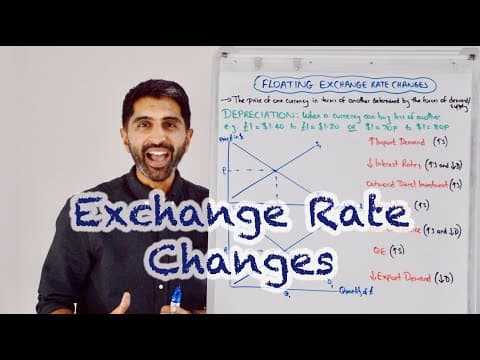
[0:00]Hi everybody, from my last video, we now understand the basics of a forex market. But let's in this video understand why a floating exchange rate can change in value. Remember, a floating exchange rate is determined by the forces of demand and supply, so a change in demand and or supply would be the reasons why a floating exchange rate can change in value. Let's take for example, a depreciation. This is a technical term for a weaker exchange rate in a floating exchange rate system. This is when the price of one currency is lower in terms of another one or more simply when a currency can buy less of another one. So for example, maybe one pound was equal to one dollar forty, now it's only equal to one dollar twenty, that's a weaker pound, a depreciation of the pound. Or flip the other way, maybe one dollar was equal to seventy P, but now one dollar is equal to eighty P, that's a stronger dollar, which implies a weaker pound, a depreciation of the pound. So what could cause that to happen in a forex market? Well, diagrammatically, it could be an increase in supply of a currency or reduction in demand for a currency. So we can illustrate that by shifting supply to the right, so here from S one to S two. And what we can see is that the value of the pound in this situation has fallen from P one to P two, that's a depreciation of the pound. But also a reduction in demand. We would show that by a shift left of the demand curve. So here from D one to D two, and we see the same reduction in the exchange rate from P one to P two, a depreciation of the pound there. But from my last video, we understood that supply of a currency is selling, and demand for a currency is buying. So this is more selling of a currency, and this is less buying of a currency. Understanding that takes us nicely to factors that can depreciate a currency. So for example, there might be an increase in import demand within the UK. When we buy imports in the UK, we're buying in foreign currency. So that involves more selling of the pound in order to buy imports in foreign currencies, increasing supply of the pound. Maybe it's a reduction in interest rates. Yes, that can significantly weaken an exchange rate. There is a big link between interest rates and the exchange rate, and that link is hot money flows. Hot money is investor savings that chases the best interest rate internationally. So in this situation, if interest rates in the UK are low, relative to interest rates elsewhere in the world, investors who are saving their money in UK banks are thinking, look, the rate of return I'm getting on my savings in the UK is low, relative to what I could get in other countries. So instead, let me move my money out of the UK and save it in other countries where interest rates are higher, chasing that higher interest rate. As investors move their money away from the UK, they're selling pounds to convert to currencies they're moving to, increasing supply of the currency. That is a hot money outflow from the UK, which would then depreciate the value of the pound. But equally, there is a link to lower demand for the currency as well. Naturally, if interest rates are low in the UK, relative to other countries, investors aren't going to be as inclined to save in the UK, reducing demand for the currency, compared to if interest rates were kept at their normal rate. It could be outward direct investment, that's firms leaving the UK. That could be British firms, that could be foreign firms leaving, but naturally when firms leave, they're going to be selling pounds to convert to currencies they're moving to, increasing supply of the currency, depreciating the value of the pound in this case. It could be speculation. Yes, that the pound is going to fall in value in a few days time. Speculators are currency traders who make trades on what they think is going to happen to the value of a currency, hoping to profit off that trade. So if you're a speculator and you think the pound is going to fall in a day or two, what's a logical trade to make money off that hunch? Well, you will sell the pound now at what you think is a high price, and if you're right in a couple of days, the pound does fall in value, you can buy it back at that lower price. So by selling high and buying back low, you can make the profit margin that's in between. That trade is known as shorting, shorting of a currency. But by selling now, that trade would increase supply of the currency, depreciating it in value. It could be low confidence in how the UK economy is performing. It could be macro performance, it could be the state of our government finances coming under pressure, it could be unsustainable funding of a current account deficit, whatever it is that is trigging low triggering low confidence in how the UK economy is doing. That could lead to then capital flight, people moving their money out of the UK for safe keeping elsewhere. We call that movement of money capital flight, when money leaves a country because of a lack of confidence in it. Not to be confused with hot money flows, hot money is all about chasing the best interest rate, whereas capital flight is all about a lack of confidence, and money leaving because of that lack of confidence. And naturally, as people move their money out of the country for safe keeping elsewhere, there'll be more supply of the pound, more supply of the currency, depreciating it in value.
[5:34]Also quantitative easing is naturally, directly, an increase in the money supply in a country. So directly will increase supply of a currency, weakening it in value. And also lower export demand for any reason will mean lower demand for that country's currency. So in this case, lower demand for British exports will mean lower demand for the pound, because British exports are sold in pounds. And this is great, because once we've understood once we've understood factors that can depreciate a currency, it's just the reverse of factors that can appreciate our currency. Let's go there now. So an appreciation is the technical term for a stronger exchange rate in a floating exchange rate system. And this is when the price of currency rises in terms of another one or more simply when a currency can buy more of another one. So for example, one pound was one dollar forty, maybe now it's one dollar sixty, right? The pound can buy more of the dollar. Or flip the other way, one dollar might have been seventy P, now it's only sixty P. That's a weaker dollar, that's a stronger pound, an appreciation of the pound. So what could do that diagrammatically? Well, a shift right of demand, so more demand for a currency, or a shift left of supply. Uh, less supply of a currency. Um, both shifts here at the same exchange rate, there would be an excess demand for the currency, which then puts the upward pressure on the currency from P one to P two in both situations. But now remember demand shifting right is more buying, supply shifting less is less selling. So let's go to the factors, which are pretty much the flip reverse of the factors we've just covered, make sense of these. So, number one, higher export demand, so if there is more demand for British exports, those exports are sold in pounds, this is naturally going to increase demand for the pound. Higher interest rates in the UK relative to other countries in the world would attract hot money inflows. Investors will look to move their money into UK financial institutions, chasing that higher interest rate in the UK, increasing demand for the pound. But also investors will look to move their money out of the UK less, reducing supply of the currency, appreciating it that way, too. It could be inward direct investment, firms now coming into the UK, investing in the UK, all their operations will be conducted in pounds. Whether it's the setting up of factories or shops, whether it's investing capital machinery, paying wages and other costs, all of that will take place in pounds. So naturally, increasing demand for the pound in this situation. It could be speculation that the pound is likely to rise in a couple of days. If you're a trader, the trade to make is to buy the pound now at what you think is the low price, and if you're right in a couple of days, the pound goes up in value, you can sell it at the higher price. So by buying low, selling high, you're making the profit margin in between. But by buying now, that's increasing demand for the currency. It could be high confidence in how the UK economy is performing. If that's the case, people will look to save their money in the UK, seeing the UK as a safe haven country, where nothing really is going to go wrong with their savings. So as they save in the UK, that's naturally going to increase demand for the pound, because their savings will need to be in pounds in the UK. But also high confidence will mean less capital flight, less supply of the currency that way too. Could be quantitative tightening. This is the exact reverse of quantitative easing. So this is when the Central Bank is selling bonds back into the market to reduce the overall money supply to increase interest rates. By reducing the overall money supply, that in itself is shifting supply left, potentially appreciating the value of the currency. But also it could be lower import demand in the UK. If UK consumers or firms are buying less imports, that's less supply of the currency than was taking place before, potentially appreciating it in value. So there you have it guys, factors that can both depreciate and appreciate a currency. Simplify, demand is buying, supply is selling, and it becomes very easy to cover these. So stay tuned for my next video, where we're going to look at how a fixed exchange rate works and how it's maintained. Can't wait to see you then. Thanks for watching this one.


