[0:00]Iran's military has accused the United States of negotiating with itself over the conflict in the Middle East. A spokesperson added, someone like us will never come to terms with someone like you. Well, President Trump insists his administration is talking to the right people in Iran and that they badly want a deal to end the war. Well, Mr. Trump also claimed he had been given a great prize by Iranian negotiators, adding it was related to oil and gas and the Straight of Hormuz. Iran has said what it called non-hostile vessels can pass through the strait, which is critical to the global economy. Well, from Washington, David Willis begins our coverage. Amid talk of peace, the war continues in the Middle East. But reports suggest that Trump administration has come up with a 15 point plan aimed at ending the fighting and that negotiations are already underway. Pakistan, which acted as intermediary, is offering to host peace talks and President Trump says Iran is desperate for a deal. They have no navy left, they have no air force left, they have no anti-aircraft equipment left, no radar left, no leaders left. The leaders are all gone, nobody knows who to talk to. But we're actually talking to the right people and they want to make a deal so badly. He followed that with the startling claim that Iran had already agreed to abandon its nuclear ambitions and added that they had given the US a gift. Actually, they gave us a present. And the present arrived today. It was a very big present, worth a tremendous amount of money. And I'm not going to tell you what the present is, but it was a very significant uh, uh, prize. All the president would say is that it was related to this vital stretch of waterway, the Straight of Hormuz and the oil and gas that passes through it. Iran has now said it will allow so-called non-hostile vessels to pass through here safely provided they coordinate with Iranian authorities. Tehran is yet to comment on the latest claims by President Trump having previously denied that any such negotiations were taking place. And amid all the talk of peace, the US is deploying more troops to the Middle East. The amphibious assault vessel USS Tripoli is en route from Japan, leading one of two marine expeditionary units and an elite contingent of paratroopers is on its way from the 82nd airborne division. Meanwhile, Iran continues to lash out at its neighbors, a reminder that for all the talk of negotiation, this conflict is far from over. David Willis, BBC News. So let's get the very latest we can cross over to Doha. Our security correspondent Frank Gardner is there and Frank, once again different competing narratives about this war. Where are we with what is happening? Who's talking to who? So, I think what is happening is that messages are being passed from the United States indirectly to Iran via intermediaries like Pakistan, Turkey, and Egypt. That's happening. That's not the same as negotiations. And I think what we're seeing is that the White House appears to be, in certainly what people here think, um, rather inflating the passage of messages into the idea of some kind of a deal because that's being vigorously denied by Iran. And I have to say that the best way to drive Iran away from a deal is to keep saying publicly that Iran is desperate for a deal. That's not going to appeal to this very stubborn, defiant, and surprisingly resilient Iranian regime, which is essentially now the Iranian Revolutionary Guard Corps because the supreme leader Ali Khamenei is gone, he's been assassinated. We haven't seen uh, from his successor Mojtaba Khamenei, he's not appeared in public. So we've got to assume that the military, the hardcore Iranian Revolutionary Guards Corps are in charge. They've spread out their um, their control laterally, horizontally as it were amongst the 31 provinces. They're still acting on orders, they've got uh, extraordinary resilience. They are in control largely of the straight of Hormuz. They are charging shipping $2 million a time for every vessel that comes through there, saying, you can come through, you can't, you're an aggressor, you belong to an aggressive state, you don't. They're exporting over a million barrels a day of their own Iranian oil through the straight of Hormuz to China and to India. Well, Gulf Arab states, oil and gas is sitting idle here on this side of the Gulf. It's a terrible situation for the Arab Gulf states, it's a pretty strong one for Iran and the US is not, despite what it says, achieving its aims in this war. So Frank, just help us to understand, as you say, Iran has these 31 provinces, all of these provinces have their own effective uh, Iranian revolutionary guard core. Who is in charge of the overall if you like the the federal part of it? Because there's got to be somebody heading this. We know that Mojtaba Khamenei is not seen. Is there one person that is overseeing all of this? To be honest, I think that's probably a question you need to put to an Iranian expert of which I'm not. Um, but we do know that prior to his assassination a few days ago, Ayatollah sorry, excuse me, Ali Larijani, not an Ayatollah, Ali Larijani, who was the secretary of the Supreme National Security Council in Iran, a very experienced former speaker of Parliament, but he was certainly reported to be overall running the the conduct of the war. Other reports are saying that um uh Qalibaf, Muhammad Qalibaf, is a speaker of the parliament, is in some way in charge. But I think we're perhaps looking at through the the wrong lens. Iran planned for this day. It had war gamed and practiced and rehearsed for this day. The all those IRGC commanders in the 31 provinces are acting on pre-existing orders that have been left by the supreme commander, the supreme leader, Ali Khamenei before he died. And until those orders are countermanded, they are going to carry on with the existing orders they've got, firing drones and missiles at targets at this side of the Gulf, intermittent. I mean, we haven't been struck here in Qatar since last week since about Thursday. Um, but other states, Kuwait, Saudi Arabia, Bahrain and the Emirates are being hit. And most importantly, the Straight of Hormuz is being uh partially strangled by Iran, only allowing through um its own oil to its own friends. And as I say, that is giving an enormous amount of strategic power to what's left of this regime. So the power is spread out horizontally rather than vertically before. Frank, as always, really good to get your analysis, Frank Gardner there joining us from Doha. Well, let's cross over to Dubai now and get the very latest from there. Azadeh Moshiri, my colleague there is there. So Azadeh, obviously, we've got these uh conflicting messaging coming from the Trump administration, coming from the Iranian regime. The Gulf States, obviously watching to see how this will unfold. Absolutely, because Iran's control of the Straight of Hormuz is so essential uh and it's having such huge ramifications on the way these Gulf countries have uh have modeled their economies. Energy sector is hugely important and they depend on that shipping lane for their exports. And so they're going to be watching these conflicting reports. It said that they're not as involved as they typically would be. Qatar, Oman usually essential to this. Pakistan not too much of a surprise that it could reportedly be involved given the relationship between the military chief there and Donald Trump. Asim Munir and Donald Trump have had multiple conversations and meetings in the past year. The what's concerning is that uh it's unclear who the White House is actually negotiating with and as Frank mentioned, who is actually in charge. Yes, this is a regime that has been built on survival. We've seen that it's willing to sustain a huge amount of pain and damage to its economy via sanctions uh and also suffering amongst its people. We've seen that through the brutal crackdowns uh that this this regime has unleashed on the people as early as as January most recently. But you've also got these new leaders at the top. Donald Trump has said, oh, well there has been a sort of regime change. These are new leaders at the top, we've we've killed the others. But who are these new leaders? If you look at the trifecta of names that is getting repeated here, uh most recently Mohammad Bagheri Zohrat, who's replaced Ali Larijani on the Supreme National Security Council, of course, uh supreme leader Mojtaba Khamenei, and whatever health he is. He's just lost multiple family members including his father, killed by these US Israeli strikes. Uh and then you've also got uh and then you've also got uh Muhammad Qalibaf, Bagher Qalibaf, who is the head of the um who's the speaker of Parliament. All three of these people have very strong links with the uh Islamic Revolutionary Guards, hardline figures. And so, in some ways what you're seeing happen is exactly what Iranians I've spoken to inside the country and many Iran watchers around the world have warned against the idea of the Revolutionary Guards, these hardliners suddenly getting more control of the country just as people from the outside are pushing for regime change. Azadeh, as always, thank you very much. Azadeh Moshiri there joining us from Dubai in the UAE.
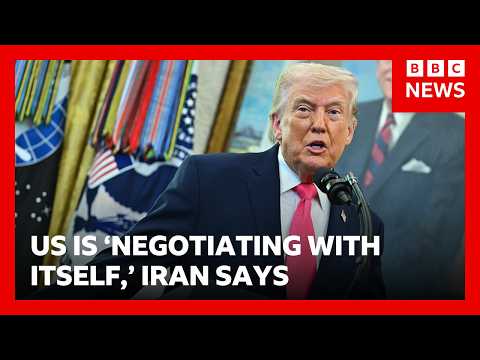
US is 'negotiating with itself,' Iranian military says | BBC News
BBC News
12m 40s1,620 words~9 min read
YouTube auto captions
Transcript source
YouTube auto captions
This transcript was extracted from YouTube's auto-generated caption track. The transcript below is server-rendered so it can be read, searched, cited, and shared without opening the original YouTube player.
Pull quotes
[0:00]Iran's military has accused the United States of negotiating with itself over the conflict in the Middle East.
[0:00]A spokesperson added, someone like us will never come to terms with someone like you.
[0:00]Well, President Trump insists his administration is talking to the right people in Iran and that they badly want a deal to end the war.
[0:00]Trump also claimed he had been given a great prize by Iranian negotiators, adding it was related to oil and gas and the Straight of Hormuz.
Use this transcript
Related transcript hubs
Watch on YouTube
Share
MORE TRANSCRIPTS


