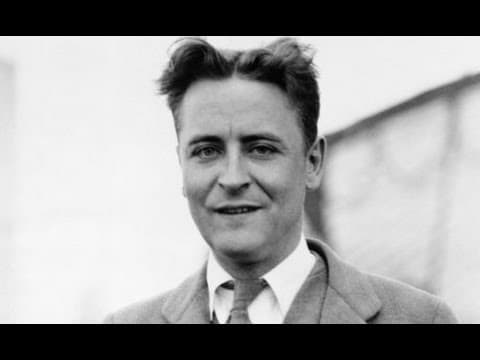
[0:06]New York's a lucky city. At least as far as literature is concerned. Every few decades, it produces a writer who tells its stories, its triumphs, its tragedies, its comedies, its romance.
[0:25]About 30 years ago, the job fell to me, J. McInerney.
[0:33]A fair number of reviewers of my first novel, Bright Lights, Big City, invoked the name of F. Scott Fitzgerald. His work hadn't made a deep impression on me up until that point, but I returned to it then and fell under its spell.
[0:53]I beg your pardon. Mr. Gatsby would like to speak to you. Alone. His masterwork, The Great Gatsby, has already been filmed four times. A fifth version, directed by Baz Luhrmann, will reach cinemas this summer. I'm certainly glad to see you again. I'm certainly glad to see you as well. Gatsby embodies the American Dream of self-invention. A man who reinvents himself for love, just as Fitzgerald would, not once, but twice. He captured the reckless postwar spirit of youth in the roaring 20s, the flappers and the parties, and the bootleg liquor. The inevitable reckoning in the hangover to come. Fitzgerald never wrote an autobiography. He left us something better. Letters. Letters to editors, or publishers or lovers or friends. Some signed faithfully, some ever yours, but almost always meant sincerely, F. Scott Fitzgerald.
[2:15]On January 10th, 1918, Francis Scott Fitzgerald was in an Army camp in Kansas. Waiting for the call that would take his company to France and war in the trenches. To pass the time he'd been writing a novel. Before it was quite finished, he paused to write a friend about it. There are 23 chapters, all but five are written, and really, if the publishers take it, I know I'll wake up some morning and find that the debutantes have made me famous overnight. I really believe that no one else could have written so searchingly the story of the youth of our generation. God, how I miss my youth. The aspiring author was all of 22. And he was in love with his future wife, Zelda Sayre. Zelda's home was near his military base, but she wasn't sure that Scott was worth marrying. Both Scott and Zelda seemed solidly middle class, but in fact, Scott's family had no money. His Princeton college education had been paid for by his grandfather. The uniform hid a multitude of financial sins. With no prospect of inherited wealth, his novel was an essential tool in his seduction kit. In fact, apart from his good looks, it was all he had. He was convinced that if he finished it and published it, he would get the girl. He sent it to a New York publisher, Scribner's. They rejected it, twice. And Zelda, after briefly accepting his proposal of marriage, rejected him too. The war ended. Fitzgerald moved to New York and got a job in advertising. But he didn't stop writing. He couldn't. Writing, even letter writing, was a vital part of what he needed to see in the mirror every morning. Without it he was just another face in the crowd. So he rewrote his novel, renamed it This Side of Paradise, and sent it off once again to Scribner's. On September 18th, 1919, he received a reply from a junior editor named Maxwell Perkins. The answer was yes. He wrote straight back.
[4:45]Dear Mr. Perkins, I've been in a sort of trance all day. Not that I doubted you'd take it, but at last I have something to show people. Terms, et cetera, I leave to you, but would it be utterly impossible for you to publish the book Christmas or say by February? Have so many things depended on its success, including, of course, a girl. Excuse this ghastly handwriting, but I'm a bit nervous today. Of course he was nervous. He'd written the book in part to get the girl. So the news that he was about to become a published novelist was only half the news he needed. It worked. Zelda took him back.
[5:46]F. Scott Fitzgerald and Zelda Sayre got married here in St. Patrick's Cathedral in New York on the 30th of March, 1920. It was a small affair, conducted in the vestry. This Side of Paradise had been in print four days. A novel described by its author as a bad book full of good things. A novel about flappers, written for philosophers. It had been selling faster than his publisher could print it, complete with a cover that those attending the wedding must have smiled at, because they're only two or three paces from the people it was modeled on.
[6:33]Scott was the novel's hero, Emery Blaine. Zelda was the heroine, Rosalind, the classic flapper girl, flirting, kissing, viewing life lightly, saying, Damn, without a blush. After the wedding, Scott and Zelda went straight to the Biltmore Hotel. Straight back to the party that people were beginning to believe they stood for as the perfect jazz age couple. They started dancing, flirting, kissing, drinking. A quart of Bushmills whiskey, then out into the freshly bewitched city, through strange doors into strange apartments, with intermittent swings along and taxis through the soft nights, and writing all night again and again.
[7:41]The first speakeasies had arrived. The toddle was passé. Within a few months, we scarcely knew anymore who we were, and we hadn't a notion what we were. And we were quoted on a variety of subjects, we knew nothing about.
[8:04]To what extent do you think that Scott and Zelda collaborated in dramatizing their own life in creating their own myth? They worked hard on that legend, particularly when when they were young and when they were really inseparable. They love telling stories about each other, glamorizing each other, building each other up, exaggerating stories that had actually happened. They were both performers. They were both very good actors. This is who I'm going to be today. This is how I'm going to dress. They dressed for the part. Zelda was very emphatic about dresses. Today can't be a pearl gray dress, it has to be a dress the color of fresh green paint because it's spring. They dressed for the parts, they looked the part. Scott talks about the way in which he felt that they were ultimately unable to live up to the role that the public expected of them. And yet it seems to me that for a time they really did and that they really together symbolize the era of the era that Scott had partly created in his fiction. The era of the flapper, the jazz age, New York in the early days of prohibition. The two of them together working in tandem, were were so highly symbolic of everything that was bright and white and light in New York City at the time. And they were going to remain frozen in that golden moment forever.
[9:48]In an unguarded moment, his life was full of those. F. Scott Fitzgerald once admitted that he wasn't sure whether he and Zelda were real or characters in one of his own novels. The first producers of a movie version of Paradise were equally unsure. They asked Scott and Zelda to play the lead roles. Scott's publisher finally convinced him that it would be unwise.
[10:22]Life imitates art, they say, but in the case of F. Scott Fitzgerald, there often seemed to be no difference between the two. Journalists visited and found him difficult to distinguish from the people he'd written. New York Tribune, May 7th, 1920. With the distinct intention of taking Mr. Fitzgerald by surprise, I ascended to the 25th floor of the Biltmore and knocked in the best waiter manner at the door. On entering, my first impression was one of confusion, a sort of rummage sale confusion. A young man was standing in the center of the room. I'm looking for my hat, he said dazedly. How do you do? He seemed slightly tipsy, both amused and bemused.
[11:20]And his wife was loosely based on several of his paragraphs.
[11:30]Rosalind is utterly Rosalind. She wants what she wants when she wants it, and she is prone to make everyone around her pretty miserable when she doesn't get it. But in the true sense, she is not spoiled. Her fresh enthusiasm, her will to grow and learn, her endless faith in the inexhaustibility of romance, her courage, and fundamental honesty. These things are not spoiled.
[11:59]In October of 1921, Zelda gave birth to a daughter. When the child was placed in her arms, Zelda, still befuddled from the ether, muttered, Oh, God, goof, I'm drunk. Isn't she smart? She has the hiccups. I hope it's beautiful and a fool, a beautiful little fool. Fitzgerald wrote that down, saved it for later. They christened the child, Francis Scott Fitzgerald, Francis with an E. They called her Scottie.
[12:40]And back they went to the party, baby and all.
[13:05]Through it all, he remained astonishingly productive. A book of short stories, a second novel, another collection. Dear Mr. Perkins, here are some suggested blurbs. Tales of the Jazz Age, satire upon a saxophone by the most brilliant of the younger novelists. He sets down flappers and then proceeds in section two to fresher and more fantastic fields. A medley of bathtubs, diamond mountains, Fitzgerald flappers, and jelly beans. These books did nothing to disturb his public image as the Jazz Age author. But Fitzgerald was getting tired of all that. Increasingly aware that as long as he didn't write anything radically different, he couldn't complain that the articles written about him all seemed to have the same kinds of titles. Flapper novelist, flapperdome's fiction ace. He wanted to write something lasting, a or the great American novel.
[14:09]In October of 1922, Scott, Zelda and their baby daughter moved out to Long Island. A place called Great Neck. The last 80 years have filled in a lot of the gaps. In 1922, Great Neck was more a place of parks and mansions.
[14:30]The parties in Great Neck were studded with celebrities. Scott and Zelda held as many as they could themselves, in their more modest residence. And when Great Neck was quiet, Manhattan was hazily visible across Long Island Sound, like a memory that you could actually revisit. Only 30 minutes away, if you drove dangerously fast. Slowly a new story began to form in Fitzgerald's mind.
[15:07]I believe that on the first night I went to Gatsby's house, I was one of the few guests who had actually been invited. People were not invited, they went there. They got into automobiles, which bore them out to Long Island, and somehow, they ended up at Gatsby's door. And after that, they conducted themselves according to the rules of behavior associated with an amusement park. Blocked in Long Island, Fitzgerald took his unfinished manuscript and his family to Europe, to the Riviera first. It was somehow better if Manhattan and Long Island were more distant memories. But Zelda felt like luggage, something attached to the arm of the fashionable young novelist. It wasn't enough. She fell for a young French aviator in a white duck uniform who used to buzz their house in his biplane. She asked for a divorce. Fitzgerald refused. The aviator went away, taking Scott's youth with him. Fitzgerald wrote his best men. Dear Lud, I remember our last conversation and it makes me sad. I feel old, too, this summer. That's the whole burden of this novel. The loss of those illusions that give such color to the world, so that you don't care whether things are true or false, as long as they partake of the magical glory. The finished manuscript went back across the Atlantic in October of 1924. Completed at the same time as Scott and Zelda reassembled their relationship, it was indeed a novel about lost illusions. A novel in which the central character, J. Gatsby himself, was never clearly described, apart from his smile. The novel is told to us by an observer of the events, Nick Carraway. There's a lot of reported speech, this person said this, this person said that. And Gatsby himself remains largely a reported figure. I'm Gatsby, he said suddenly. What, I exclaimed. Oh, I beg your pardon. I thought you knew, old sport. I'm afraid I'm not a very good host. He smiled understandingly, much more than understandingly. It was one of those rare smiles with a quality of eternal reassurance in it, that you may come across four or five times in life. It faced or seemed to face the whole eternal world for an instant, and then concentrated on you with an irresistible prejudice in your favor. It understood you just as far as you wanted to be understood, believed in you as you'd like to believe in yourself and assured you that it had precisely the impression of you that, at your best, you hoped to convey. Precisely at that point, it vanished, and I was looking at an elegant young roughneck, a year or two over 30, whose elaborate formality of speech just missed being absurd.
[18:29]He remains shadowy and indistinct, and thus glamorous and mysterious. We never really see him more clearly. There are other parts which receive clearer descriptions. The girls in yellow dresses at Gatsby's parties, Meyer Wolfsheim, the man who fixed the 1919 World Series. Whenever the camera of Fitzgerald's prose approaches Gatsby, the focus is soft, indefinite, and thus glamorous and mysterious.
[19:23]The question was, how could Fitzgerald support himself while he wrote the novel? Ever since his career began, his bread and butter had come from selling short stories to the American popular press, but he'd lost the knack. Apart from brief lapses, he'd been off the booze for a year and a half. His final binge began in April of 1939. It would last almost nine months. Between drinking bouts, he worked on the novel. Scottina, look, I have begun to write something that is maybe great. And I'm going to be absorbed in it for four or six months. I am alive again. I'm not a great man, but sometimes I think the impersonal and objective quality of my talent, and the sacrifices of it, in pieces, to preserve its essential value, has some sort of epic grandeur. Anyway, after hours, I nursed myself with delusions of that sort, with dearest love, Daddy. By November, Fitzgerald had written an outline and six or 7,000 words of completed prose. He ground to a halt. With a fragment of fiction too short to sell, he drank and died. On the first of December, Fitzgerald assaulted a nurse he'd hired to moderate his alcohol intake. Struck Sheila and repeatedly threatened to kill her. She'd hidden his gun weeks before, or this might be a different story. Sheila called the police, and then she left him to die. It is odd that the heart is one of the organs that does repair itself. His heart did not repair itself.
[21:37]Fitzgerald died of a massive heart attack in 1443, North Heathworth Avenue, on December 21st, 1940. He was just 44 years old. When I looked once more for Gatsby, he had vanished. And I was alone again in the unquiet darkness.


