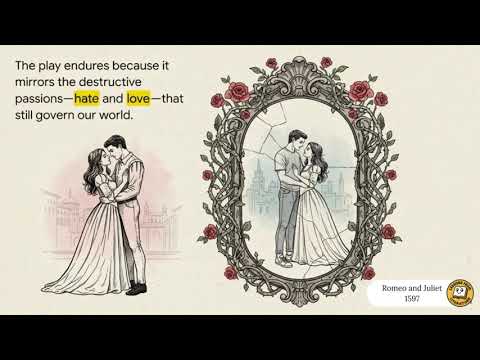
[0:00]Most of us think we know the story of Romeo and Juliet. We see it as the greatest romance ever told. But what if it's not a love story at all? What if it's actually a brutal cautionary tale about a society poisoned by hate, where love isn't the cure, but the very thing that lights the fuse? You see, the tragedy here is fueled by forces we still see all around us today. Right from the very first lines, Shakespeare spoils the ending. There's no mystery about what happens. The whole point of the play is to show us why it has to happen. So we're not watching to see if they'll make it out alive. We're watching to understand the machinery of their doom. So let's talk about the first and most powerful force in this story, hate. And we're not talking about a simple disagreement. This is a deep, systemic, inherited hatred between two families, the Montagues and the Capulets. This ancient grudge, as the play calls it, is basically the toxic air that everyone in the city of Verona has to breathe. And look, this conflict isn't just between the two old guys in charge. It's like a tribal infection that has spread to absolutely everyone. You know, the play doesn't open with the nobles, it opens with their servants trying to pick a fight over a stupidly petty insult, biting a thumb? Right away, that shows us that this feud defines everyone's identity, from the absolute top of the ladder to the very bottom. And doesn't that sound familiar? I mean, think about modern political polarization, or rival groups on social media. Your identity becomes less about what you stand for and more about who you stand against. You're not a person first, you're a Capulet or a Montague first. And if you want to see this hate in human form, look no further than Tybalt, Juliet's cousin. This guy doesn't need a reason to fight. The fact that you're a Montague is reason enough. He's less of a character with complex feelings and more of a walking, talking grudge. He is a pure force of conflict, and as long as he's around, peace is completely off the table. Okay, so you've got this city that's basically a powder keg of hate. Now, let's introduce the second key ingredient, a love that moves with the speed and intensity of a forest fire. Romeo and Juliet's passion isn't just romance. It's the accelerant that gets poured all over that smoldering grudge. Just look at this timeline. It is breathtakingly fast. They meet on a Sunday. They're married by Monday morning. And by Wednesday, they're both dead. Their entire story from that first glance to their deaths happens in less than three days. That's not just moving fast. That's a kind of reckless momentum that leaves zero room for thinking, for planning, or for just catching your breath. Friar Lawrence is pretty much the one adult in the room who sees the danger. This warning he gives them, it's basically the play's central argument against moving too fast. He sees the train wreck coming. And yet, because he hopes their marriage might end the feud, he agrees to help them. Basically becoming a co-pilot in the very disaster he predicted. So when you combine this inherited hate with this reckless, super fast love, you create a tipping point. A single moment where every other possible future just vanishes, and the path to disaster gets locked in. In this story, that moment is a chaotic, bloody street brawl. Let's just break this down moment by moment. Tybalt challenges Romeo, seeking revenge. But Romeo, who's now secretly married to Juliet, Tybalt's cousin, refuses to fight. His best friend, Mercutio, thinks this is cowardly, so he steps in. Then Romeo, trying to do the right thing and stop the fight, literally jumps between them. And it's in that exact moment that well-intentioned attempt to make peace, that Tybalt stabs Mercutio right under Romeo's arm. Romeo's effort to fix the problem is what directly causes the catastrophe. And once the grief-stricken Romeo retaliates and kills Tybalt, that's it. The story is sealed. He's no longer just a boy in love. He is the killer of his new wife's cousin. From this moment on, their love story and the path of bloody vengeance are the exact same thing. There is no going back. This is the moment Romeo gets it. He screams this out because he realizes that his own actions, even the ones he took for love and peace, have just made him a pawn in some cruel cosmic game. He tried to defy the system of hate, and in doing so, he became its most perfect, tragic instrument. The trap just snapped shut. All right, so the real power of this play isn't just in the sad story. It's in the models for human behavior that it gives us. We can actually pull some clear, usable frameworks from the wreckage of Verona that are frankly startlingly relevant to our lives right now. First, there's the escalation spiral. Minor provocations spiral into fatal conflict. Biting a thumb spirals into a sword fight, which spirals into death. Second, the information gap. The entire tragic ending hinges on failed communication, a letter that doesn't arrive, a message that comes too late. It's a masterclass in how logistical failures can lead to disaster. Third, you have identity versus self. When Juliet asks, what's in a name? She's questioning the entire tribal system she lives in. She's asking, are we just our labels, or is there more to us? And finally, there's the paradox of intervention. Romeo trying to stop the duel, the Friar trying to end the feud, both show how sometimes the best of intentions can backfire in the worst possible way. So that brings us to the big question. Why? Why, after more than 400 years, do we keep coming back to this story about two doomed teenagers? Well, I think the answer is that the play asks a question that we're all still trying to figure out. Was it Romeo's choice to kill Tybalt that sealed his fate? Or was he destined from the start to be a star-crossed lover? The genius of the play is that it never gives you an easy answer. Its power comes from living on that razor's edge between free will and fate, attention that every single one of us feels in our own lives. In the end, this story feels so incredibly modern because the ingredients are timeless. You've got tribal hatred, impulsive decisions, massive communication failures, and the terrible role of just plain bad luck. These aren't 16th century problems, they're human problems. Their love didn't just happen in a vacuum. It was born into a world that was already broken. Broken by a feud they didn't start, but were forced to inherit. Their story is a permanent warning that when we build our world on foundations of division and hate, the first casualty will always, always be love.
❤️ Romeo and Juliet — Book Explained | Lessons From Literature
Lessons From Literature
6m 29s1,185 words~6 min read
YouTube auto captions
Transcript source
YouTube auto captions
This transcript was extracted from YouTube's auto-generated caption track. The transcript below is server-rendered so it can be read, searched, cited, and shared without opening the original YouTube player.
Pull quotes
[0:00]What if it's actually a brutal cautionary tale about a society poisoned by hate, where love isn't the cure, but the very thing that lights the fuse?
[0:00]This is a deep, systemic, inherited hatred between two families, the Montagues and the Capulets.
[0:00]This ancient grudge, as the play calls it, is basically the toxic air that everyone in the city of Verona has to breathe.
[0:00]You know, the play doesn't open with the nobles, it opens with their servants trying to pick a fight over a stupidly petty insult, biting a thumb?
Use this transcript
Related transcript hubs
Watch on YouTube
Share
MORE TRANSCRIPTS


