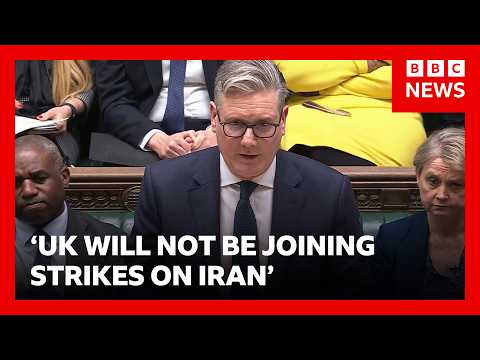
[0:00]Mr. Kier Starmer is just beginning to speak on the situation in Iran and the wider region uh and our response. Mr. Speaker, the United Kingdom was not involved in the initial strikes on Iran by the US and Israel. That decision was deliberate. We believe that the best way forward for the region and for the world is a negotiated settlement. in which Iran agrees to give up any aspirations to develop a nuclear weapon. and ceases its destabilizing activity across the region. That has been the long-standing position of successive British governments. President Trump has expressed his disagreement with our decision not to get involved in the initial strikes. But it is my duty to judge what is in Britain's national interest. That is what I've done and I stand by it. But Mr. Speaker, it is clear that Iran's outrageous response has become a threat to our people, our interests, and our allies. And it cannot be ignored. Iran has lashed out across the region. They've launched hundreds of missiles and thousands of drones at countries which did not attack them. including the UAE, Saudi Arabia, Kuwait, Qatar, Iraq, Bahrain, and Oman. And overnight Hezbollah, Iran's proxy in Lebanon, launched attacks on Israel, seeking to escalate the war. Mr. Speaker, there are an estimated 300,000 British citizens in the region. Residents, families on holiday and those in transit. Iran has hit airports and hotels where British citizens are staying. It is deeply concerning for the whole house and the whole country. And Mr. Speaker, our armed forces are also being put at risk by Iran's actions. On Saturday, Iran hit a military base in Bahrain with missiles and drones. There were 300 British personnel on the base. Some within a few hundred yards of the strike. Last night, a drone hit RAF Acritiri in Cyprus. There were no casualties in this strike. Mr. Speaker, it is important for me to say that our bases in Cyprus are not being used by US bombers. The security of our friends and partners in Cyprus is of critical importance. And, Mr. Speaker, I want to be clear, the strike on RAF Akrotiri in Cyprus was not in response to any decision that we have taken. In our assessment, in our assessment, the drone was launched prior to our announcement. Iran's aggression towards Britain and our interests is long-standing. And that's why we've always ensured that protections for British bases and personnel are at their highest level. Mr. Speaker, it is very clear that the death of the supreme leader will not stop Iran from launching these strikes. In fact, their approach is becoming even more reckless and more dangerous to civilians. They are working ruthlessly and deliberately through a plan to strike not only military targets but also economic targets in the region with no regard for civilian casualties. That is the situation we face today and to which we must respond. Mr. Speaker, I've been speaking to our golf partners over the weekend. They're outraged by Iran's acts, particularly as they played no part in any strikes. And they've asked us to do more to defend them. Moreover, it is my duty, the highest duty of my office, to protect British lives. That is why we put British jets in the air, typhoons and F-35s, as part of coordinated defensive operations, which have already successfully intercepted Iranian strikes. including Mr. Speaker, taking out one drone that was heading towards a coalition base in Iraq, housing UK service personnel. I want to pay tribute to our brilliant service men and women, putting themselves in harm's way to keep others safe. And I know the whole house will join me in expressing our gratitude and our respect. But Mr. Speaker, it is simply not possible to shoot down every Iranian missile and every drone after they've been launched. The only way to stop the threat is to destroy the missiles at source, in their storage depots or at the launchers. The US requested permission to use British bases for that specific and limited defensive purpose because they have the capabilities to do so. Yesterday evening, we took the decision to accept that new request. in order to prevent Iran firing missiles across the region, killing innocent civilians, putting British lives at risk and hitting countries that have not been involved. To be clear, the use of British bases is limited to the agreed defensive purposes. We are not joining the US and Israeli offensive strikes. The basis for our decision is the collective self-defense of long-standing friends and allies and protecting British lives. It is in accordance with international law, and we produced a summary of our legal advice, which clearly sets this out. We will keep the decision under review. Mr. Speaker, we are not joining the strikes, but we will continue our defensive actions in the region. France and Germany are also prepared to enable US action to destroy Iran's capability to fire missiles and drones from source. I've been in close contact with President Macron and Chancellor Merkel in recent days, as well as President Trump and leaders across the region to that end. Mr. Speaker, be in no doubt, the regime in Iran is utterly abhorrent. In January, they murdered thousands of their own people. The full horror of which is still hidden from the world. For decades they have sought to destabilize the region and export terror around the world. Their proxies in Yemen have targeted British ships in the Red Sea. They've facilitated Russia's attacks in Ukraine. The regime's tentacles have even reached these shores, posing a direct threat to Iranian dissidents and to the Jewish community. Over the last year alone, Iran has backed more than 20 potentially lethal attacks on UK soil, each of which, Mr. Speaker, we have foiled. So it's clear, the Iranian regime must never be allowed to get their hands on nuclear weapons. That remains the primary aim of the United Kingdom and our allies, including the US. And ultimately, this will have to be achieved at the negotiating table. Mr. Speaker, in this dangerous moment, our first thoughts are with our citizens in the region. Friends, family members, and constituents. I recognize the deep concern that the situation is causing for those involved and for communities across the country. We're asking all British citizens in the region to register their presence so we can provide the best possible support. and to monitor the home office travel advice, which is being regularly updated. Across much of the region, air space remains closed and local authorities are advising individuals to shelter in place.
[9:10]The situation on the ground may remain challenging for some time. So we're sending rapid deployment teams to the region to support our British Nationals on the ground. And we're in close contact with the travel industry and governments in the region, including with our friends in the UAE, given the concentration of British nationals in that country. And we're looking at all options to support our people. We want to ensure that they can return home as swiftly and safely as possible. The FCDO phone lines are open to provide consular support, and ministers are available to meet MPs to discuss any individual cases. Mr. Speaker, we're also reaching out to communities across the United Kingdom, including Muslim and Jewish community organizations. And we're making sure that sites across the country, including places of worship, have appropriate protective security in place. Mr. Speaker, the situation in the region is developing rapidly, so we'll continue to update the house in coming days. Mr. Speaker, I've spoken recently about the toll that global events are taking here at home. They come crashing into our lives with ever greater frequency, hitting our economy, driving up prices on the supermarket shelves or at the pump, dividing communities, bringing anxiety and fear. That's why how we operate on the world stage matters so much. Mr. Mr. Speaker, we all remember the mistakes of Iraq. And we have learned those lessons. Any UK actions must always have a lawful basis and they viable thought through plan. I say again, we were not involved in the initial strikes on Iran, and we will not join offensive action now. But in the face of Iran's barrage of missiles and drones, we will protect our people in the region and support the collective self-defense of our allies. because that is our duty to the British people. It is the best way to eliminate the urgent threat, to prevent the situation spiraling further and support return to diplomacy. It is the best way to protect British interests and British lives. That is what this government is doing. And I commend this statement to the house.


