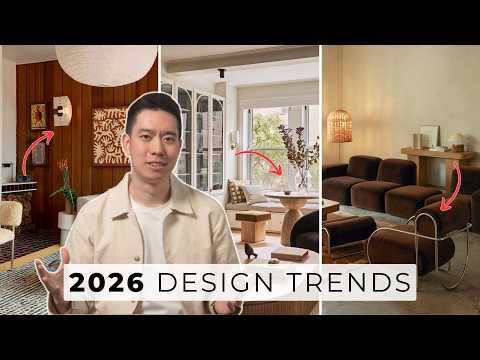
[0:00]For the past few years, many homes have leaned pale, foxy, and overly safe. In 2026, that is shifting. Homes are getting warmer and far more expressive. Curves are replacing hard lines, richer colors are coming back, and spaces are being designed to feel layered, grounded, and personal again. In this video, I'm breaking down the interior design trends that will define 2026, and more importantly, why they actually matter in real homes. This isn't about ripping everything out or blindly following trends. It is about understanding where design is heading and choosing what actually makes sense for your home and how you live.
[0:40]Straight lines are taking a back seat in 2026, as curves become a major design moment across furniture, objects, and even architecture. From sculptural sofas and rounded dining tables to arch headboards and kidney-shaped sofas, curved pieces are everywhere. Personally, I totally welcome this. I think modern homes, especially new builds, tend to be boxy by default. Add flat packs on top of that, and everything is straight and angular, which can make spaces feel rigid and a little lifeless. Introducing curves is one of the simplest ways to soften that as they add movement and visual flow to the space. But we're not just seeing this in furniture and objects. Bathrooms are embracing curves with arch shower screens, rounded mirrors, and softer vanity profiles. Kitchens are following suit with rounded island corners or features such as the exhaust. More than just simple curves, sculptural accents are also becoming a big thing. Sculptural lighting, in particular, is becoming increasingly popular. And I really like how people are blurring the boundaries between what is purely functional and what is art. That said, this is not a curve everything moment. Just like a room full of straight lines feels stiff, a room full of curves quickly starts to feel trendy because there's not enough contrast. You need to make sure you're juxtaposing soft, rounded shapes against structured linear elements. When you get the balance right, spaces feel softer, calmer, and far more considered. Color in 2026 will continue to become deeper and moodier. After years dominated by off-whites and quiet neutrals, we are finally embracing richer palettes that feel warm, grounded, and intentional. I think this reflects a broader shift towards designing a home that feels more lived in. Blue is officially back, and it's one of the defining colors of 2026, but it's not about sky blues or soft pastels. The focus is on darker, more saturated blues that brings in that moodier theme. Dulux has even named a trio of deep blues as part of its color of the year, reinforcing this broader move towards richer, more enveloping tones. At the same time, browns are getting browner. Where recent years lean into coffee and biscuit shades, 2026 is welcoming richer, chocolatey browns. These tones work beautifully with natural materials and layered textures, which is another 2026 trend. And they pair just as well with vintage pieces as they do with contemporary ones, which is what makes brown such a versatile color choice right now. Many of the warm hues that define 2025 are also carrying into 2026. Ocre, oxblood, and deep terracotta are still going strong, but they're being used in more intentional, restrained ways as anchoring colors rather than accents sprinkled everywhere. In terms of how color is being applied, color drenching is sticking around, but it is evolving. Instead of default accent walls, which honestly feel quite dated now, people are experimenting with the fifth and even sixth wall. Painting ceilings, floors, or architectural details is becoming a more popular way to introduce color without chopping a room up visually. The key takeaway for 2026 is not to use more color, it is to use color with purpose. When colors are layered thoughtfully, they make a space feel calmer, more cohesive, and far more intentional. If you want help applying these ideas in a way that makes sense for your home, I've put together a free in-depth designer home guide, plus 45-point checklist that walks you through the key principles I use when designing a space. Following the shift towards warmer, moodier color palettes, we're seeing that same change reflected in wood finishes for 2026. Pale oak and bleached timber, which have dominated interiors for years, are giving way to darker, richer woods that bring depth and a sense of permanence to a space. Woods like walnut, mahogany, teak, and warmly stained oak are becoming increasingly popular. It is a natural extension of the move toward interiors that feel layered and considered, and they work just as well in traditional homes as they do in contemporary ones. This is a trend I'm personally very on board with. Our cozy family room, which is still a work in progress, uses mostly darker stained woods, particularly walnut and warm-toned oak. The darker timber elements are balanced against lighter wood flooring, which keeps the space from feeling heavy, while still giving it richness and depth. Another reason darker woods are especially appealing is their versatility. They pair beautifully with rich browns, deep blues, and earthy tones, while also complementing natural textures like stone, wool, and linen. Use thoughtfully, they add visual weight and warmth without locking you into a specific style or era. That said, this isn't about abandoning lighter woods altogether. Natural finishes like oak, birch, and maple are still timeless. And if you already have them, there's no reason to rip them out. In many cases, layering darker wood through furniture or accents alongside lighter timber is what creates the most depth. Texture, pattern, and layering are becoming essential for creating homes that feel warm and lived in and visually rich, especially in spaces that rely on neutral color palettes. There are three main ways this is showing up. First is textural layering. Think rich wood grains, woven fibers, tactile surfaces that invite touch and add depth. Interiors are increasingly combining materials like velvet, wood, rattan, and linen within the same space, mixing soft with structured, refined with relaxed. Second is what many designers are calling dressed rooms. A lot of newer homes lack architectural details. No crown molding, minimal trim, very flat walls. In response, people are adding that sense of structure back in. This might look like paneling, moldings, detailed joinery, or layered window treatments. It is texture that is built into the room itself, not just added on top. It makes spaces feel more finished and intentional. Third is the return of pattern, but in a more restrained, grown-up way. Rather than bold, high-contrast prints, 2026 is about smaller scale patterns that at subtle visual texture. These are the kinds of patterns you notice up close, not from across the room. They reward attention rather than demand it. At the same time, pattern drenching is gaining traction, and this time, it is not limited to walls. We're seeing it across wall coverings, upholstery, cushions, lamp shades, and even furniture. The key here is consistency, not chaos. When patterns share a similar scale or color family, they feel intentional rather than overwhelming. Tile trends are reflecting this shift as well. After years dominated by Zellige tiles, mosaics and small format square tiles are coming back. It is another example of how detail, texture, and craftsmanship are becoming more important than big, bold statements. If there's one key takeaway from this trend, it is that texture is doing a lot of the heavy lifting in 2026. Even the most neutral spaces feel richer and more inviting when texture and pattern are layered thoughtfully. And if you're watching this thinking, I love these ideas, but I struggle to picture how they would actually look in my own home. That is exactly why I built Room Visualizer AI. You can upload a photo of your space and some inspiration images to test different design directions and see a realistic preview of your space before you commit to anything. It is currently in beta and invite only for now, but you can join the waitlist via the link below. Overly large, fully open plan layouts have been falling out of favor for a while now, and that shift is continuing into 2026. But this isn't a return to the closed-off floor plans of the 1990s. Instead, we're seeing a move toward hybrid open-closed living, spaces that still connect, but don't bleed into one another. The reason for this shift is simple: homes are doing more than ever. They're places to work, relax, exercise, socialize, and switch off, often all in the same day. When everything happens in one big open space, it becomes hard for it to feel calm or intentional. In 2026, homes are still prioritizing open social areas, but also carving out smaller, defined zones you can step into and mentally switch gears. Think reading nooks, quiet hobby corners, conversational zones, or focused work areas. These spaces don't need to be large, they just need to feel purposeful. Rather than relying on solid walls, definition can be created through a mix of permanent and flexible elements. Partial height walls, fluted or reeded glass, built-in shelving, curtains, sliding panels, and changes in flooring or lighting are all being used to signal where one space ends and another begins. In many cases, furniture itself is becoming architectural. Modular sofas, banquette seating, double-sided storage, and custom joinery are acting as subtle room dividers while still allowing light and flow. A big driver behind this trend is the growing need for both visual and acoustic privacy. As open homes feel with noise, sound control has become just as important as layout. Ultimately, defined spaces in 2026 aren't about closing people off. They're about giving each activity the environment it actually deserves. Statement stone has been an architectural feature for several years now, and it's not going anywhere in 2026. What is changing is how it is being used. In 2026, we're seeing statement stone extend well beyond benchtops. Stone is wrapping vent hoods, running up backsplashes, framing islands, and continuing down edges and trims. Instead of stopping abruptly at one surface, it is being used more continuously, which is what gives it that intentional, built-in feel. If you're considering statement stone, cohesion matters more than drama. Bold veining can look incredible, but only when it works with the rest of the space. Pay close attention to the color of the veining and how it connects to your cabinetry, flooring, and overall palette. Stone that fights the room will date quickly, no matter how beautiful it looks on its own. It's also important to be realistic about how you actually live. Marble, for example, stains and etches easily. If you're cooking every night, wiping spills constantly, and want a low-maintenance kitchen, it may not be the most practical choice. If you use your kitchen more lightly or you're comfortable with patina over time, then it can absolutely work. You can check out my video on kitchen design regrets for more deep dive if you're currently planning a kitchen renovation. Think of a statement stone like a statement coat. It elevates everything around it, but only if the rest of the outfit is relatively simple. Use thoughtfully, stone becomes timeless architecture rather than a trend moment. Continuing the shift we started seeing last year, chrome and silver finishes are gaining more traction in 2026. What is interesting about this return is that it feels both fresh and historically informed. Rather than reading as overly modern or cold, the current interpretation draws on subtle retro references while still feeling timeless. After a long period dominated by warm metals like brass and bronze, interiors are introducing cooler metals, but in a far more restrained, thoughtful way. This isn't about shiny, high gloss everything, it is about balance. I personally think these metals look best when they're used as contrast against warmth. For example, a chrome piece paired with rich fabrics or deeper tones instantly feels more grounded. A great example is this chromeo armchair upholstered in chocolate velvet. The reflective metal frame keeps it crisp and modern, while the velvet softens the look and stops it from feeling stark or clinical. This is why chrome works really well as a finishing layer. Lamps, accent furniture, hardware, or side tables are where it really shines. When chrome is layered into an already warm textured space, it adds tension, not coldness. One of the more interesting evolutions for 2026 is the rise of sanded or brushed stainless steel. Unlike high-polished chrome, these finishes introduce subtle texture and variation, making it feel more architectural and less fashy. As a rule of thumb, chrome shines when paired thoughtfully with warmer woods, textiles, and softer forms, as they strike that balance between retro and timeless. Playful, but still sophisticated. If you enjoyed this video, check out this video on the three layers that make any living room look high-end. And this video on nine decor and finishes that cheapen your home and what to get instead. Otherwise, thanks for watching, and I'll see you in the next one.