[0:10]The world is divided into two groups. See which one you fall into. People who can handle stress, succeed, build a great life, and people who can't handle stress, feel like a constant failure, and struggle their whole lives. Here's the good news. I made up those groups. That's not a thing. But my whole life, I thought that was a fact. And that I had been born into that second group. My name is Elyssa Smith. I'm a trauma informed life strategist, and I'm going to tell you today how to completely eradicate your procrastination for good. My whole life I procrastinated. I left everything to the last second in school, and I constantly felt like I wasn't good enough. Like I thought everything was just harder for me, and in order to compete with that first group, that successful group, I had to work harder, be better, do more. And it was crushing. Today I'm going to share with you the deep secret that lies beneath your procrastination. It's probably not what you think. It lies inside your brain. Now, you might procrastinate and feel like it's not that big of a deal, I get stuff done eventually, right? And I did too. I was actually a really good student. I was the overachiever in my family, but that pressure to constantly be better than I actually thought I was, left me feeling like I couldn't breathe. So, I procrastinated as a coping mechanism. I mean, after all, why would I start that pain, that agony, the pressure to perform perfectly, the risking of the judgments, literally even one minute before I actually had to? But what I didn't realize is that that seemingly innocent negative self-talk and bad habits actually hinted at something much darker. And that something was about to derail everything that I had worked so hard for. The same emotions and thoughts that told me I wasn't good enough, that led me to procrastinate in the first place, also led me into an emotionally abusive relationship. It shredded my identity. I walked right into the arms of someone who agreed with me that I was less than and needed to work for my self worth. It left me on the floor emotionally bleeding out. And I almost lost myself completely.
[2:52]Today, we're going to take So, let me rephrase this. So today we're going to take procrastination seriously, because procrastination was the Canary in the Coal Mine that I didn't notice at the time. It turns out that procrastination is a stress response system that the brain automatically puts into place for you. Today, we're going to take these warnings seriously and I'm going to show you how you can completely overcome your procrastination. Stop working so hard endlessly and actually achieve your highest potential.
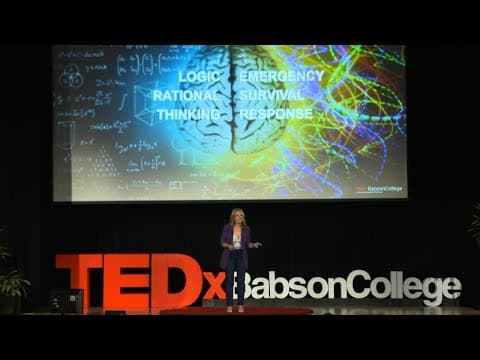
[3:38]Now, we have come to know that procrastination, negative self-talk, and the inability to handle stress, can be signs of past trauma. And when you think of trauma, you may just think of big things like war, natural disasters, domestic violence, or maybe that like really bad haircut you had in middle school. Was it just me? Maybe? And that is the most commonly known type of trauma, that's called Big T trauma. Big bad things that should never happen to anyone. What you may not realize is that there are lesser known types of trauma. Little T trauma is one of those. Little T trauma is non-violent situations that actually still cause a lot of emotional distress. Think like bullying or losing a pet. What I've come to realize in the last 10 years of doing trauma training and helping my clients to heal is that there's another sneakier form of trauma that most people have no idea they're dealing with. I call it tiny T trauma. Tiny T trauma is little unmet needs throughout childhood that cause your brain to create negative self-beliefs. So this could be anything from only being rewarded when you performed perfectly, to actually watching your caregivers work too hard without a break. And what you need to know about your brain's response to trauma, whether it's big T, little T, or tiny T, it's the same. It creates unique survival coping mechanisms. Procrastination is one of these mechanisms. Raise your hand if you've ever felt like I actually perform better under stress. I procrastinate and I kind of need that in order to do my best, right? And I did too. I mean, I after all, we have evidence that we get that ish done when there's a fire lit underneath us. And sometimes that's what it takes. But here's the thing, you were never meant to lean on the crutch of procrastination forever. The way it was meant to work is that you you could use it as a last resort, this sort of emergency bundle of energy to hurry up and get stuff done. How many of you have heard of the differences between right and left brain? Yeah. So your right brain will start over here with your right. The right brain is the survival brain. That is the part of your brain that is very primal. It has one focus, just don't let you die. Keep you safe. The left brain is the logical rational brain, and this holds all of your higher level decision making, like the real smart stuff. And in an emergency, your right brain is well equipped to take over and do your fight, flight, freeze, fawn, all of that good stuff. But what it does is it also tells your left brain, take a hike. We don't need higher level calculus in the middle of a life or death emergency, normally. So, when you are a procrastinator, what your brain does is it senses that survival brain mode, and you're going to go looking for every ridiculous excuse not to do that thing you don't want to do. Procrastination is a tool that your survival brain uses to avoid confirming that you're in the unsuccessful group. If you are running a race and you kept tripping over your shoelaces, would your solution be, I'm just going to keep my bandaids right here and every time I fall, you're just going to dress your wounds? No, right? I mean, you would tie your laces before the race starts. Procrastination is the bandaid. It's the thing that makes you feel safe, but you actually have no shot at winning the race. Now, why would we choose the bandaid instead of tying the laces? Because of fear, right? Fear of failure, fear of judgment, fear of success or of reaching your potential. Now, imagine your fears like they're a violent storm out on the ocean. And procrastination is that safe harbor that keeps you away from the perceived pain. But the real solution, tying your shoelaces, lies in calming down your nervous system so that you can feel safe even when you're embarking out into that perceived storm. If you'll close your eyes for just a moment, I'd like to have you imagine something. I want you to imagine your future if you were better prepared, better rested, and could use all of your available energy to rise above emergencies instead of having it drained out in the procrastination stress cycle. What would it be like if you gave yourself all the time in the world to do your very best in every high pressure situation? Let's see what that looks like in action. My client Francesca was killing it at work, but when she came to me, no amount of alarm clocks or lattes or self-inflicted bullying could get her out the door to work on time. She thought maybe she was just sort of lazy or something, but what we found out when we dug deeper is that she hates being told what to do. She doesn't like to be bossed around. Don't tell me what to do with my time, right? And so every time she had to beat her work on time, it reminded her of her childhood, where she was constantly reminded she needed to be more grown up, more organized, more on time. But what we discovered is she's actually a free spirit. She needs to flow. So that childhood expectation and her true identity as a free spirit, that was the clash, was her tiny T trauma that made her procrastinate. Now, let's talk about Amani. Amani wanted to build a new kitchen in her house and she made the plans, added the photos to the mood board. Years later, no kitchen. So she just thought she was bad at managing her time. And we kind of dug into it and figured out, she was very resistant to start the project unless she had every single thing planned out to a T. And she wanted to have all the time that she needed to complete it all in one fell swoop all at once. And we discovered that this is the same as the cycle that happened for her in childhood when she felt like she wasn't as smart as the other kids. So she would put off her school work so that she could blame the lack of time, instead of giving her all and risking being in that unsuccessful group. What could happen globally if all of us understood our tiny T trauma, could stop procrastinating, and could show up at our highest potential? And is that even possible? Can we get rid of this automatic response? We can if we learn how to navigate without procrastination as a crutch. Now, you may be able to actually complete that project or give that presentation, even if you put off preparing for it until the last second, but you're only doing it with half a brain, so to speak.
[10:42]Remember, right brain has taken over when you get stressed. Left brain is not here, and at that moment you've got an imbalance and aren't going to be able to perform your best. In the short term, you can regain that balance with breath and nervous system regulation. In the long term, you can actually rewire the negative self-beliefs that the trauma created and stop procrastinating altogether. Francesca and Amani, once they figured out what their tiny T trauma was, we were able to completely rewire all those beliefs. Francesca's not late to work anymore, and not only that, but she got a promotion. Amani got her kitchen, and she also decided to quit her super stressful job and get one that she loves that's not as hard on her. Now that you know that your procrastination could be caused by past trauma, and that with leaving that behind, you could be showing up at a higher level. It's time to for you to learn the tool that's going to help you create safety for your brain. Are you ready? I heard a yes. Yes. Yes, please. Please now. Okay. Rub your hands together in front of your face like this. We're going to activate the Vegas nerve, which is in charge of the calming response for the brain, okay? And now I want you to place your hands on your cheeks and neck, give a little pressure and take a deep breath. Now rub your hands together again. We are calming the nervous system directly and sending that safety message to the survival brain. Cross your arms, squeeze your shoulders, deep breath. One more time. Rub your hands together. We're bypassing your survival coping mechanisms. It's this easy. Now cross your arm, squeeze just above your elbows, deep breath. How did that feel? Good? Do this anytime that fear, that anxiety, those doubts, do this when those come up. Work through your tiny T trauma so you can leave your procrastination behind for good. I can tell you from personal experience that on this side of that work, it is absolutely delightful to know how much amazing self-love is available to us. Life is good now. Go on out, unleash your highest potential to the world. I'll go tell him you're coming. Thank you.


