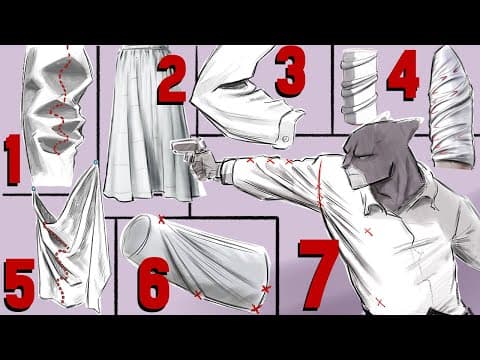
[0:00]If you want to draw clothing, there are seven different types of folds you need to know. Let's start with the zigzag fold. You'll see this fold most often in baggy sleeves and pants. Specifically, when they bend, or when gravity is buckling the fabric. The zigzag fold takes its name from the zigzag pattern that goes through these folds. And if you can draw a zigzag like that, you're on your way. The next thing you'll need to draw is triangles. Except, think more warped or deformed triangles. So check this out, you don't even need reference for this. I'll start with a zigzag. Just try and keep the zigzag varied, instead of uniform. All right, now for the triangles. Invent a series of paired elongated triangles. One triangle has a point that faces up, connected to a triangle that has a point facing down. Go ahead and shade these in, but make the upper triangle darker. And remember, these are deformed triangles, not neat and tidy ones. Putting a contour around these triangles will define the thickness of the cloth. I'll use the contour on the right as the final contour, but I need a straighter contour on the left to show the back of the sleeve, which does not have buckled fabric. On this side, I can use my thickness lines as a guide for a shadow shape. Then to add shading to the rest of it, the major thing you want to do is soften all edges of your triangles. Get rid of any dark outline too. This will make the folds look like they're rolling, rather than cut out. Here, I'm finding some foreshortened triangles on the other side of the arm. These can be tricky, but they add a lot. And the only other thing I did is in the little tracks between triangles, that is the thickness part of the fabric. I found tiny little plane changes, and I shaded halftones where the plane faced down, indicated there by the red dots. Think of halftone as a darker variation of the light. They add a lot of dimension. Okay, let's try this from reference now. First, I'll block in a couple of tubes for the arm, then I'll draw a zigzag inspired by the photo. Because the elbow is quite bent, this zigzag pattern will be more compressed in the middle. Now I'll get my triangles in around my zigzag pattern, taking notes from the photo that these triangles are quite wide because that fabric is particularly compressed in this pose. It's important to note that I'm not copying the photo shape for shape. Rather, I'm using the photo for information. Here's that thickness contour, which is kind of like a ballooned-out profile of the triangles. And where the fabric is not compressed, like on the left side here, those lines will trend more straight, though you might find a few undulations there, too. Now for shading, other than the triangles themselves, there isn't much of a shadow side here. So that just leaves those small plane changes between the triangles. Notice that I'm using very subtle changes of value. In this case, putting a lighter tone where the plane faces up. One last tip: in areas that are further away from the crux of the bend, like here and here, you may still find triangles to shade in, but they won't have much depth. So be careful with your value. Pants commonly have zigzag folds, too. Except with pants, they're mostly bunched up at the bottom where gravity is compressing the fabric. So this time I started with an outline, which is bunched up at the bottom, and designed my zigzag around that. And here come the triangles. Notice that they get a little more compressed and even saggy at the bottom. That's due to gravity and weight. When you do these studies, don't try and copy your photo reference shape for shape. It's much more useful to develop a process that captures the structure of the folds, because that's what ultimately allows you to draw them from imagination. All right, the pipe fold, also known as the stretch fold. You see this in clothing when the fabric is, well, stretched between two points. Unlike the zigzag fold, the stretch or pipe fold will trend toward a more linear path. I like the term pipe fold because pipe conjures the form of a cylinder, which is essentially what these folds are. A series of cylindrical forms running through the fabric. A basic cylinder is easy to light. It has a light side and a shadow side, with a soft edge in the middle. You can arrange several of these cylinders on top of an underlying form, and in pretty short order make it look like the fabric is stretching. And a little simple cylindrical shading adds tons of dimension to these folds. For realism, try to keep the width of these cylindrical forms varied. Now, see those red X's I started with? Those are tension points, and they dictate the start and end of the folds. A tension point usually represents the fabric either touching the skin or being held taut by a seam. And it'll stretch between those two points. Pipe folds are extremely common to find on clothing. Here, I'll block out a rough silhouette first, and then mark out some tension points. Again, thinking skin contact or seam connection. Then just build out your cylindrical forms, keeping in mind the roundness of these cylinders. Add a bit of simple cylinder shading, and that's the pipe fold.
[6:17]Getting better at art can be a nebulous and even scary process. It takes a lot of alone time, which means you're going to be inside your own head often. That part of learning can be as challenging as the art itself. And I've had students over the years tell me that it can interfere with basic mental health necessities, like day-to-day happiness. That's why I'm excited to tell you about today's sponsor, Betterhelp. Betterhelp's mission is to make therapy more affordable and accessible. By filling out a few simple questions, Betterhelp can match you with a professional therapist within days. It's easy. There are different options to schedule sessions, based on your preferences and level of comfort. Because it's a remote and online service, you can even text your therapist at any time. There's a link in the video description. It's betterhelp.com/MarcoBucci. Using that link will get you 10% off your first month at Betterhelp, which gives you time to connect with a therapist and see if it helps you. If your therapist is not the right match for you, which happens, you can switch to a new one with no additional cost, no complications with insurance, or anything like that. I know firsthand that it helps to talk to someone about your state of mind. Especially in a world whose future is as uncertain as it is for artists. If you're struggling, consider online therapy with Betterhelp. Click the link in the description or visit betterhelp.com/MarcoBucci. And thank you, Betterhelp, for supporting my channel.
[8:30]All right, let's talk about compression folds. A compression fold is like a pipe fold in the sense that it's cylindrical. Except these folds are caused by fabric compressing rather than stretching. Because compression folds are not under tension, they're free to bend and waver a bit more. These compression folds are pretty thin. A compression fold's girth depends on the qualities of the fabric. One helpful tip on spotting these, they often come in conjunction with stretch folds. A stretch in one place can involve a complimentary bend in another place. In the crook of that bend is where you're likely to find resulting compression folds. Think of it like the principle of squish and stretch. In order to stretch one side, you've got to squish the other.
[9:30]All right, moving on to half-lock folds. Not gonna lie, this one's tough. It occurs, thankfully, in just one particular instance. A significant bend of a joint, usually it's an elbow or a knee. Let's look at this closer. On the inside of the bend, the fabric folds in on itself. And as it does, let's watch this again. The fold assumes a shape, which doesn't really change. It just gets more pronounced as the bend increases. It's like the fabric gets locked into a shape. The other half of the joint, the underside of the arm in this case, the fabric there is free to stretch. It's not locked. Thus, we derive the term half-lock. Okay, that's just how I think about it. I'm not sure that's what it actually means. Anyway, the half-lock fold is best understood in profile. There's this characteristic bit of overhanging fabric, which then dives into a deep recess, touching the underlying form, then reemerging and abruptly morphing into zigzag folds. I consider the half-lock fold to be a cousin of the zigzag fold. This red line blocks in that overhanging fabric, and then turns into a zigzag pattern. From here, it's making sure that the half-lock fold has the biggest mountains and valleys, and look out for this neighboring deep fold, which often comes with a half-lock. When drawing half-lock folds, if nothing else, make sure you get that fabric overhang and the deep recess. That'll be enough to communicate it. I love how Juanjo Guarnido simplifies the half-lock fold in this little drawing. He's wittled the whole sleeve down to just a few folds, but he hits all the bases. He's got the pronounced half-lock stuff here, the zigzag fold area, and the pipe fold area underneath. Really great. I was playing with my daughter the other day, and I couldn't help but notice this great half-lock fold in the pants. So naturally, you stop playing with the child to take a photo for later study. On this one, the fabric overhang happens on the bottom of the fold, and that is fairly common. Notice how that's the first thing I go for when drawing a half-lock fold. Then from there, you can pivot to the incidental folds that might be happening around it. All right, let's quickly look at the drop fold. I say quickly because a drop fold is basically a pipe fold. The main difference being, a drop fold has only one tension point from which the fabric drops. Of course, with drapes like this, you're looking at multiple drop folds. Let's bring up this photo again. This is probably the most common drop fold you'll see on a figure. The knee is a tension point holding the fabric, and then gravity does the rest of the work, dropping the fabric down. And remember to maintain that cylindrical form. Here's a drop fold in three-quarter/front view. We've got that tension point at the knee, and let's track that cylinder form widening as it moves downward. In a quick study here, I'll block in that tapered cylinder with lines, and then when I move to tone, I'll just be careful that the transition is subtle enough to reflect the diminishing nature of that fold. Skirts are another very common drop fold scenario. There's a whole seam of tension points around the waist, which radiate cylindrical forms dropping to the ground. Now, because drop folds only emanate from a single tension point, the most concentrated cylindrical forms will be up near the waist. By the time you get to the bottom of the skirt, those cylindrical forms will have tapered out, gotten much wider, and in some cases, even faded away. All right, next up, the diaper fold. I'm holding a towel fairly taut. So each hand is a tension point. Move those tension points in a bit, and that's a diaper fold. It makes these saggy cascading ellipses. It seems simple, but it's probably worth practicing just that pattern. The next step is to wrap your head around the planes here. It is quite a complex form. I'm drawing some lines that go over the form to show just how much 3D undulation there is. Now to pivot to a three-quarter perspective, the basic geometry of a diaper fold looks like this. I'll put this drawing in the corner here for reference as we now draw an actual diaper fold. To start, I'm drawing the same thing I just drew, only less blocky. The red dashed line goes over the form there, and that's our first segment. Now, we just add another similar segment, but because it's cloth, it's going to vary a little bit. But the underlying structure is the same. So here's an update to our red dashed line. Then we add a third segment, which will take us to the bottom of the cloth. But you can see the overall form of this layer is the same as well. And for good measure, notice the drop folds on the dangling part here. You don't see diaper folds too much on the figure, although here's one example. I always find the challenging part about drawing diaper folds is making the rhythm look continuous. You know, stacking those similarly structured layers as we just saw, but while making the folds within each layer varied. And that's where the photo reference is really helping me here. I'm just snagging shapes as I see them, trying not to repeat myself really. And there you have the diaper fold. Okay, one more. The spiral fold. Spiral folds are like zigzag folds in the sense that it's a compressed piece of tubular fabric, like a sleeve, for example. Except spiral folds take on a spiral pattern. To do a quick study of this one, first I'll block out the underlying form, and here's the end of the sleeve wrapping around the arm. Now, here come the spiral folds themselves. I'm imagining a point kind of just out of view that the spirals are emanating from. A handy graphic trick to keep track of these is to arrange them with triangles in the negative space. When it comes to adding some shading to spiral folds, pay special attention to how thick or substantial those folds are. Quite often, they're going to be on the thinner side, kind of the opposite of zigzag folds, which have that thickness layer to them. So what that means for shading is not going too heavy with your dark shadows. In fact, in this study, most of those darker tones are still actually in the light, they're halftones. If you're having trouble drawing spiral folds, here's a basic exercise. Start with a cylinder, and then begin drawing these tubular forms that wrap up and around it. Now we can erase out the cylinder underneath, and just splash in some value on the bottom of these forms to give them a bit more volume. You could even add a shadow tone to the cylinder itself, of course, wrapping it over these tube forms to even further describe their volume. Springboarding off that study, here's a great example of spiral folds on a rolled-up sleeve, a very common place for spiral folds to form. Spiral folds, by the way, do often show up on tight clothing. When the clothing is baggier, you tend to see more zigzag folds. So, just like in the basic study there, I'm making sure these spirals weave their way up the arm, the spacing between each fold is not equal. And when it comes to shading, I'm making sure to pick a few hero folds to be more substantial than the others. Therefore, casting a more prominent shadow. And there's the spiral fold. And that's it. We did it. I hope this helps your drawing and painting. I have premium classes available at Marcobucciartstore.com. Thanks to my patrons for their generous support. Thanks to Betterhelp for sponsoring this video. I'll see you in the next one.