[0:00]Hello, hello, it's Tony Hody here and today we're going to be talking about handling objections, one of my favorite topics. So we're going to be discussing the proper method for handling objections when you are generating leads for home improvement. So if you're out there in the field and you're knocking on doors or maybe you're in the call center calling on the telephone or perhaps you're out at a fair, festival, trade show, home show, some type of event or even at a big box store. Maybe you're uh inside one of the retail stores generating leads in one of the stores. In any of those cases, we're going to hear the same objections over and over again. The big three, what are they? Not interested, can't afford it, and not ready right now. So we're going to tackle those three and we're going to give you a systematic approach, a methodology that you can use to eliminate those objections whenever possible. So first and foremost, I want to talk to you about the psychology, you know, behind how we're going to handle these objections. We're not going to use rebuttles, all right? We're not going to argue with our prospect. Instead, we're going to ask probing questions, okay? We're going to empathize first, I understand, no no problem, that's completely okay. And then we're going to, after we're done empathizing, we're going to ask some probing questions because we want to seek to understand before we wish to be understood. And furthermore, we want to, you know, embrace the ideology that people really don't care how much you know until they know how much you care. So we want to ask questions, we want to take an interest in our prospect. So, having said that, I want to give you three outstanding questions that you should memorize. You should master these three questions and the sequence of these questions so that you can handle these real common objections. So if a prospect gives you I'm not interested, if they're still got friendly enough disposition and they're not irritable, I would at that point say, Let me ask you a question, is updating your bathroom, for example, something you're ever going to do? Is replacing your window something you're ever going to do? Emphasis on the word ever, is replacing the roof something you're ever going to do? That's going to be the number one question, getting that baby commitment, that tiny commitment that this is a project that they are going to do someday, right? So, you know, I'm not an amateur on the Bible myself, but everybody seems to know this old story that Jesus turned water into wine. Well, what's the big secret there? You know, he had water to start with. He had something to start with, Jesus didn't turn nothing into wine, right? So we're going to ask that really important question, is this something you're ever going to do? Because we need a little bit of water to start with. If they say no, this is not something we're ever going to do, I move on to the next prospect. So let's focus on the ones that say, yes, this is something I'm going to do someday. At that point, we're going to ask a follow-up question and that question is, what type of time frame or what type of timeline do you have in mind? We're going to do it your way, we're going to do it the prospect's way. We're going to get them to reveal by not backing them into a corner, but asking probing questions that make them feel comfortable revealing the truth about their situation. And what I find is that people do not think in terms of doing projects or solving problems years and years down the road. They know if they need a new roof, if they need a new bathroom, they need to do windows that they need to get on this thing pretty sooner than later, right? So they're going to tell you that uh they're probably going to do it in the spring, they're probably going to do it in six months. They're probably going to do it a year from now, uh these are the real common responses that we hear when people say when we ask the question, what type of time frame do you have in mind? On occasion we'll get a longer time frame of two or three years down the road but that is very rare. In any case, we have now established that they are going to do the project. We've established that they're going to do it within a reasonable time frame. So we're going to follow it up with that last probing question, which is, Is that time frame that you have established for yourself based on some estimates that you've had or are you still kind of guessing at this point? What we're doing here is we're getting the prospect to realize that since they haven't had any prices, they really don't know if their timeline is realistic. And if they haven't had any prices from our company, then they really haven't been given all the information they need to make an intelligent decision. So we're going to help usher the prospect to that conclusion with these three magical questions. That's, is this something you're ever going to do, what type of timeline do you have in mind? And is that timeline based on some estimates that you've had or are you still kind of guessing at this point? Three outstanding questions for handling objections, handling the most common objections. This line of questioning works for can't afford it, not interested, and not ready right now. So I employ you to put those questions to work, use it as a funnel that will actually take the objection and help you usher your prospect to the conclusion that they haven't gotten all the information yet because they haven't gotten a quote from you yet. And you can explain your value of the visit that you are going to provide a free, no obligation estimate that's going to be good for an extended period of time. This is going to help them plan and budget for the future, so even if they're not ready right now, this service is perfect for them. So hope you find this information helpful. I hope you put this content to work for you in handling objections and I wish you the best of luck.
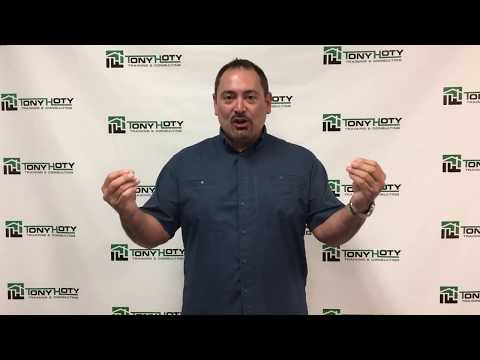
Handling Objections With Tony Hoty
Tony Hoty
6m 25s1,095 words~6 min read
YouTube auto captions
Transcript source
YouTube auto captions
This transcript was extracted from YouTube's auto-generated caption track. The transcript below is server-rendered so it can be read, searched, cited, and shared without opening the original YouTube player.
Pull quotes
[0:00]Hello, hello, it's Tony Hody here and today we're going to be talking about handling objections, one of my favorite topics.
[0:00]So we're going to be discussing the proper method for handling objections when you are generating leads for home improvement.
[0:00]Maybe you're uh inside one of the retail stores generating leads in one of the stores.
[0:00]In any of those cases, we're going to hear the same objections over and over again.
Use this transcript
Related transcript hubs
Watch on YouTube
Share
MORE TRANSCRIPTS


