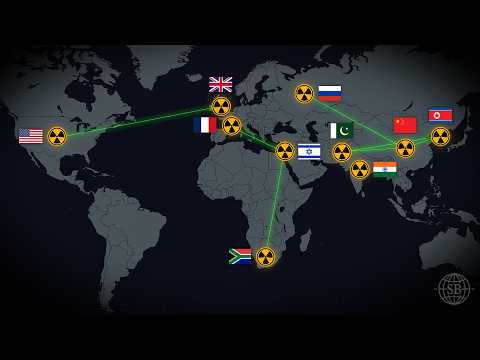
[0:00]We all know the story of how the United States was the first to develop the nuke, but today there are now 10 countries around the world that have successfully created them.
[0:09]Some helping each other, but most in secrecy involving a lot of spying, rivalry and betrayal. Each of them have a story just as interesting as the U.S.'s Manhattan project, but are rarely told. We're going to go through the full timeline of how the 10 countries raced each other to build this technology and also the other countries that came close and might soon be added to the list. The story begins in 1938 when German scientists first discovered nuclear fission, the ability to split atoms releasing massive energy through a chain reaction. The following year, Albert Einstein would warn the U.S. of the dangerous possibilities in weaponizing this technology. The United States was famously the first to create nuclear weapons after a long and secretive operation against the backdrop of the Second World War. Scientists from the U.S., UK, and Canada collaborated in the Manhattan project. They spent nearly 1% of the U.S.'s entire GDP on the effort as they were racing the Germans who were also working on their own nuclear program, but to much less success. Germany had surrendered by May 1945, but in July, while President Truman was at the Potsdam Conference with Stalin and Churchill, planning what to do with Germany. Truman was secretly informed that the Trinity test in New Mexico was successful, and they now possessed the most powerful weapon humanity had ever seen. Truman told Stalin that the U.S. was about to use this weapon on the Japanese. Although at the time, Stalin was already working on his own nuclear weapons project and had spies within the U.S.'s Manhattan Project, internally, he was secretly furious that the Americans had beaten them to making this bomb. The following month, in August, the U.S. unleashed Fat Man and Little Boy on Japan, forcing their surrender, ending the war, but starting a new race around the world for everyone to catch up. The Soviet Union was second to obtain the technology, having started as early as 1941, after noticing German, British and American scientists stopped publishing papers on nuclear fission, they suspected they were also working on creating weapons. The program was accelerated rapidly after seeing the Americans nuclear attack on Japan, and while they had a lot of information from spying on the U.S. programs, they were worried of potentially being fed misinformation from double agents. Because of this, they didn't trust the stolen American design, so they still ended up doing a lot of their own research, using many captured German scientists, they built their own project while also using the United States's designs to check it was correct. Earlier than the U.S. expected, in 1949, the Soviets successfully completed the RDS-1 test in Kazakhstan. The U.S. no longer had the monopoly on this technology, and this would create the Cold War arms race with the United States to stockpile as many nukes as possible. The third country was the United Kingdom. Now you might assume that the U.S. would have helped them as they were key allies fighting side-by-side in both World Wars, and in theory, America would want to empower their good friends in Europe, but this was not the case. The U.K. pioneered a lot of the groundwork on nuclear weapons before the U.S. with a project called Tube Alloys starting in 1940. They did this with the help of German, Austrian, and Polish scientists that were fleeing Germany at the time, but due to limited resources fighting the Second World War, Britain handed over all of their work to the U.S., merging it with what would become the Manhattan project, and providing a significant amount of research under the Quebec Agreement, stating that the U.S. and U.K. would share the technology once completed and not use it on each other. But in 1945 when the U.S. successfully tested and used its nukes, they also terminated the agreement and didn't share the final results to Britain, keeping it to themselves. This prompted the U.K. to resume its own nuclear program and this was done quickly as they had already done a lot of the work and controlled most of the world's uranium. The U.K. successfully completed its first test called Operation Hurricane in 1952 at the Montebello Islands, just above Australia. Meanwhile, after the Soviets had developed nukes much faster than expected in 1949, the U.S. immediately began work on a newer type called thermonuclear weapons. Unlike the standard atom bomb, which uses fission to split atoms, these use fusion to combine atoms, the same process that happens inside stars, and these are significantly more powerful than atom bombs. Scientists like Oppenheimer who led the Manhattan Project warned the U.S. not to develop these because of the extreme danger to mankind and where this nuclear arms race was going. But despite this, President Truman gave the go ahead to continue. In 1952, the United States successfully completed Ivy Mike, the first test of a hydrogen thermonuclear bomb, over 450 times more powerful than the one dropped on Nagasaki. The Soviets then completed theirs in 1955 called the RDS 37, and the U.K. completed theirs in 1957 called Operation Grapple. Because of this new threat of hydrogen bombs, the U.S. then decided to resign a nuclear agreement with the U.K. the following year in 1958. The fourth country was France, who already had a few scientists working on the Manhattan Project and started their own nuclear program after World War II, collaborating with Israel, but mainly focusing on energy instead of weapons. That was until after the embarrassment of the Suez Crisis and increasing tensions between the U.S. and Soviets prompted France to want their own deterrent strategy and to retain their place as a great European power. The United States was much more against the idea of France having nukes than Britain, as France had a slightly different policy on how they could be used, so France developed them almost completely independently. The French President, Charles de Gaulle, spearheaded the effort and stated that nuclear weapons were essential for France to be a truly sovereign and great power. He also wanted strategic independence from NATO and the United States. They sourced uranium from its colonies in Niger, Gabon, and Madagascar which was a huge help, and despite being in ruins after the Second World War, the French scientists worked tirelessly. They successfully carried out their first test in 1960 called the Gerboise Bleue in the French colony of Algeria, in the Sahara desert, and then its first hydrogen bomb in 1968. China would be the fifth country on the list wanting their own nukes as a deterrent against the U.S. Initially, they received a lot of help from the Soviet Union as they saw China as a useful ally, but, as Khrushchev began destalinizing, China's chairman Mao denounced Khrushchev's more cautious approach to the West as being too soft and not in line with the true communist principles. This led to a rift between the two nations as Khrushchev withdrew all its help from the Chinese program, leaving them to the rest of the work alone. China continued their development with impressive speed, especially considering they were dealing with the challenges of the Great Leap Forward and cultural revolution. Significant resources were poured into the effort and they also discovered large deposits of natural uranium which massively helped. In 1964, the Chinese successfully detonated their first atomic bomb in the large dried up lake of the Lop Nur region called Project 596. And only 32 months later, they tested their first hydrogen bomb, which is impressive as this is the fastest any country has ever gone from fission to fusion bombs. The sixth country was Israel, who is the only nation in the world to never actually acknowledge possessing nuclear weapons, and have never declared they exist, so nobody knows exactly when or how many were created, but lots of details have leaked. As mentioned, the Israelis were working with the French since the 50s on nuclear energy, and France helped Israel build a secret nuclear facility in the Negev Desert, which became a problem in 1963, as U.S. President Kennedy became concerned the Israelis were developing nuclear weapons. JFK was strongly opposed to this and demanded the U.S. be allowed to inspect the facility to ensure it was being used for energy and not bombs. Israel repeatedly denied and delayed the U.S. demands only allowing careful staged inspections while conceiving hidden underground facilities that were later revealed to be creating weapons. Israeli Prime Minister and founder, David Ben-Gurion was reportedly obsessed with obtaining nuclear weapons and it created a rift with the United States who weren't close allies at the time. This cooled off as JFK's successor, Lyndon B. Johnson was much less aggressive on preventing Israel's nuclear weapons program, which is believed to have been completed around 1967. While Israel's nuclear capabilities had been rumored and speculated all throughout the 60s, a big revelation came later in 1986. Mordecai Vanunu, an Israeli technician who worked at that Negev Nuclear Research Center, fled Israel and leaked to the British press a massive amount of photos he took personally and documents detailing what the facility was really being used for. He was then kidnapped by Israel's Mossad in Rome, after being lured there by a female Mossad agent he believed he was going on a date with, who was then sedated and brought back to Israel where he was sentenced to 18 years in prison for espionage and treason in a behind closed doors trial. He's currently under significant restrictions to his speech and travel and has been rearrested many times for parole violations, speaking to the press and attempting to leave Israel.
[8:58]It's also believed from his leaks that Israel has developed thermonuclear weapons. The seventh country on the list is India, who like many others, expressed the need to have this latest technology after the Second World War, mainly for deterrence and protection from Pakistan and China. Research began in the 1940s, but would take several decades to complete the process. This was accelerated after India lost a border war with China in the Himalayas in 1962 to stop Chinese aggression. It had first been developing nuclear energy, getting supplies for its reactors from countries like Canada and the U.S. while secretly using them to develop weapons. The first test was successfully completed in 1974, codename Smiling Buddha in the desert of Rajasthan, and which they called a peaceful nuclear explosion. This test drew worldwide condemnation and sanctions as India was using a Canadian reactor provided for energy purposes and because they refused to sign the Nuclear Non-Proliferation Treaty. This is where countries agree to set rules to limit the spread and use of such weapons. However, India did deliberately refrain from fully weaponizing the technology into warheads while theoretically researching the means to weaponize in case they needed to in the future. Most Indian politicians were opposed to creating activated nuclear weapons, so it was a slow process that wouldn't be completed until the 90s. The eighth country to develop nuclear weapons was South Africa, which is one of the most unique stories. It possessed one of the world's largest reserves of natural uranium, which is a key ingredient, and had been supplying it to the U.S., U.K., France, and potentially the Soviet Union and Israel. Most of which was intended for peaceful energy reactors, but it's likely some also ended up being used for weapons. Since 1948, South Africa had created a nuclear energy program, but by the 1960s and 70s, they shifted interest into weapons due to the increased Soviet influence that was spreading in Namibia and Angola. As well as this, the apartheid regime drew worldwide condemnation causing South Africa to become politically isolated and without many allies for protection. In 1977, they created a testing facility in its Kalahari Desert and nearly detonated a bomb, but when a Soviet satellite spotted it and reported this to the U.S., the backlash and international pressure stopped the test. In 1979, U.S. satellites detected a double flash of light in the Prince Edward Islands controlled by South Africa in the Indian Ocean. This was called the Vela Incident and is widely believed to have been a joint nuclear test by Israel in collaboration with South Africa. They likely allowed Israel to test its weapons there in exchange for South Africa gaining some of this research for its program who didn't have functional weapons yet at the time. By the mid-1980s, it had created six nuclear bombs roughly the size of the one dropped on Hiroshima, and it's believed to have achieved this with the help of Israel, likely in exchange for its large uranium supplies. South Africa maintained deliberate ambiguity around its weapons, never admitting to having nukes, similar to Israel, to act as a deterrent from hostile nations. But by the 90s, as the Soviet Union collapsed, its need for protection from communist threats dissipated, and with the apartheid regime coming to an end, it feared handing over nuclear weapons to the next incoming government. So it opted to be the first nation in history to dismantle and dispose of its nukes, and then admitted to the world that it had actually possessed them. The designs were destroyed and the enriched uranium was locked in a nuclear facility vault, although in 2007, armed intruders breached the facility and came close to stealing the materials before being stopped. And there are still fears today about this weaponized uranium falling into the wrong hands. Pakistan would become the ninth country, beginning the process in the 1970s after losing a war with India, their biggest rivals in 1971, causing East Pakistan to become Bangladesh. Their prime minister said that if India builds the bomb, we will eat grass or leaves, even go hungry, but we will get one of our own. After India conducted its Smiling Buddha test in 1974, the race was on to catch up. Abdul Qadir Khan was a Pakistani scientist who while working at the Dutch nuclear facility, stole top-secret intelligence on how to enrich uranium and brought them back to Pakistan, which was a main foundation to their nuclear weapons program. They also had significant help from China who provided expertise, materials and blueprints to develop a bomb. This was because China wanted another ally against India, also being one of its rivals and saw the benefit in arming Pakistan. The U.S. did little to stop Pakistan's nuclear weapons program, initially underestimating their capabilities, but also because Pakistan was a key ally against the Soviet invasion of Afghanistan. The U.S. didn't want to risk their alliance and often turned a blind eye despite mounting evidence that Pakistan were using the U.S. military funding to develop weapons. In 1998, India detonated five non-peaceful warheads, including a thermonuclear bomb. Just weeks later, in response, Pakistan also detonated five bombs underground in the Ras Koh mountain range, successfully completing their first ever test and making them the latest nuclear armed nation. While India operates a no first use policy, meaning they are only for deterrent and to be used in retaliation to such weapons being used on them, Pakistan operates a first use policy, preserving the right to use them however it sees fit. And indicated it would use nukes against India even if no nuclear weapons were used on them. While this policy concerns many nations, it has proved successful for Pakistan, leading to a weaker response from India in their many conflicts since out of fear of how Pakistan might respond. An Indian military spokesperson said that Pakistan's threat of nuclear first use has deterred India from seriously considering conventional military strikes. Abdul Qadeer Khan, the man mentioned earlier for stealing the Dutch nuclear blueprints and dubbed the father of Pakistan's nuclear program, confessed in 2004 that he had been involved in illegally selling nuclear weapons technology to North Korea, Iran, and Libya. Seeing as none of these countries are a part of the Non-Proliferation Treaty, it drew worldwide concern about the uncontrolled spread of this technology. North Korea became the 10th and final country so far to develop nuclear weapons. The North Korean founder, Kim Il Sung, saw nuclear weapons as crucial to ensuring his regime's survival, and asserting its power to the world to deter long-time rival South Korea and the U.S. In the 1950s, the Soviet Union initially helped them develop their first nuclear research facilities for peaceful energy purposes, with many North Korean scientists being trained in the Soviet Union. Both China and the Soviets refused North Korea's many requests to help them develop weapons, and towards the 1970s, North Korea focused on building their own nuclear program using its own large natural uranium deposits, which proved essential as they didn't need to rely on sourcing it from any other country. By the 1980s, the U.S. became aware that North Korea was using spent nuclear energy fuel on creating weapons. Then in the 90s, North Korea signed the Nuclear Non-Proliferation Treaty, despite secretly building weapons, and delaying inspections from the International Atomic Energy Agency. In 1994, the U.S. offered them light-water reactors which would allow for peaceful nuclear energy production while making it very difficult to use them for making weapons like their current graphite reactors were. The North Koreans initially agreed to this deal, but ultimately broke down in 2002 due to a lack of trust between the two countries. The U.S. accused the North Koreans of secretly enriching uranium violating the agreement. This led North Korea to officially withdrawing from the Non-Proliferation Treaty and continuing its weapons program. As well as the initial help from the Soviets in the 50s on energy, they also had some limited help from China, but most importantly, Pakistan, as mentioned earlier, which was crucial to their development. In 2005, Kim Jong Il claimed to have possessed functional nuclear weapons, and the next year, in October 2006, they completed their first successful nuclear test. Although it was so small at an estimated .5 kilotons, experts believed it didn't go off correctly and may have malfunctioned. In 2009, while Kim Jong Il's health was rapidly deteriorating, in what's believed to have been a show of strength, they detonated a second, much more powerful bomb and a third in 2013.
[17:10]Then in 2016 and 17, it tested its first thermonuclear bombs. Now, while those are the 10 countries that have made their own nuclear weapons, there are lots more that hosted nukes from other countries under alliances for protection and deterrence. During the Cold War, the United States held nuclear weapons in Belgium, Germany, Italy, the Netherlands, Turkey, Greece, Denmark's Greenland, South Korea, Japan, the Philippines, Taiwan, Canada, Morocco, and Puerto Rico. Although some of these were brief and some of them only had vehicles that contain nuclear weapons. Although most of these were removed towards the end of the Cold War, U.S. nukes still remain today in Belgium, Germany, Italy, the Netherlands and Turkey. The Soviet Union also stored significant amounts in their Soviet Republics, with the most being in Ukraine, and others being inside Belarus, Latvia, Lithuania, and Estonia, Georgia and Armenia, Kazakhstan, Uzbekistan, Turkmenistan, and as well as briefly in Cuba. All of these were since removed and dismantled with the collapse of the Soviet Union, although in 2023, Russia again provided Belarus with an estimated 130 warheads. There are also several other countries that were working on developing their own nuclear weapons, but abandoned the work due to international pressure or lack of resources. These include Argentina, Brazil, Sweden, Romania, Algeria, Libya, Iraq, Iran, Egypt, Syria, Taiwan, and Japan. Many of these countries were actually very close to successfully developing the technology, notably Iraq, Syria and Iran, who each made significant progress, but all had facilities destroyed or sabotaged by Israeli missiles and cyberattacks. Iran is widely speculated to be the next nation closest to developing nukes, but their rival, Israel, being the only nuclear armed country in the Middle East is very keen to prevent this. Saudi Arabia's leader, Muhammad bin Salman, has also said multiple times that without a doubt, if Iran gets them, then they will too. The Saudis are already working on a nuclear energy program and certainly have the funds and means to create weapons. Japan is considered to be one of the most capable countries in the world that could very easily create nuclear weapons if they wanted to. They have some of the most advanced nuclear energy technology and large stockpiles of enriched uranium, but they currently employ a policy of pacifism. Both Argentina and Brazil were also extremely close to completing their development, having created the infrastructure and technology. But interestingly, Mexico proposed the Treaty of Tlatelolco, declaring the entirety of Latin America to agree to not having nuclear weapons, then every country in the region eventually signed it, except for French Guiana, because it is technically a territory of France, which is a nuclear armed country. Although the territory is still considered part of the treaty and France has not stored nuclear weapons there. There are also similar treaties in place around the world since then, which have agreed not to host, develop, or test any nuclear weapons, such as the Rarotonga Treaty covering the South Pacific, the Pelindaba Treaty covering the African continent, the Semipalatinsk Treaty covering Central Asia, the Bangkok Treaty covering Southeast Asia, and the Antarctic Treaty which prohibits any military activity. However, while these treaties are useful, most of the world's nuclear armed states store their nuclear weapons inside submarines, which means they are everywhere and anywhere, secretly hidden inside the oceans at any given time. This acts as one of the strongest deterrents as even if a country's launch facilities were completely destroyed, the submarines lie ready waiting to retaliate and are impossible to destroy. Creating nuclear weapons is an extremely expensive and conspicuous process. As we saw in the 1979 Vela incident, even a very small explosion in the middle of the Indian Ocean, hidden under cloud cover back in the 70s, was picked up by a U.S. satellite. So you can imagine the level of surveillance today with the sophistication of satellites. Even when that submersible imploded at the bottom of the Atlantic, the U.S. Navy still detected it. So it is very hard to have a secret nuclear program without the world knowing. But while those are the 10 nations that completed the process, it's likely only a matter of time until more are added to the list.


