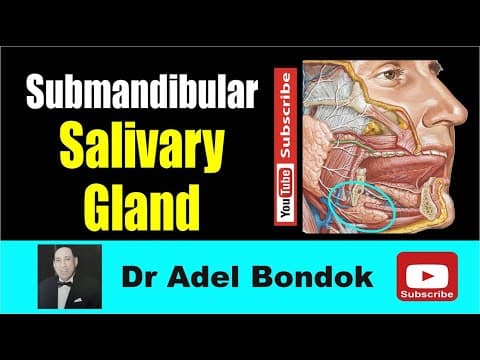
[0:12]Good morning. This is Dr. Adel Bondok, Professor of Anatomy and Neuroscience, Mansoura University, Egypt. I am going to talk about the submandibular salivary gland. I will talk about the position, the extension, then the capsule, the parts, because it is divided into two parts. Then we'll talk about the relations and the surfaces of the submandibular salivary gland, then the arterial supply, nerve supply and the submandibular duct. And the submandibular duct stone, start by the position. This is the submandibular salivary gland, okay? It lies in the digastric triangle, below the mandible and deep to the mandible. So the position in the digastric triangle deep to the mandible and below the mandible. It lies over the mylohyoid muscle, this is the mylohyoid muscle, okay? It lies over the mylohyoid muscle, regarding the extension of the submandibular salivary gland. It extends in four directions, it extends upward, deep to the mandible till the mylohyoid line. It extends downward to overlap the intermediate tendon of the digastric, it extends forward till the level of the mental foramen. It extends backward till the angle of the mandible, so extension of the submandibular salivary gland. It extends upward deep to the mandible till the mylohyoid line, it extends downward to overlap the intermediate tendon of the digastric. It extends forward anteriorly till the level of the mental foramen, it extends posteriorly till the angle of the mandible. Regarding the capsule of the submandibular salivary gland, this capsule is derived from the investing layer of the deep cervical fascia like the parotid gland. And the submandibular gland is separated from the parotid gland by this ligament, which is the stylomandibular ligament. And the stylomandibular ligament is sickening of the investing layer of the deep cervical fascia. Therefore, the capsule of the submandibular salivary gland is derived from the investing layer of the deep cervical fascia. This is the investing layer, okay? And it is separated from the parotid gland by the stylomandibular ligament. Then the parts of the submandibular gland. This is the submandibular gland. It is divided by the mylohyoid muscle, this is the mylohyoid muscle, it is divided into two parts.
[2:55]Superficial part, superficial to the mylohyoid. Okay? Superficial part, superficial to the mylohyoid, and the deep part, this is the deep part, it lies deep to the mylohyoid. So the mylohyoid muscle separates the superficial part from the deep part, regarding the relations and the surfaces of the superficial part. This is the superficial part, it has three surfaces. This surface is the medial surface. And the medial surface is in contact with the mylohyoid muscle, this is the mylohyoid muscle. Then lateral surface. This lateral surface is in contact with the mandible, is in contact with the submandibular fossa of the mandible. And this is the inferolateral surface, this inferolateral surface lies deep to the skin and fascia. Okay?
[3:50]So regarding the relations of the lateral surface and inferolateral surface. The lateral surface is related to the submandibular fossa of the mandible. It is related to the facial artery, okay?
[4:06]Actually, the facial artery lies between the gland and the mandible, and also the insertion of the medial pterygoid muscle. This is the inferolateral surface, of course the inferolateral surface is related to the skin and fascia. Cervical branch of VIL nerve and then this vein, the common facial vein. And these lymph nodes, the submandibular lymph nodes. So the inferolateral surface, skin and fascia, cervical branch of the facial nerve, common facial vein and submandibular salivary glands. Let us talk about the medial surface, which is related to the mylohyoid. This is the submandibular salivary gland, okay? I will remove the submandibular salivary gland, this is the superficial part. I remove the superficial part to see the deep relation. This is the mylohyoid muscle. And this is the intermediate tendon of the digastric, okay? So the first deep relation is mylohyoid and digastric. So this is the mylohyoid and digastric, deep to the mylohyoid. Okay? Number one, lingual nerve and submandibular ganglion. And the deep part of submandibular gland and submandibular duct. Remember that the deep part of the submandibular gland lies deep to the mylohyoid, then the hypoglossal nerve, and this muscle, stylohyoid muscle. Let us put the sub superficial part of the submandibular gland again. This is the superficial part of the submandibular gland. The deep relations are mylohyoid and digastric, number two lingual nerve and submandibular ganglion. Deep part of submandibular gland and submandibular duct, hypoglossal nerve and stylohyoid muscle. Regarding arterial supply and nerve supply. Arterial supply, facial artery. Regarding the nerve supply, parasympathetic, which is secretomotor, sympathetic, which is vasodilator and sensory to the capsule and the parenchyma. So parasympathetic, parasympathetic from the facial nerve through the chorda tympani branch. Sympathetic from the superior cervical sympathetic ganglion through the plexus around the facial artery. And then sensory lingual nerve, regarding the parasympathetic. Start from the superior salivatory nucleus in the pons, then the facial nerve, chorda tympani branch. It joins the lingual nerve, then the fibers synapse in the submandibular ganglion, and from the submandibular ganglion the postganglionic fibers reach the submandibular salivary gland. So, this is the parasympathetic pathway of the submandibular gland.
[7:08]Sympathetic, superior cervical sympathetic ganglion, plexus around the external carotid artery, then plexus around the facial artery, then the submandibular gland. So the nerve supply, parasympathetic facial nerve, sympathetic, superior cervical sympathetic ganglion, sensory lingual nerve. So again, the parasympathetic nerve supply to the submandibular gland, start from superior salivatory nucleus in the pons. From the superior salivatory nucleus of the pons, fibers enter the facial nerve, then the chorda tympani. Chorda tympani nerve joins the lingual nerve, and the fibers of the chorda tympani synapse in the submandibular salivary ganglion. And from the submandibular ganglion the postganglionic fibers supply the submandibular salivary gland. Salivary gland secretions. This is the parotid gland, submandibular gland, and lingual sublingual gland. The parotid gland, the secretion of the submandibular of the parotid gland is totally serious. These are the serious glands, so the secretion of the parotid gland is watery serious. The submandibular gland contains mucus glands, so the submandibular gland secretes water and mucus. Okay? So the submandibular gland is mostly serious plus mucus secretion, the sublingual gland is mostly mucous. So compare between the secretions of the three salivary glands. Parotid gland is totally serious, submandibular gland is mostly serious, sublingual gland is mostly mucous.
[8:57]This is the submandibular duct. Arising from the deep part of the submandibular gland, okay? And it opens here, it lies deep to the sublingual gland. The submandibular duct is about five centimeters long. Okay? It begins from the medial surface of the gland, it opens in the floor of the mouth on each side of the frenulum. Regarding the course of the submandibular duct, it lies between two muscles. Mylohyoid and hyoglossus. This is the mylohyoid, this is the hyoglossus. It lies between two nerves, it lies between two nerves, between the lingual nerve above and hypoglossal nerve below. So it lies between two muscles, mylohyoid and hyoglossus, it lies between two nerves, this one, the lingual nerve and hypoglossal nerve. And actually the relation to the lingual nerve, the lingual nerve hooks around the submandibular duct. The terminal part of the submandibular duct lies deep to the sublingual gland, this one. Regarding salivary gland stones. Salivary gland stone is usually in the submandibular duct. So, this is the submandibular duct and this is a stone at its opening. So the submandibular duct is more prone to obstruction by stone, why? Five reasons. First reason, the saliva is thicker than that of the parotid gland, because it contains mucus. Number two, the saliva contains high concentration of calcium and phosphate. And number three, the saliva has higher mucus content. Regarding the course of the duct of the submandibular duct, the duct has anti-gravity flow. Okay? Regarding the parotid gland secretion is watery, regarding the sublingual ducts are short and many. So why the submandibular duct is more prone to obstruction by stone? The saliva is thicker than that of the parotid gland. The saliva contains high concentration of calcium and phosphate, the saliva has higher mucus content. The duct has anti-gravity course, the parotid secretion is watery, and the sublingual ducts are short and many. And thank you very much. Best wishes and good luck.


