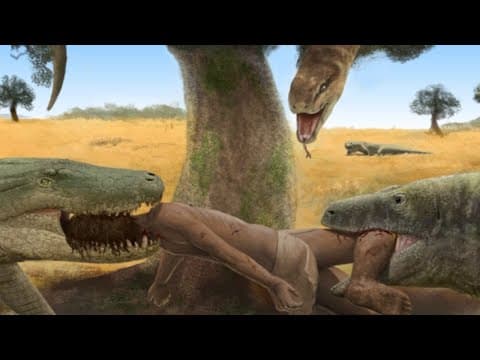
[0:00]Just like how everything is bigger in Texas, everything is deadlier in Australia, mostly the nature. As it's home to a highly disproportionate amount of potentially lethal animals. Having more venomous species than all but two countries. Yet, it takes the cake when only considering venomous animals that are fatal to humans. On top of this, it is home to 20 of the 25 most deadliest snakes in the world, including all of the top 11. And it's the native country of one of the only birds known to occasionally kill humans, the cassowary. Meanwhile, you also have the classics like the saltwater crocodile, great white shark, spiders, and potent jellyfish. And in case you needed a little more proof that Australia really is the land of nope, you should know that it's where some of the largest insects in the world call home. It's one of the few places where pinecones can kill you, and it's where the top three largest wildfires in the 21st century took place. The list could go on and on, but you get the idea. So maybe hard to stomach the fact that Australia is actually much more tame than it used to be. And I'm not talking about the fact that it used to be home to dinosaurs, but rather giant monitor lizards and terrestrial crocodiles, just to name a couple. And surprisingly, you don't even have to travel that far back to arrive at this forsaken Australia. As it reached its peak in chaoticness about 50,000 years ago, which is right around when humans first arrived. Talk about good timing. Back in those days, reptilian predators, not mammalian, ruled Australia. And it wouldn't take long for anyone to realize that something was very wrong once they set foot on land. As there were a host of nightmarish creatures wandering around. One, being a literal landcroc, not a crocodile look alike, but a genuine real crocodilian that happened to run comfortably on land. This creature was known as the Quinkana, and it was one of Australia's top predators during the Pleistocene. It shared many features with the crocodiles we know of today and was once even considered a true crocodile. Although, thanks to a very odd skull structure, it was moved to the extinct clade of Mekosuchinae. Along with the odd skull, paleontologist also noticed that it had some strange legs as well, that were very long for a crocodilian, allowing it to keep its body clear of terrain and potentially sprint. This has led to it being considered a terrestrial predator, with further evidence coming from its hoof-like toes and flat tail, which wasn't designed for swimming. Unfortunately for all land dwellers, the Quinkana was also no small critter, with most adults measuring 3 m or 10 ft and weighing 200 kg or 440 lbs. Making it nearly identical in weight to a medium-sized American alligator. Not to worry though, as there were larger individuals as well. With one specimen reaching 6 m or 20 ft in length. At this size, it had no problem taking down mammals, including an unlucky human from time to time. Getting attacked by this croc was an absolute nightmare, as its teeth were designed to slice animals up like a filet mignon. With each tooth being blade-like, compressed and heavily serrated. These kind of teeth are referred to as ziphodont teeth, and is what was commonly seen in theropods. Having such vicious dentition, led the Quinkana take down animals that were considerably larger than itself. With each bite tearing through large portions of flesh and muscle. There's a chance as well that you couldn't even outsmart this croc by jumping in the water. As there is some evidence that it was an accomplished swimmer, in spite of spending most of its life on land. Shockingly, or maybe by this point, unshockingly, even a terrestrial croc that could swim and had dinosaur-like teeth, wasn't safe from other Australian creatures. As there was also the largest known terrestrial lizard walking around, Megalania. There's a fair chance you've heard of this reptile due to its recent popularity. Yet, you may not have heard that it's no longer known as the Megalania, rather Varanus priscus. Meaning, it was actually a giant species of monitor lizard. Despite this classification change, the Megalania is still usually referred to by its original name. Perhaps because it's much more fitting, as it translates to the Great Roamer. A nod to its massive size, and massive it was. Paleontologists never seem to agree on the exact measurements, but all estimates have given it a length of at least 3.5 m or 11 ft, with an approximate weight of 158 kg or 348 lbs. So at the minimum, we are talking about a lizard that it was as long as a sea lion and as heavy as a reindeer. And at its maximum, things frankly got crazy. With studies finding it to have potentially obtained the lengths of up to 7.9 m or 26 ft. Which is based on fragmented remains that were scaled up to living monitor lizards. This would have made them just as lengthy as the longest recorded Anaconda, but 8.5 times heavier due to its robust build, with an absolute maximum weight of 2 tons. However, for the most part, large Megalania were probably no more than 575 kg or 1,200 lbs. Although it wasn't only a giant, as like living monitor lizards, the Megalania possessed razor-sharp teeth that were fairly long and recurved, granting extra grip while holding onto prey. The Megalania is further thought to have used its tremendously powerful legs and sharp claws to bring down prey and foe alike. Naturally, in true Australian fashion, the Megalania might have been venomous as well due to its heritage. Since all monitor lizards presently living are considered to be venomous. Their venom, similar to what is seen in some snakes, works as a an anticoagulant. Meaning it prevents blood from clotting, which leads to shock and infections as it keeps wounds open for longer periods of time. And because the Komodo Dragon, also known as the Komodo Monitor, is the Megalania's closest living relative, certain paleontologists believe that the two shared similar hunting tactics of biting prey, retreating, and then letting the venom do the work. So that's to say, even if you managed to get away from an attacking Megalania, you would still be doomed. All of these attributes make Megalania feasibly the worst thing you could have run into. Unless that is, you have ophidiophobia, a fear of snakes. In this case, your mortal enemy back then would have been Wonambi. This name may not sound like much, but it should strike fear into any who hears it. As it belongs to a now extinct giant serpent that lived right alongside both the Quinkana and Megalania. This snake is unlike any we know of today. For it belonged to a family of now extinct snakes, known as the Madtsoiidae. Snakes from this family were primarily characterized by somewhat inflexible primitive jaws and giant sizes. With the Wonambi being one of the biggest. It didn't quite reach the length of the longest living snakes of today, but came awfully close, with the largest specimens having a length of 6 m or 20 ft, equivalent to a large Burmese python. Luckily for us, the Wonambi did break the Australian trend of possessing venom. Nevertheless, its size still rendered it a potent killer, who might have hunted in a very similar fashion to the extant constrictor snakes. Which is to say, by using ambushes near bodies of water to strike unsuspecting prey that were then killed by tightening its muscles and squeezing the animal so hard that blood couldn't reach their brain or heart, thus incapacitating them. Afterwards though, is where things got different. Because as mentioned, the Wonambi had an inflexible and somewhat smaller head that couldn't swallow prey whole. This may sound like a good thing for prey, but in reality, it just made the snake more nightmarish. As to make up for this inability, it would simply use its sharp teeth and powerful body to tear chunks off prey, sometimes even disemboweling them. Such an unpleasant way to go out may have been more common for early Australians than being preyed upon by the Megalania or Quinkana. As one study found that in some indigenous populations today, snake attacks by constrictors are a common cause of death. By now, it would be reasonable for you to wonder how any mammal could survive living with so many reptilian horrors. And the answer is, the mammals were just as crazy. Best exemplified by the Thylacoleo. This mammal is best known for its immense size, with adults being the largest known mammalian predators to ever live in Australia. On average, specimens were about the same size as a European wild boar, while the largest Thylacoleo were on par with fully matured female lions and tigers, with whom it also shared a few characteristics. Yet, this was no feline, far from it actually. As the Thylacoleo was really a marsupial mammal that is most closely related to the koala. And like the koala, it's thought that the Thylacoleo had a smaller brain. However, in its case, a smaller brain was a huge advantage, as it gave the skull more space for extremely dense muscles and wide sturdy bones. That ultimately led to the strongest bite pound for pound of any known mammal. It's been estimated that a medium-sized Thylacoleo was capable of biting with the same force as a lion 2.5 times its size. Leading paleontologists to suspect that this marsupial was capable of taking down big-bodied prey, that were 15 times heavier than itself. And it likely did so in an extremely unique fashion. Thanks to its dentition, which consisted of large incisors that were similar to the elongated canines seen in other mammals. Furthermore, it boasted giant premolars that almost resembled flat blades. Together, with its powerful muscles, these bizarre teeth worked wonders, killing animals by piercing deep into the flesh with the incisors while the premolars severed the poor animal's windpipe, spinal cord, and arteries, causing all sorts of fatal problems. This mode of killing was so efficient that researchers think it took less than a minute for this marsupial lion to kill large prey. While the same task for an African lion can take up to 15 minutes or more. And for whatever reason, if its bite didn't do the trick, the Thylacoleo had lethal claws as well. On each of its front feet, there was a single large retractable claw that was attached to semi-opposable thumbs. This implied it could move these claws around with ease and dish out killing blows if needed. These additional weapons were also hooked, leading to the idea that Thylacoleo was a climber who possibly dragged kills up trees like leopards do. Climbing further allowed it to navigate caves and rough terrain, adding another layer of complexity to this already overpowered marsupial. And so with all of this said, Australia had no doubt some pretty terrifying predators all around, making life fairly interesting for the first humans to arrive. And for them, they wouldn't even be able to find peace around the herbivores. As in response to biological killing machines, the herbivores got pretty ferocious themselves. A good demonstration of this is the Diprotodon, an extinct marsupial whose closest living relative is the wombat. The two also did look in some ways similar. Except, unlike the wombat, the Diprotodon was massive, plausibly weighing up to 3.85 tons, which makes it equal in weight to a fully grown Asian elephant. This size gave it much needed durability and would have made hunting it a questionable endeavor. A task further discouraged by the presence of a surprisingly strong bite. The Diprotodon was strictly a vegetarian, but nonetheless, it still had a nasty bite that reached 11,000 N in force at the back molars. Giving it more than enough power to technically break a human's femur. In addition to elephant-sized wombats, birds too were supersized in prehistoric Australia at the time. Especially, the Genyornis. This ancient bird resembled the once widespread terror birds. However, it actually belonged to a separate family of flightless birds, known as the Dromornithidae, or thunderbirds. All members of this family, Genyornis included, are believed to have been herbivores despite their menacing appearances. Though, like many ancient Australian creatures, they did have size to help balance their defenses out. The Genyornis in particular routinely grew to heights taller than humans, with the average individual coming in at 2 m or 6.5 ft. Moreover, this bird had giant robust bones that gave it durability and heftiness, resulting in it weighing a full quarter of a ton. And if its size wasn't enough of a deterrent, the Genyornis could always use its beak or sharp claws to ward off predators that got too close. By now, it should be obvious that ancient Australia was the last place you'd want to visit. And just to really drive it all home, remember that nearly every dangerous animal in Australia today was also still around back then. And that's not to mention other extinct animals which I didn't mention, including large turtles and additional extinct crocodilians like the Paludirex. And of course, nature itself was also harsh with extreme droughts being present. And yet, despite all of these odds, humans still survived in Australia. In fact, not only did they survive, but they managed to thrive and dominate the lands, with evidence showing that they preyed upon multiple of the megafauna mentioned today. Suggesting that maybe we were actually the scariest animals around during those times. Thanks for watching and until next time on extinct zoo.
Prehistoric Australia Was Pure Nightmare Fuel
ExtinctZoo
14m 1s2,309 words~12 min read
YouTube auto captions
Transcript source
YouTube auto captions
This transcript was extracted from YouTube's auto-generated caption track. The transcript below is server-rendered so it can be read, searched, cited, and shared without opening the original YouTube player.
Pull quotes
[0:00]Just like how everything is bigger in Texas, everything is deadlier in Australia, mostly the nature.
[0:00]Yet, it takes the cake when only considering venomous animals that are fatal to humans.
[0:00]On top of this, it is home to 20 of the 25 most deadliest snakes in the world, including all of the top 11.
[0:00]And it's the native country of one of the only birds known to occasionally kill humans, the cassowary.
Use this transcript
Related transcript hubs
Watch on YouTube
Share
MORE TRANSCRIPTS


