[0:00]Is the purge beginning in Venezuela?
[0:05]It's been over a month since Nicolas Maduro and his wife were captured in the capital Caracas in an operation that decapitated the Chavista regime. Since then, in just a few weeks, we've been seeing things like this news item. Take a look. Delcy Rodriguez's government arrests Alex Saab, Nicolas Maduro's alleged front man. This past Wednesday, 4th of February, the hunt officially began. The Rodriguez siblings want to consolidate their power and in the process, appease the United States. And that can only be done by getting rid of anyone who might be inconvenient to them. The first to fall, former Minister Alex Saab, Nicolas Maduro's right-hand man, and for two decades a heavyweight in all things related to Chavista corruption. First they kicked him out of the government, and now they've arrested him. Ostensibly to extranate him to the United States. Although that remains to be seen, because apparently there are no charges against him. Of course, Alex Saab was once extradited to the United States on charges of conspiracy to launder money and acting as a front man for the government. He then got off thanks to an agreement between Caracas and Washington that granted him a presidential pardon. A revocable pardon, and he's not alone in being arrested. Along with him, Sebin, the regime's political police, in collaboration with the FBI, it seems, has also arrested Raul Gorin, owner of the Globo Vision Channel. And a businessman known for his ties to Maduro and for being sanctioned by the US Treasury Department. This is a harsh turn of events, and of course, everything indicates that these will not be the last, nor were they the first. Besides changes in the government, Delcy has promoted almost 30 replacements in the military, where she has relieved generals who command troops in the regions, and also the heads of the two most important air bases. It's clear that in order to survive, the new government must purge all hostile elements. And not only that. While many spoke of the birth of post Chavez Chavismo back in 2019, these days we have to speak of post Maduro Chavismo. An era that promises improvements, which will surely come about, if only because many of the international sanctions will be lifted, but let's not fool ourselves. The change doesn't look like a great institutional and democratic revolution for now. Because, and we have to say this with complete frankness, you can put lipstick on a pig, but it's still a pig.
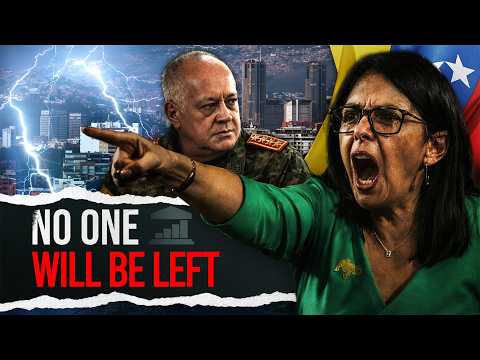
[2:23]There is no humanitarian crisis, there is none. I affirm this with full responsibility, there is none. Venezuela has been awarded prestigious prizes for its fight against poverty and hunger. So whoever is a foreigner who enters this country without permission, they can enter, but they cannot leave; they will stay here. We are obliged to defend this sacred soil, to defend our sacred skies, to defend our seas and our rivers. And of course, this other guy is still around as well, though we'll see for how long, clinging tooth and nail to his sphere of power. He's one of Venezuela's top kingpins, or maybe he used to be, because, honestly, he looks increasingly nervous. There's even speculation that he sleeps in a friendly embassy to avoid being caught off guard at night. Likewise, it's striking that his TV show no longer has an audience. while they see us united they will think about it If they see one of us here, another there, they'll eat us one by one and there won't be anyone left. There won't be anyone left, not a single one of us. They're going to eat one, they're going to eat us one by one. That's the message being sent to the leaders and troops of a regime that is more shaken than it appears. Cabello has tried to appear normal, but things are not going well for him. Diosdado is nervous. His smile has disappeared. He's on edge. He knows that Delcy is trying to corner him, that she's encroaching on his territory, and that he's in Washington's crosshairs. Caballo is Maduro's key hardline enforcer, has continued to intimidate and suppress Venezuelan voices. He remains in control of Venezuela's security forces, security services, the colectivos. Uh, we're seeing extraordinary, uh examples, uh, that the constant oppression of the people is continuing. Uh, as these folks are, uh, are remaining in control of the country. And it only takes a quick look, for example, at the case file of Maduro's trial in New York, to quickly come across his name, Diosdado Cabello Rondon. Diosdado is a long-standing pillar of narcochavismo, and obviously, he's no stranger to Washington. On the contrary, he's been on the radar of the US Department of Justice for years. Investigations place him as a key player in the trafficking of white powder to the United States. Between in or about 2022 and in or about 2024, CABELLO RONDON regularly traveled to clandestine airstrips controlled by the ELN near the Colombia-Venezuela border to ensure the cocaine's continued safe passage in Venezuelan territory. And what is Diosdado doing? Well, trying to maintain his influence, he's trying to hold onto his power. He's even throwing a few barbs and warnings at the acting president, such as publicly insinuating that Maduro was going to dismiss Delcy herself this January. But regardless, his power is not what it used to be.
[5:17]Be that as it may, it's undeniable that in record time, Delcy Rodriguez and the new Chavista clique have managed to win the sympathy of Donald Trump. With political prisoners on the verge of being released and an express oil reform to facilitate the entry of US companies, Miraflores is riding high in the White House. The romance with Caracas is intensifying practically day by day. We just had a great conversation today, and she's a terrific person. I mean, she's somebody that we've worked with very well. Marco Rubio is the only one who I dealt with her this morning. We had a call, a long call. We discussed a lot of things, and I think we're getting along very well with Venezuela. But the question is, how far do the changes really go? Chavismo is cooperating with the US, yes, but let's not fool ourselves. If they're doing so, it's because they see this cooperation as a direct path to retaining power, not handing it over, generating a lot of dollars along the way. And yes, Venezuela will probably improve, but Chavismo hasn't gone anywhere, although it is changing its skin and its faces. For all these reasons, here on Visual Politic, we've been asking a few questions. What changes are taking place in Venezuela? How is Chavismo becoming an ally of the White House? Will we soon see a conversion to a kind of Bolivarian Trumpism? Has this really been a win-win situation? Who is really benefiting from all these changes? Well, in this video, we're going to tell you about the pillars of the new Chavismo allied with Trump. But first, if you're interested in the world of investing, if you want to learn how to manage your savings, protect yourself against inflation, and figure out how to make money beyond your day job, I've got some good news for you. At Visual Factory, we've created the Visual Factory Club, a newsletter where every week we send out free content focused on essential financial education. The ABC of what everyone should know to understand the stock market, financial markets in general, investment platforms, how to assess investment opportunities, and which markets may have more or less potential. Because of course, if you want to invest your money, so you're not at the mercy of your country's economic instability, you at least need to understand the basics of the financial world. In the Visual Factory Club, you'll learn all of this completely free of charge. Through the link below and this QR code, you can sign up for the club and start receiving the upcoming editions. What's more, when you sign up, you'll receive a dossier where I explain in a clear and simple way, the most essential investment concepts. What multiples or the PE ratio are, what indices are, ETFs, derivatives, funds, EPS, you get the idea. After that, every week, you'll receive additional materials and market analysis to help you stay informed about what's going on. And by the way, the sooner you sign up, the better, since we send each episode of the series by email, and every addition is unique. If you're not subscribed, you might miss some of them, and you won't be able to access them later. But with that said, let's get back to our topic.
[8:07]Although Venezuela is nowhere near flirting with a true democratization process, we cannot deny that the acting president, Delcy Rodriguez, has stirred up a hornet's nest during her first month in office. The fact is that post Maduro Chavismo is rising on three fundamental pillars with which it aims to achieve a broad and almost obscene image makeover in Washington. Three pillars that form the life boat with which they hope to prolong the life of Venezuela's Bolivarian Chavista socialist project, or in other words, prolong the life of the system of widespread plundering from which they've been benefiting for years. Well, here's the first pillar. Since Nicolas Maduro was detained in New York, the Chavista clique has radically toned down its political rhetoric. Now, the regime's spokespeople talk incessantly about reconciliation, forgiveness, reparation, and the need for Venezuelans to come together in a common coexistence. These are values and principles that have long been forgotten, basically because Hugo Chavez himself took it upon himself to erase them from the dictionary of the revolution. Stop him! I give the order once and for all, Mr. Minister of Defense, Minister of the Interior, and the police chiefs: From this moment on, anyone who goes out to burn a hill, burn some trees, or block a street, you will be sprayed with tear gas and thrown in jail. Decades of authoritarianism and repression have left nearly a thousand political prisoners in Venezuela. Innocent prisoners who could now begin to dream of no longer living behind bars. Of course, while the regime has expressed its willingness to release them all, this has not yet happened. For now, it's estimated that only a quarter of them have been released, and take note, in reality, many are being coerced upon release from prison to leave the country, the same strategy that Ortega has followed for years in Nicaragua.
[10:04]But anyway, the most important thing is that day by day, slowly but surely, these prisoners are regaining their freedom. This has brought a glimmer of hope that we cannot ignore. Neither we, nor the official narrative, which takes advantage of every public intervention to project an image of moderation, as if we were facing a new, clean, neat, and honest government in Venezuela. We are all Venezuelans. We are all protected under the same beautiful sky of this Republic. We embrace the same flag. We sing the notes of the same national anthem. But can we really believe that the Rodriguez family wants national reconciliation and a genuine transition? Well, what do you want me to say? It's hard to believe. In fact, I don't think anyone in Venezuela really believes that Chavismo is doing all this as a result of self-criticism or as a miracle of Providence. With these messages, both Delcy Rodriguez and her brother Jorge are not addressing Venezuelans, but rather a few guys who live a little further north. Prisoners that nobody thought they would ever see again by being released, yeah. And in many cases, good people is what I understand. But prisoners nobody ever thought they'd be released. So, we're going to be working with them and leadership of the country, and so far we've been working very well. The government sees the amnesty as a move to buy time, save face, and reduce tension. Although for Diosdado Cabello's wing, this is a stab in the back. Remember what he said a few years ago? There will be no law here Nor amnesia, nor a law of impunity, nor a law of amnesty, nor conciliation, nor reconciliation. Amnesty has been a missile aimed at the regime's political power base in recent years. As head of state, I will not accept any amnesty law because they violated human rights, and I say this and I stand by it. They can send me laws, but the murderers of a people must be tried and must pay. But none of that anymore. You know, amnesia and amnesty. This is the first pillar of post Maduro Bolivarian Chavismo. It was all the former bigwigs' fault.
[12:22]Donald Trump keeps talking about Venezuelan oil as if it were some kind of magic elixir that will revitalize not only the country, but the entire Western energy landscape. Of course, the problem, which I think you all know, is the severe limitations of Venezuela's black gold infrastructure after decades of neglect and continuous negligence. Organic law that reserves to the State goods and services related to primary hydrocarbon activities, very well, National Broadcast, to sign this on national television so they can scream even more. Of course, because the Yankees, since this was transnational private property, they thought they could take everything - so they took it. Bring the crude oil here, refine it here, and from here send it directly to the refineries in the United States. But now, Chavismo has also changed its mind on this issue, and in record time, they have approved a reform of the Hydrocarbons Law. A reform with which, in a way, Delcy Rodriguez is reversing the oil model dictated by Hugo Chavez himself. Some even say that it ends the state's dominance in this industry, which was established in the 1970s. 50 years and 28 days later, today marks the formal end of the oil nationalization era. Today also marks the end of the expropriation policy carried out during the Chavez administration. But let's not get too excited. The reform is limited and disappointing. Well, it's still the same people who promoted it. What did you expect? But anyway, it's true that despite being disappointing, it does introduce notable changes. So, we have both positives and negatives.
[14:03]For example, it's said that with the approved reform, Chavismo has managed to reverse the oil nationalization of the 1970s, which gave the state a dominant share in oil wells, and that now private companies will be able to play a leading role. But this is not entirely true. The law establishes that primary activities, which refer to exploration and extraction, basically getting the oil out, will fall to, first possibility, PDVSA. Second possibility, joint ventures, in which the government, or a government-owned company, has a 50% or greater stake, as was previously the case with Chevron and Repsol. And thirdly, private companies that have been awarded a contract by a public company that will own the field. In other words, private companies will only have a role to play when the government wants them to. That hasn't changed much, because it was already happening. Companies such as Halliburton and Baker Hughes were already providing services in Venezuela through PDVSA contracts. But let's see, although the fundamentals have not changed, some things have been tweaked. For example, in joint ventures, the private sector will be able to take over all operations. That way, it could be much more efficient. Then, in the case of contracts, what's the point of PDVSA or the government leasing a field to a private company instead of exploiting it themselves? Well, it makes a lot of sense, because by handing it over through a contract, they hope that the private party will be able to put it into operation. In other words, that it will be able to gather the financial, technical, and human resources necessary to start production. This is something that neither the state nor PDVSA can probably do due to a lack of capital. And yes, once the contract term has expired, the law is very clear. Everything will revert to the state. It is a contract, not a transfer of ownership, whether the contract is for 10 or 20 years. Once the term is expired, the fields and infrastructure will revert to the government or PDVSA without any compensation. Well, all this is progress, but it's very limited.
[16:03]The reform also changes the strict 30% royalty to a maximum that the government can reduce at its discretion. Does this make sense? Well, yes, because technically, it could be said that it's a way for companies to have to invest more to start paying less tax. But it also opens up enormous scope for rampant corruption. Because it will be Delcy Rodriguez who determines in each case how much tax a company has to pay. And finally, it also recognizes that private companies can resort to independent arbitration to resolve disputes instead of being forced to use exclusively Bolivarian courts. Although there are doubts about the scope of this point. Well, these are the main changes in the reform of the hydrocarbon laws, a reform announced with great fanfare, but the content of which is actually much weaker than it seems, and it's not clear that it's arousing much enthusiasm among international investors. Yes, some will come, but euphoria, no, there's none of that. That said, with this reform, the Chavistas are acknowledging that Chavez's 2006 law was nonsense. It's something, at least. We welcome foreign investment, national investment for productive development in the areas of oil, gas, and petrochemicals. Visual Politic community, these kinds of changes not only meet Trump's expectations for Venezuelan crude oil, but they may also begin to play a somewhat more important role. The new promise of dollars for the leaders if they abandon the former bigwigs and embrace the new neo-chavismo. It remains to be seen how far this goes and what its real scope is. In any case, the opening up of the oil industry is the second major pillar of what we can already identify as neo-Bolivarian neo-chavism. If what we have already seen so far seems like a radical shift in the ideological worldview of Chavismo, watch out, because now you're about to see something truly absurd. And I say absurd because it's the perfect, appropriate, and ideal word to describe the supposed change being made by the Chavista Ministry of the Interior under the command of Diosdado Cabello himself. Yeah, yeah, the same guy who's been singled out dozens of times in Maduro's trial as an essential part of the Venezuelan drug trafficking scheme. Well, he's the same guy we've now seen on television wearing a suit and tie, leading drug operations and seizures in the country. The problem is that for you, Diosdado, it just doesn't fly. This is what we have been doing since September, which is more or less the time it has taken to complete this investigation dealing with the detainees, carrying out operations, the destruction of aircraft in Bolívar state and Apure state. It's a severe blow to the narrative that Venezuela is a country that facilitates drug trafficking. No cocaine, no marijuana, nor any other drug that the State can intercept will pass through here. All of this is, of course, something that the White House will surely spin us soon. I'm sure that in the mid-term campaign, we'll hear messages about the victory against drug trafficking due to the change in Venezuela, even though this is not actually the case. According to documents from the State Department and the DEA in Latin America, only Mexico is a significant source of illicit fentanyl and similar substances. What's more, it's estimated that only 8% of the cocaine that has recently entered the United States came through the Caribbean Corridor, mainly from Venezuela, in contrast to the 74% that used the Pacific Ocean. The fact is, Venezuela may be a narco stronghold, but its role in the narcotics market heading to the US is minimal. Venezuela is much more significant for drug exports to Europe or for the illegal trafficking of minerals, people, and other illicit businesses in the region. But all that doesn't matter. The facelift has pushed all that into the background. Normality is the new status quo. You know, I opened up the airspace over Venezuela, so that now people from Venezuela, came from Venezuela here, they're going to be able to go back for the first time, go back to Venezuela, and stay perhaps, or go back and see their relatives, go for a short trip. In any case, this is the latest version of Chavismo, and these are its three fundamental pillars. Of course, we can hope that all these changes will improve the situation in Venezuela. We can also hope that more bigwigs will fall by the wayside, and logically, we're very happy that this is the case. But you know they are limited. The pillars of change are limited, and besides, there's another problem. Have the Chavista leaders and the regime's military really changed that much? Are they going to be willing to settle for everything they've stolen and behave themselves from now on? Are they going to put aside rampant corruption, extortion, and criminal activities? These are the crucial questions, and honestly, it's hard to imagine. People said I want to be, I'm supportive of this regime and they didn't, not because they like Nicolas Maduro, but because Nicolas Maduro set up a system that guaranteed them a profit. Some people were making that profit from drugs, some of them were making it from stealing money from their food program, called Clap. Some of them were making their money from an oil field that was literally given to them in exchange for buying them their loyalty. Some were making their profits from all three. Well, for now, with a much more moderate political tone, a handful of prisoner releases, the opening of the oil sector to foreign capital and a more decorous quasi-criminal attitude. This is how Chavismo is weaving its new relations with the White House. It's neo-chavism, neo-Bolivarianism. Darwinian Chavism. In recent days, various sources in Washington have indicated that negotiations on possible elections in Venezuela have begun. It's said that a period of between 18 and 24 months is being considered for their organization. And while the hydrocarbon reform and the initial demands of the US dominate the headlines, the Chavista parliament has also been preparing other key changes. Changes such as this one. Jorge Rodriguez announced a reform to Venezuela's Electoral Code to eliminate "bureaucratic obstacles". Rodriguez argued that the new legal instrument should review both the requirements for party registration and the procedures for forming the Electoral Power, processes he described as slow and bureaucratic. Although there are no details yet, it's clear that Chavismo knows that sooner or later, it will have to face the polls, although it will not be quick. And of course, it won't catch them off guard. They've already begun to prepare. They will do everything possible to ensure that the process is not fair, starting with the old practices of political exclusion so that only candidates tailored to their liking can run. Even amid amnesties and promises of reconciliation, Delcy Rodriguez has made it clear that her desire is to marginalize anti-politics. Take note. But there is also our responsibility to ensure that those sectors of anti-politics that have led to extremism and fascism, applauding military aggression against the country, applauding economic, financial, and commercial blockades, applauding invasions against Venezuela. Enough is enough, enough is enough. I ask on behalf of Venezuelans that revenge, retaliation, and hatred not be imposed. We are giving them a chance to live in peace and tranquility in Venezuela with differences that exist. In theory, neo-chavism or Darwinian chavism operates on two levels. Maintaining the best of manners with the US on one hand, while actively limating any enthusiasm from the internal opposition on the other. While for the White House, the release of political prisoners is an unprecedented act in Venezuela, Delcy makes it clear that this is only an opportunity resulting from her clemency. And although the game is beginning to be more open, ultimately the pieces and domestic limits will continue to be set by Chavismo. Although it's not ideal, the Oval Office is clear about what is feasible and what is not in Venezuela. And just as Marco Rubio said he would evaluate Delcy Rodriguez for what she does and not for what she says, we must do exactly the same with them. And what we see is that as long as Chavismo knows how to appeal to Trump's demands, even if it means sacrificing its ideological cows, there's no reason to think that Washington will call for regime change. Chavismo's middle command and the Venezuelan opposition are aware of this new reality. Of course, no one knows how long this unprecedented Chavista Trumpist tandem will last. With the current US president, you never know. But clearly, this is not the first time that Trump has been enthusiastic about an antagonistic leadership in exchange for geopolitical or energy submission. Do you want an example? The back and forth with Claudia Sheinbaum in Mexico ended with Mexico imposing tariffs on China. And Trump was happy about this, singing the praises of this president. Another example, Lula's Brazil. But well, you know what the orange man is like, a box of surprises.
[25:13]What is certain is that the Venezuelan outlook has changed forever, even if Chavismo endures. It's clear that the model used until now has run its course. And most importantly, it's possible that all these changes, even without any real reformist intention, will end up breaking down old internal power structures and lead to a broader dismantling of the regime. It would not be surprising. And of course, as we've already outlined, the next chapter may well have a lot to do with Diosdado. The most uncomfortable guy for the Rodriguez siblings, and for now, what have they done? Well, nothing less than this. Acting President appoints Daniela Cabello as new Minister of Tourism. It may sound contradictory, but what does it really mean? Is Diosdado gaining power or is his daughter being promoted for another reason? Perhaps because they're going to remove her father, maybe to keep him on a tighter leash. We'll see, although truthfully, we wouldn't bet on the future of Diosdado Cabello. A guy who is not only considered the iron fist of the Venezuelan dictatorship and the contact with the drug traffickers, but someone who's been waging an open war with Marco Rubio for years. But now, it's your turn. How do you think this friendliness between Trump and the new Chavista clique will end? How far will the opening up of Venezuela go? Will we really see free elections? How could the Venezuelan opposition gain any participation in this context? Will the Chavista base be able to assimilate this change in behavior? Leave us your opinions below in the comments and let's open up the debate. And very importantly, if you like this video, click the like button and subscribe to Visual Politic if you haven't already. Thank you very much for being there. All the best, I'll catch you next time.


